
Encyclopedia - 5 peer-reviewed sources
Infrared vs Traditional Sauna - Science, Benefits, and Which to Buy
A science-first comparison of infrared and traditional saunas. How they work differently, what the research shows, and which one matches your goals.
Written by Dr. Maya Chen
Wellness & Health Editor
Reviewed by Erik Nordgren
Senior Sauna Reviewer
The debate between infrared and traditional saunas has become one of the most contested topics in wellness - and for good reason. The two technologies heat your body through fundamentally different mechanisms, carry different bodies of scientific evidence, and suit different lifestyles. After analyzing 30+ studies and reviewing clinical trial data spanning two decades, I can tell you that the choice is neither obvious nor trivial. Get it wrong and you spend $5,000 on a cabinet that collects dust; get it right and you may be adding years to your life.
What makes this comparison genuinely difficult is that the popular wellness conversation conflates the two technologies constantly. You'll find influencers crediting "sauna use" for cardiovascular benefits while citing studies that were conducted exclusively in 190°F Finnish wood-fired rooms - then recommending 120°F infrared units as equivalent alternatives. That's not a minor distortion. The core science behind why heat exposure changes your cardiovascular system, activates heat shock proteins, and triggers hormetic stress responses is temperature-dependent in ways that matter enormously when you're choosing between modalities. This article will walk through the actual mechanisms, the actual studies, and the practical realities of owning each type.
I'll be direct about what the evidence supports and where it falls short. Traditional Finnish saunas have a 20-year longitudinal dataset behind them that infrared simply cannot match. Infrared saunas have genuine clinical utility in specific populations that traditional heat cannot serve. Both have a place - but they are not interchangeable, and the marketing around both is riddled with exaggeration.
How Traditional Saunas Work - Convective Heat
Traditional saunas operate on a principle that Finnish culture refined over thousands of years: heating a dense mass of rocks to extreme temperatures and then using that stored thermal energy to raise the temperature of an enclosed room through convection. The heater - whether wood-fired or electric - drives rock temperatures to 300-500°F, and the surrounding air rises to 160-212°F (70-100°C). Your body then absorbs heat primarily through convection (hot air contact with skin) and radiation from the hot walls and rocks.
The physiological cascade this triggers is well-characterized. Core body temperature rises 1-2°C within 10-15 minutes at standard temperatures, which is significant - that's the same magnitude of temperature increase associated with a moderate fever. Heart rate responds accordingly, climbing to 120-150 beats per minute as the cardiovascular system works to shunt blood to the skin for cooling. Cardiac output can increase by 60-70%, mimicking the hemodynamic load of moderate aerobic exercise 4. This is not a metaphor. The cardiovascular demand is real and measurable.
The Role of Löyly and Humidity
The traditional Finnish practice of throwing water on the rocks - called löyly - adds a humidity dimension that changes the experience substantially. Dry Finnish sauna typically runs 10-20% relative humidity. Adding water creates a brief burst of steam that drives perceived heat dramatically upward without changing the air temperature. The steam increases thermal conductivity at the skin surface, accelerating sweat onset and deepening the heat stress. This is why Finnish purists insist that löyly is not optional decoration - it's central to the physiological response.
From a heat physics standpoint, humid air transfers heat to skin approximately 10 times more efficiently than dry air at the same temperature. This is why a 180°F dry sauna feels manageable for 15-20 minutes while a 150°F steam room can feel unbearable. The wood-fired kiuas (sauna stove) traditionally holds more rocks than electric versions and can sustain higher temperatures during löyly without dropping - a genuine functional difference from electric heaters with small rock beds.
Wood-Fired vs Electric Traditional Saunas
Electric heaters dominate modern installations for convenience, but wood-fired units remain the gold standard for purists and for off-grid applications. Wood-fired options like those available in wood-burning saunas reach temperature faster in some configurations and provide the authentic crackle-and-smoke sensory experience that contributes to the meditative quality many users report. The tradeoff is practical: you need a chimney or flue, a supply of dry wood, and more maintenance attention.
Electric heaters running on 240V reach operating temperature in 30-45 minutes and maintain it precisely. Units designed for electric heater saunas offer thermostatic control that wood-fired units cannot match. For home users in suburban settings, electric is usually the pragmatic choice. The physiological output - when temperatures are equivalent - is comparable.
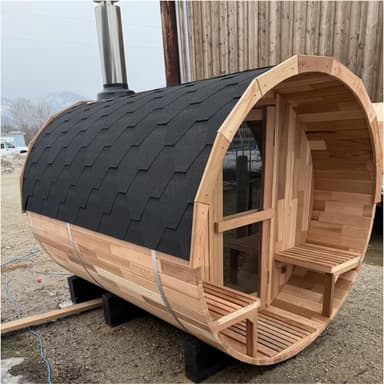
Smartmak 2-10 Person Canadian Hemlock Barrel Sauna
- Barrel shape genuinely improves heat distribution compared to box saunas
- Real red cedar and hemlock construction should last 15-plus years with care
- ETL-certified heater hits 195°F - legitimately hot for authentic steam sessions
The Smartmak Canadian Hemlock Barrel Sauna is representative of traditional outdoor barrel designs that use convective heating to excellent effect. Barrel geometry is functionally superior to box saunas for convective heat distribution - the curved ceiling eliminates the stagnant hot air layer that accumulates in flat-ceiling rooms, creating more even temperature distribution from floor to bench level.
How Infrared Saunas Work - Radiant Heat
Infrared saunas operate on an entirely different principle. Instead of heating air to extreme temperatures, they emit electromagnetic radiation in the infrared spectrum (wavelengths of approximately 0.7 to 1,000 micrometers) that is absorbed directly by body tissues. The air inside the cabin may only reach 113-140°F (45-60°C) - well below the threshold of traditional sauna - while your body absorbs radiant energy directly and heats from within.
The infrared spectrum relevant to sauna use divides into three bands with distinct tissue penetration depths. Near-infrared (NIR, 0.7-1.4 μm) penetrates approximately 5-10mm into skin and is primarily absorbed by superficial tissues and blood vessels. Mid-infrared (MIR, 1.4-3 μm) reaches slightly deeper into soft tissue, approximately 10-20mm. Far-infrared (FIR, 3-1000 μm) has the longest wavelength and the most counterintuitive characteristic: despite being the "longest" wave, it is most efficiently absorbed by water molecules in tissues at depths of roughly 1.5-2 inches (3.8-5cm) 1. Most single-spectrum infrared saunas use FIR exclusively. Full-spectrum units combine all three.
Heat Shock Protein Activation - The Core Mechanism Question
One of the most important mechanistic questions is whether infrared saunas activate heat shock proteins (HSPs) as effectively as traditional saunas. HSPs are molecular chaperones that protect cells from stress-induced protein damage, reduce inflammation, and have been linked to cardiovascular protection, improved insulin sensitivity, and potentially longevity. They are activated by thermal stress - but the threshold matters.
Research confirms that both modalities activate HSPs through different mechanisms 3. Traditional saunas achieve activation primarily through elevated core body temperature - the whole-body thermal load drives systemic HSP70 and HSP90 expression. Infrared saunas may achieve some HSP activation through localized tissue heating even without equivalent core temperature rise, a mechanism sometimes called "infrared-specific signaling." However, the magnitude of HSP induction appears lower in infrared sessions at typical temperatures. The practical implication: if HSP-mediated benefits are your primary target, higher temperatures achieve this more reliably.
Full-Spectrum vs Single-Spectrum Units
The full-spectrum designation has become a major marketing differentiator, and it warrants scrutiny. Genuine full-spectrum infrared saunas use separate emitter types for NIR, MIR, and FIR - typically carbon panels for FIR, ceramic rods or specialized LEDs for NIR, and dedicated MIR emitters. The claimed benefit is simultaneous targeting of different tissue depths. Premium units like Sunlighten's mPulse line use this approach and include programmable presets that emphasize different spectrum ratios for different goals.
Budget infrared units typically use ceramic or carbon panels that emit primarily in the FIR range and label themselves "full-spectrum" loosely. This is a meaningful difference. Before purchasing, request the emitter spectral output data - legitimate manufacturers provide this. If a unit under $2,000 claims full-spectrum performance, examine the specifications critically.
Temperature and Experience Comparison
The temperature gap between modalities is the single most immediate difference new users notice, and it shapes everything from session duration to who can tolerate the experience.
| Parameter | Traditional Sauna | Infrared Sauna |
|---|---|---|
| Air Temperature | 160-212°F (70-100°C) | 113-140°F (45-60°C) |
| Tissue Penetration | Superficial (convective) | 1.5-2 inches (radiant) |
| Session Duration | 10-20 minutes | 20-45 minutes |
| Heart Rate Response | 120-150 bpm | 90-120 bpm |
| Core Temp Rise | 1-2°C | 0.5-1°C (typically) |
| Sweat Onset | 5-10 minutes | 10-20 minutes |
| Warm-Up Time | 30-60 minutes | 15-20 minutes |
| Humidity Control | Yes (via löyly) | No |
The subjective experience diverges significantly. Traditional sauna is intense and somewhat confrontational - the heat hits you immediately, breathing requires conscious adjustment, and the first few minutes demand mental commitment. Many users describe a "breaking point" around 8-12 minutes where discomfort peaks before the parasympathetic nervous system begins overriding the stress response. What follows - the endorphin and dynorphin release, the deep relaxation - is what veteran users call the "reset." It requires earning.
Infrared sessions feel gentler from minute one. The lower air temperature means breathing is comfortable, and the radiant warmth feels more like lying in strong sunlight than sitting in an oven. Sessions typically last 30-45 minutes because the experience remains tolerable throughout. The sweat response is real and eventually substantial, but it develops more slowly. Users who are heat-sensitive, elderly, claustrophobic, or managing chronic pain often find infrared accessible where traditional sauna is simply prohibitive.
The 190°F Threshold Debate
The neuroscientist Rhonda Patrick, whose work has done more than almost anyone's to popularize sauna science, emphasizes that the Finnish mortality data specifically associates benefits with temperatures at or above 174°F (79°C) and session frequencies of 4-7 times per week. This is not a casual observation - the dose-response relationship in the Laukkanen data is steep. Men using sauna 4-7 times per week showed dramatically larger risk reductions than those using it 2-3 times per week 4. The temperature floor for achieving the most significant heat stress responses appears to be in the 174-190°F range.
Standard infrared saunas operating at 113-140°F do not reach this threshold. This is a genuine limitation, not a matter of opinion. Whether the infrared-specific mechanisms at lower temperatures produce equivalent long-term benefits is simply unknown - no 20-year longitudinal studies exist for infrared sauna use. That absence of evidence is not evidence of absence, but it is a critical factor in honest risk-benefit assessment.
Health Benefits - What the Studies Say
The evidence base for traditional and infrared saunas differs dramatically in scale, methodology, and duration - and conflating them misrepresents the science.
For traditional sauna, the anchor study is the landmark Laukkanen 2015 analysis of 2,315 Finnish men followed for 20 years 4. The findings were striking: men who used sauna 4-7 times per week showed 63% lower risk of sudden cardiac death, 48% lower cardiovascular mortality, and 40% lower all-cause mortality compared to once-weekly users. These are not small effects - they rival the benefit associated with regular vigorous exercise. Critically, this study used traditional Finnish dry saunas at 174°F+, with sessions of 15-20 minutes. Subsequent work from the same Finnish cohort has linked frequent traditional sauna use to 65% reduced Alzheimer's risk, reduced risk of pneumonia, and improved arterial stiffness.
For infrared sauna, the evidence base consists primarily of small clinical trials, most with fewer than 50 participants and follow-up periods of weeks to months rather than decades. These trials show genuine signal in specific conditions - but the evidentiary weight is categorically different. Being honest about this distinction is essential for informed decision-making.
Heat Shock Proteins and Longevity Pathways
Both modalities activate biological pathways associated with longevity and cellular stress resilience 3. Heat shock proteins, particularly HSP70, protect against protein aggregation - a mechanism implicated in neurodegenerative diseases. Both traditional and infrared exposure also activate nitric oxide synthase, improving endothelial function. AMPK and IGF-1 pathways that regulate cellular repair are engaged by thermal stress generally, not by one modality specifically.
The honest assessment is that the longevity-relevant pathways are activated by heat stress broadly, but the degree of activation correlates with the magnitude of thermal challenge. Traditional sauna's higher temperatures produce more strong HSP induction. Whether infrared's lower-temperature but deeper-tissue activation compensates for this is not established by current evidence.
Sauna Use and Mental Health
An area often overlooked in the traditional vs infrared comparison is the neurological response. Traditional sauna at high temperatures triggers significant beta-endorphin and dynorphin release - the same opioid peptides involved in runner's high. This appears to be temperature-dependent. Many users of both modalities report stress reduction and improved mood, but the neurochemical intensity of the traditional sauna response is qualitatively distinct for most users who have tried both. For depression, anxiety, and stress management applications, this neurochemical dimension may be clinically relevant, though controlled trials are limited in both modalities.
Cardiovascular Comparison
Cardiovascular health is where the evidence divergence between modalities is most pronounced - and most consequential.
The Finnish longitudinal data is unambiguous about traditional sauna: frequent use at high temperatures dramatically reduces cardiovascular mortality 4. The proposed mechanisms include improved endothelial function, reduced arterial stiffness, decreased blood pressure, improved left ventricular compliance, and anti-inflammatory effects mediated partly through HSP activation. These are not speculative - they have been demonstrated in controlled physiological studies nested within or adjacent to the large Finnish cohorts.
Infrared sauna research in cardiovascular contexts is smaller in scale but not without merit. A key study by Masuda et al. found that repeated far-infrared sauna therapy significantly improved endothelial function - specifically, flow-mediated dilation - in patients with chronic heart failure 5. This is mechanistically important: flow-mediated dilation is a validated marker of cardiovascular risk, and improving it in a heart failure population is clinically meaningful. Beever's 2009 review specifically found that FIR sauna improved cardiac function in congestive heart failure patients, including improved ejection fraction and reduced BNP levels 1.
A Critical Distinction - Treatment vs Prevention
The cardiovascular evidence for each modality clusters in different categories. Traditional sauna evidence is primarily preventive - it reduces risk in healthy populations over decades. Infrared sauna evidence is primarily therapeutic - it shows benefits in patients who already have cardiovascular disease, where the lower heat burden allows participation that high-temperature traditional sauna would contraindicate.
This is not a minor distinction. If you are a healthy 40-year-old wanting to reduce your lifetime cardiovascular risk, the Finnish data strongly supports traditional sauna at high frequency and temperature. If you are a 65-year-old with heart failure and your cardiologist has cleared you for low-intensity thermal therapy, the infrared data suggests genuine benefit with lower risk of heat-related adverse events 1.
| Cardiovascular Metric | Traditional Sauna Evidence | Infrared Sauna Evidence |
|---|---|---|
| Reduced CV Mortality | 63% reduction (4-7x/week) 4 | No long-term data |
| Endothelial Function | Improved (multiple studies) | Improved in CHF patients 5 |
| Blood Pressure | Acute reduction documented | Modest reductions in small trials |
| Arterial Stiffness | Reduced in Finnish cohort data | Preliminary positive signals |
| Heart Failure Patients | High risk of adverse events | Specific benefit shown 1 |
| Study Duration | Up to 20 years | Weeks to months |
For anyone with an existing cardiac condition, the decision between modalities should be made with a cardiologist. Both heat modalities impose cardiovascular demand - traditional sauna substantially more so - and contraindications apply to both.
Pain and Recovery
This is the domain where infrared sauna's evidence is most competitive and clinically relevant.
Musculoskeletal pain conditions have been specifically studied with infrared sauna in ways that traditional sauna has not been targeted for. A Journal of Clinical Rheumatology study examining patients with rheumatoid arthritis and ankylosing spondylitis found that infrared sauna sessions produced statistically significant reductions in pain, stiffness, and fatigue during the 4-week treatment period, with effects measurable at each weekly assessment. The researchers noted the lower temperature burden allowed patients who could not tolerate traditional sauna to complete the full protocol.
For athletic recovery specifically, Mero et al. found that far-infrared sauna sessions following strength training showed favorable effects on neuromuscular recovery markers, including reduced creatine kinase levels and faster restoration of maximal force production 2. The proposed mechanism involves enhanced blood flow to muscle tissue through radiant heating, accelerated metabolite clearance, and reduced inflammatory cytokine activity. The study was small (N=10), which is a significant limitation, but the mechanism is biologically plausible and consistent with FIR's known effect on microcirculation.
Traditional Sauna for Recovery
Traditional sauna also has solid recovery evidence - particularly relevant is its acute anti-inflammatory effect through heat shock protein induction and the hormetic stress response. Many elite athletes and sauna for beginners protocols use post-workout traditional sauna for exactly this purpose. The difference is practical: a 15-minute traditional sauna session requires more thermal adaptation than most beginners have immediately post-workout, while infrared's gentler curve is more accessible.
The cold plunge combination - alternating between hot and cold exposure - is better established for recovery with traditional sauna, where the temperature differential is more extreme. The evidence for contrast therapy (hot/cold alternation) in reducing delayed onset muscle soreness is reasonable, though not definitive, and the temperature difference achievable with traditional sauna (180°F to 50°F cold plunge) produces more dramatic vasodilation/vasoconstriction cycling than infrared-to-cold transitions.
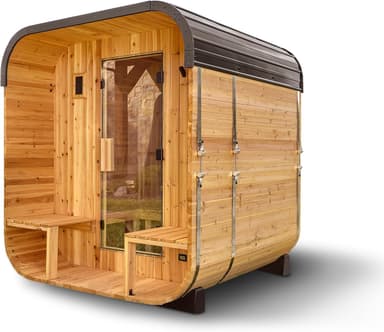
Backyard Discovery Lennon 2-4 Person Cedar Cube Sauna
- 9kW heater reaches temperature significantly faster than budget competitors
- 5-year warranty covers heater and hardware, not just the shell
- Wi-Fi preheat control adds genuine everyday convenience
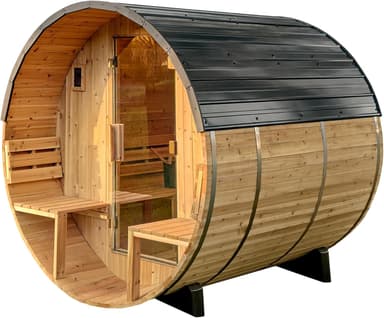
Backyard Discovery Paxton 2-4 Person Cedar Barrel Sauna
- 9kW heater reaches 170°F roughly 50% faster than budget competitors
- Barrel design eliminates dead zones with superior natural heat convection
- HDPE cradles and galvanized steel roof built for genuine year-round outdoor use
Outdoor barrel saunas like the Backyard Discovery models work particularly well for recovery applications precisely because the proximity to a garden hose, outdoor shower, or cold plunge tub enables contrast therapy. The outdoor barrel saunas format is purpose-built for this kind of integrated use.
Detoxification Claims - Fact vs Fiction
The detoxification narrative around saunas - particularly infrared saunas - is one of the most marketing-inflated areas in wellness, and it requires careful unpacking.
The factual baseline: sweating does expel some compounds that the body would otherwise process through hepatic and renal pathways. Studies have detected heavy metals including cadmium, lead, mercury, and arsenic in sweat. Some persistent organic pollutants, including certain BPA metabolites and flame retardants, appear in sweat at measurable concentrations. This is real. The body does use sweating as one excretory pathway.
The exaggerated claims: that sauna (particularly infrared) uniquely or dramatically accelerates toxin removal beyond what the liver and kidneys accomplish routinely, or that infrared's "deeper penetration" makes it categorically superior for detoxification. These claims substantially outrun the evidence. The liver processes an estimated 1.5 liters of blood per minute and is the primary detoxification organ by orders of magnitude. Sweat-based excretion is a secondary pathway for most compounds. The "3x more efficient detoxification" figure cited in some infrared marketing lacks consistent peer-reviewed support.
What the Honest Evidence Shows
Both traditional and infrared saunas produce substantial sweating and both result in measurable excretion of certain compounds through sweat. Traditional sauna produces higher sweat volume per session due to the extreme heat load - this is documented and consistent. Infrared proponents argue that the specific absorption characteristics of FIR radiation mobilize lipid-soluble compounds stored in adipose tissue more effectively, but this mechanism has not been definitively demonstrated in controlled human trials.
The practical recommendation: if your goal is cardiovascular conditioning, recovery, and stress reduction, both modalities deliver. If you are specifically pursuing heavy metal excretion or organic pollutant clearance, the evidence base is thin for either modality as a primary intervention - and you should be working with a functional medicine or toxicology practitioner rather than relying on sauna marketing.
Adequate hydration is non-negotiable with either type. Losing 1-2 liters of sweat per session without replacement creates real dehydration risk. The recommendation is 16-32oz of water pre-session and at least that much post-session. Electrolyte replacement matters for frequent users who sweat heavily.
Energy Costs and Efficiency
Energy economics is an underappreciated dimension of the purchase decision, particularly over a 10-20 year ownership horizon.
Traditional saunas with electric heaters typically draw 6-9 kW on 240V circuits. Reaching operating temperature (175-195°F) takes 30-60 minutes, consuming 3-5 kWh per warm-up cycle before you even begin your session. At $0.13/kWh average US electricity cost, a single traditional sauna session runs approximately $0.50-$1.00 in electricity. At 3 sessions per week, that's $78-$156 annually in electricity alone.
Infrared saunas typically draw 1.2-1.8 kW on standard 110V or 120V circuits. They reach usable temperature in 15-20 minutes and sustain their lower operating temperatures more efficiently. Per-session electricity cost runs $0.15-$0.30 at the same $0.13/kWh rate. Annual electricity cost at 3 sessions per week: approximately $23-$47. The difference - roughly $50-$110 per year - accumulates meaningfully over a decade.
| Energy Parameter | Traditional Sauna | Infrared Sauna |
|---|---|---|
| Power Draw | 6-9 kW (240V) | 1.2-1.8 kW (110-120V) |
| Warm-Up Time | 30-60 minutes | 15-20 minutes |
| Energy per Session | 4-7 kWh | 0.5-1.2 kWh |
| Cost per Session | $0.50-$1.00 | $0.15-$0.30 |
| Annual Cost (3x/week) | $78-$156 | $23-$47 |
| 10-Year Energy Cost | $780-$1,560 | $230-$470 |
Wood-fired traditional saunas remove the electricity cost and replace it with fuel cost (cord wood at $150-$300/cord in most US markets), plus the labor of loading and tending the fire. For users in rural areas with wood access, this may be cost-neutral or favorable. For suburban and urban users, it typically adds cost and complexity.
The electrical infrastructure cost for traditional sauna is a real one-time expense often overlooked in purchase calculations. Installing a dedicated 240V/40A circuit typically costs $200-$500 in labor and materials, depending on panel proximity and local codes. Infrared saunas on standard 110V circuits avoid this cost entirely.
Installation and Space Requirements
Installation complexity varies significantly between traditional and infrared saunas and deserves honest treatment in any comparison.
Traditional outdoor barrel saunas are actually among the simpler installations in the traditional category. A pre-built cedar barrel saunas unit in 6-8 foot diameter arrives mostly assembled or in sections requiring a few hours to complete. You need a level, stable base - concrete pads, gravel, or pressure-treated timber platforms all work - and electrical service to the location (for electric-heated units). The barrel sauna installation process is well within DIY capability for someone comfortable with basic construction and electrical rough-in.
Indoor traditional saunas require dedicated space with specific requirements: the room must withstand heat, usually through cedar or hemlock wall construction; electrical must meet local code for sauna applications; and ventilation must be adequate (floor-level fresh air intake plus upper-level exhaust). Benladder geometry for seating at different heights is standard. Building permits may be required in some jurisdictions for permanent indoor installations.
Infrared saunas are considerably simpler. Pre-built indoor cabinets plug into standard household outlets (some larger units require 240V, but most 1-2 person units run on 110V). They require no special ventilation because they don't produce the high-humidity, high-heat environment that demands active air exchange. Many infrared units arrive pre-assembled and need only to be placed in a room with adequate ceiling height and outlet access. No permit is typically required for a freestanding cabinet.
Outdoor vs Indoor Considerations
Outdoor traditional saunas - particularly barrel designs - benefit from natural ventilation, visual separation from living spaces, and the psychological ritual of traversing outdoor space to reach them. The best barrel saunas combine this functional advantage with aesthetic appeal that genuinely adds property value in many markets. Weathering and maintenance requirements are higher for outdoor units: annual wood treatment, checking roof seals, clearing debris from around electrical connections.
For apartments and condos, infrared saunas offer the only realistic option in most cases. A 2-person infrared cabinet measuring 47"x40"x75" fits in a bedroom corner, guest room, or dedicated wellness space. The absence of steam output and the lower heat load means no special flooring or wall protection is needed beyond a mat under the unit.
If you're considering how to match sauna type to your available space and lifestyle, the how to choose a barrel sauna guide provides detailed decision frameworks beyond what space allows here.
Cost Comparison - Purchase Through Lifetime
The full lifetime cost picture requires integrating purchase price, installation, energy, and maintenance - and it changes the calculus from the sticker price comparison considerably.
Traditional Sauna Total Cost
Entry-level traditional electric indoor saunas (1-2 person, pre-cut kits) run $1,500-$3,500. Mid-range pre-built 2-4 person models in hemlock or cedar cost $3,500-$7,000. Premium traditional saunas with wood-fired heaters, custom construction, or high-end finishes reach $8,000-$20,000+. Add $200-$500 for electrical work (240V circuit), $150-$400 for a quality heater if not included, and potentially $500-$2,000 for a proper base/foundation for outdoor units.
Maintenance costs are relatively low: sauna bench cleaner, annual wood treatment for outdoor units, and eventual heater element replacement (every 5-10 years, $100-$300). Traditional saunas built from quality hemlock, cedar, or Nordic spruce last 20-30 years with proper care. The 20-year total cost of ownership for a $5,000 traditional sauna with reasonable maintenance and energy costs: approximately $7,500-$9,000.
Infrared Sauna Total Cost
Budget infrared units (1-person, carbon panels, no full-spectrum) run $800-$2,000. These are where most of the problematic no-name units live - low EMF shielding, uneven heating, panels that degrade quickly. Mid-range 2-person infrared cabinets from established brands like Health Mate or Dynamic cost $2,000-$5,000. Full-spectrum premium units (Sunlighten mPulse, Clearlight Sanctuary) run $5,000-$9,000 for 2-person configurations. Hybrid models that combine an infrared primary system with a small traditional heater option extend to $7,000-$12,000.
Infrared panel lifespan is a genuine consideration: carbon and ceramic panels typically show meaningful output degradation at 5-10 years, and full panel replacement can cost $500-$2,000. The 20-year total cost of a $4,000 infrared unit with one panel replacement cycle and lower energy costs: approximately $5,500-$7,500.
| Cost Category | Traditional Sauna | Infrared Sauna |
|---|---|---|
| Entry Level | $1,500-$3,500 | $800-$2,000 |
| Mid-Range | $3,500-$7,000 | $2,000-$5,000 |
| Premium | $7,000-$20,000+ | $5,000-$12,000 |
| Installation Extras | $350-$2,900 | $0-$500 |
| 20-Year Energy Cost | $1,560-$3,120 | $460-$940 |
| Maintenance/Repairs | $500-$1,500 | $500-$2,000 |
| Lifespan | 20-30 years | 10-15 years (panels) |
| 20-Year Total (mid-range) | $7,500-$12,000 | $5,500-$9,000 |
The total cost of ownership comparison is closer than sticker prices suggest. A mid-range traditional sauna with a 25-year lifespan amortizes to roughly $400-$500 per year. A mid-range infrared unit with panel replacement amortizes to $350-$450 per year. The energy efficiency advantage of infrared partially offsets the higher panel replacement costs and shorter cabin lifespan.
Who Should Choose What - Decision Guide
After analyzing the evidence across mechanisms, health outcomes, practical realities, and costs, the decision framework becomes relatively clear - though it depends heavily on individual priorities.
Choose Traditional Sauna If
You are primarily motivated by cardiovascular health and longevity. The Finnish longitudinal data is the strongest evidence in this entire field, and it was generated in traditional high-temperature saunas 4. If reducing your long-term risk of cardiovascular death, dementia, and all-cause mortality is the primary goal, traditional sauna at high frequency (4-7x per week) and high temperature (174°F+) is what the science actually tested.
You want the authentic experience and are heat-tolerant. The traditional sauna experience - the intense heat, the löyly steam, the profound relaxation that follows - is qualitatively different from infrared and for many users is a significant part of the value. If you have Finnish heritage, enjoy steam rooms, or tolerate heat well, traditional sauna will likely be more satisfying.
You have outdoor space and want a permanent installation. Outdoor barrel saunas are genuinely beautiful structures that add to property aesthetics and value. The barrel sauna format in cedar barrel saunas and hemlock construction is purpose-built for outdoor placement and designed to last 20+ years.
You want cold plunge integration. The temperature contrast between a 180°F traditional sauna and a 50°F cold plunge is physiologically more dramatic than contrast therapy with infrared, and the outdoor sauna setup naturally accommodates this practice.
Choose Infrared Sauna If
You have a specific pain or inflammatory condition that previous infrared research has targeted. Rheumatoid arthritis, ankylosing spondylitis, chronic fatigue, fibromyalgia - these populations have shown benefit in infrared trials specifically, and the lower heat burden allows consistent use where traditional sauna would be too intense 2.
You have cardiac conditions and have received medical clearance for thermal therapy. The Masuda and Beever data on infrared sauna in heart failure is meaningful 51, and the lower cardiovascular demand makes infrared safer than traditional for compromised cardiac patients. Always confirm with your cardiologist.
You live in an apartment or have limited space. Plug-and-play infrared cabinets in 110V configurations require no special installation, no outdoor space, and no permits in most jurisdictions. This is a genuine structural advantage.
You are heat-sensitive, elderly, or new to sauna and want daily low-intensity use. Infrared's gentle curve supports consistent daily sessions without the thermal adaptation requirement of traditional sauna. Daily 30-minute infrared sessions at 130°F are sustainable for most people from day one.
The Hybrid Option
Hybrid saunas that combine a traditional heater with infrared panels are available from brands including Clearlight and some custom builders. These units cost $7,000-$12,000 for 2-person configurations and allow users to choose between modalities or combine them. For users who genuinely want both experiences and have the budget, this is an intellectually honest solution that avoids the forced choice. The tradeoff is that the infrared panels in hybrid units are often not full-spectrum, and the traditional heater may not reach the temperatures of dedicated traditional units.
Red Flags in Either Category
Regardless of which direction you choose, several warning signs should give pause. For infrared: units below $1,500 claiming full-spectrum performance, absence of EMF measurement data from the manufacturer, carbon panels with no warranty beyond 2 years, and any unit where the emitter coverage area leaves obvious cold spots when tested by hand. For traditional: heaters with rock beds smaller than 20lbs in a standard room (inadequate thermal mass for löyly
Sources and References
- Far-infrared saunas for treatment of cardiovascular risk factors
Beever R. Canadian Family Physician, 2009. - Effects of far-infrared sauna on recovery from training
Mero A, et al.. SpringerPlus, 2015. - Sauna use as a lifestyle practice to extend healthspan
Patrick RP, Johnson TL. Experimental Gerontology, 2021. - Association Between Sauna Bathing and Fatal Cardiovascular Events
Laukkanen T, et al.. JAMA Internal Medicine, 2015. - Repeated thermal therapy improves vascular endothelial function
Masuda A, et al.. J Am Coll Cardiol, 2005.
Frequently Asked Questions
Traditional saunas heat the surrounding air using a stove, rocks, and sometimes steam, reaching high temperatures of 150-200°F (65-93°C), while infrared saunas use lamps or panels emitting infrared light to heat the body directly at lower temperatures of 113-150°F (45-65°C). This makes infrared saunas more tolerable for heat-sensitive users, quicker to heat up (10-20 minutes vs. 30-40), and more energy-efficient, though traditional saunas may enhance detoxification through intense sweating. Both promote sweating and benefits like relaxation, but no specific studies (e.g., by Laukkanen et al. on Finnish saunas) directly compare them here.
Related Guides
Medical Disclaimer - This article is for informational purposes only and does not constitute medical advice. Consult a healthcare professional before beginning any sauna routine.