
Materials - 1 peer-reviewed sources
Cedar vs Spruce vs Hemlock - Which Wood Is Best for a Barrel Sauna
The wood you choose defines your sauna experience. We break down the three most popular barrel sauna woods so you can pick the right one for your climate and budget.
Written by Erik Nordgren
Senior Sauna Reviewer
Reviewed by Jake Morrison
Installation & DIY Expert
The wood your barrel sauna is made from is not a cosmetic detail - it is the single most consequential decision you will make in the entire buying process. Wood determines how long your sauna survives outdoors, how efficiently it heats, how the air smells on a cold January morning, and whether you are refinishing staves every two years or simply enjoying sessions for two decades. I have spent considerable time analyzing the materials science, owner reports, and manufacturer claims behind this question, and the differences between cedar, spruce, and hemlock are far larger than most buyers realize before they sign a purchase agreement.
Most sauna companies lead with aesthetics - reddish cedar looks luxurious, cream hemlock looks clean, thermowood looks dramatic. But the real story lives in moisture absorption rates, radial shrinkage coefficients, thermal conductivity values, and the chemistry of natural extractives. This article walks through all of it, giving you the actual numbers and the honest trade-offs so you can match the right wood to your climate, budget, and expected use pattern. Whether you are comparing a $4,000 hemlock kit to a $9,000 cedar barrel or trying to understand why a spruce sauna failed after three winters, you will find the answer here.
Why Wood Choice Defines Your Sauna
A barrel sauna is mechanically different from a traditional rectangular sauna cabin, and that distinction makes wood selection even more critical. The barrel form works by bending flat-sawn staves into a curved shape held under radial compression by metal hoops - essentially the same principle as a wine barrel. Every stave is simultaneously under compressive stress from the hoops and exposed to dramatic humidity and temperature swings: ambient outdoor conditions on the outside, 80-100°C steam and heat on the inside.
This means the wood must perform in two completely different environments at once. A stave that swells excessively on its interior face while drying on its exterior face will try to cup, which loosens the barrel's compression fit and eventually causes gaps. A wood with high radial shrinkage will shrink more across the grain than along it, creating differential movement that cracks the curved stave geometry. A wood without natural rot resistance will begin decaying at the bottom staves where condensate pools after every session. None of these failure modes appear in a flat-wall rectangular sauna in nearly the same way, which is why wood that performs adequately in a cabin sauna can fail outright in a barrel.
The structural demands are compounded by the outdoor placement most barrel saunas occupy. Unlike an indoor sauna room built inside a protected structure, a outdoor barrel sauna sits exposed to UV radiation, freeze-thaw cycling, rain, and seasonal humidity variation for its entire service life. Wood that absorbs and releases moisture slowly, resists biological decay without chemical treatment, and maintains dimensional stability across a 60°C ambient temperature swing is not a luxury preference - it is a functional requirement.
Understanding these demands tells you exactly what properties to look for and what each species delivers. Let us go through them species by species before comparing them head to head.
Western Red Cedar - The Gold Standard
Western Red Cedar (Thuja plicata) has been the preferred sauna wood in North America for generations, and the reasons are grounded in measurable wood science rather than marketing mythology. Its reputation is earned, though not without some nuance worth understanding.
The Chemistry Behind Cedar's Performance
Cedar's most important characteristic is its extractive content - the natural oils and thujaplicins (tropolone compounds) that permeate the heartwood. Thujaplicins are potent fungicidal agents that give cedar its decay resistance without any applied preservative treatment. In practical terms, cedar heartwood is rated Class II durable by European wood durability standards, meaning it resists fungal decay for 15-25 years in ground contact and longer in above-ground applications. A barrel sauna's staves are above-ground but constantly wet - cedar's natural extractives handle this without any sealing required.
The same oils are responsible for cedar's characteristic aroma. The primary volatile compounds are thujopsene, cedrol, and alpha-cedrene, which volatilize at sauna temperatures and produce the warm, resinous scent that many users consider an integral part of the experience. This is not merely pleasant - there is emerging evidence that some of these terpene compounds have mild anxiolytic and parasympathetic nervous system effects, though the clinical literature in sauna-specific contexts is thin. What is clear is that cedar aroma at sauna temperatures is non-irritating to most users and is generally considered an enhancement rather than a problem.
Thermal and Structural Properties
Cedar's thermal conductivity sits around 0.098 W/(m·K), which is among the lowest of any commercial sauna wood. This low conductivity matters in two ways: first, the wood surface stays touchable even when the sauna air reaches 90°C, so you are not burning your back on the stave behind you; second, less heat escapes through the walls per unit time, meaning the sauna maintains temperature more efficiently. The research data used by manufacturers typically shows cedar retaining heat 15-20% longer than hemlock under equivalent conditions, which translates directly to lower operating costs over a sauna's lifespan.
Cedar's density runs approximately 350-380 kg/m³ - lighter than hemlock by a meaningful margin. This keeps barrel sauna kits manageable to ship and assemble, and it means the hoops are under less radial stress from the wood's own weight. Cedar's radial shrinkage is around 4.0-5.0% and its tangential shrinkage is 7.0-7.5%, giving it a relatively favorable T/R ratio of approximately 1.5. This ratio indicates how uniformly the wood moves with moisture changes - lower ratios mean less tendency to cup or check, which is exactly what you want in a curved stave under compression.
Outdoor Durability - The Real Numbers
For outdoor barrel saunas, cedar's service life advantage over hemlock and spruce is substantial. Owner reports and manufacturer warranties consistently align around 15-25 years for cedar barrels with basic maintenance (annual cleaning, periodic hoop tightening). The wood resists checking and splitting through freeze-thaw cycles because its low density means less water is absorbed into the wood structure in the first place, so freeze-induced hydraulic pressure inside wood cells is minimized.
One practical point worth noting: cedar's extractives are concentrated in the heartwood, and the distinction between heartwood and sapwood matters. Sapwood cedar - the lighter-colored outer rings - lacks the thujaplicins and is not meaningfully more durable than hemlock. Quality manufacturers use clear heart cedar, which specifies heartwood-dominant material. When comparing quotes, verify whether the cedar being offered is "clear heart" or simply "western red cedar" - the latter may include significant sapwood.
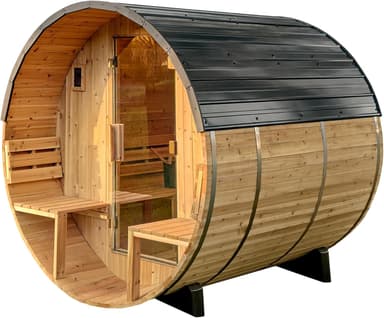
Backyard Discovery Paxton 2-4 Person Cedar Barrel Sauna
- 9kW heater reaches 170°F roughly 50% faster than budget competitors
- Barrel design eliminates dead zones with superior natural heat convection
- HDPE cradles and galvanized steel roof built for genuine year-round outdoor use
Limitations of Cedar
Cedar is not perfect. It is a relatively soft wood (Janka hardness around 350 lbf), which means it dents and scratches more easily than hemlock. The aroma, while loved by most, can be overpowering for users with scent sensitivities or certain respiratory conditions. The reddish color grays to silver outdoors unless oiled periodically - not a structural issue, but an aesthetic consideration. And cedar commands a price premium of 20-50% over hemlock, which is a real budget constraint for many buyers.
Nordic Spruce and Thermowood
European and Nordic spruce (Picea abies) is the traditional sauna wood in Finland, where the sauna tradition originates. Finnish saunas - the original saunas - were built from whatever local conifers grew nearby, and in Scandinavia that was primarily spruce and pine. This historical context sometimes confuses buyers into thinking spruce must be excellent for barrel saunas because the Finns used it. The reality is more nuanced.
Standard Spruce Properties
Raw spruce has thermal conductivity around 0.11-0.14 W/(m·K), slightly higher than cedar but reasonable for indoor use. Its density runs 400-500 kg/m³, making it heavier than cedar. The critical weakness is its extractive content - spruce contains very little natural decay resistance, earning it a Class IV-V durability rating, meaning it can begin decaying within a few years in wet conditions without chemical treatment. Its radial shrinkage runs around 3.6-4.1% and tangential shrinkage around 7.1-8.8%, with a T/R ratio of approximately 2.0 - higher than cedar and indicating more tendency to cup across the grain.
For indoor rectangular sauna construction, where the wood is protected from direct weather exposure, these limitations are manageable. For a barrel sauna sitting outdoors year-round, they become serious problems. The barrel's constantly wetted interior combined with outdoor humidity means untreated spruce staves in an outdoor barrel sauna can begin showing decay, checking, and mold growth within 3-5 years.
Thermowood - The Thermal Modification Solution
The solution the Scandinavian wood industry developed is thermal modification - heating wood in a low-oxygen, steam environment to temperatures of 185-215°C for several hours. This process, marketed as Thermowood (a trademark of the Finnish Thermowood Association), chemically alters the wood's structure in ways that dramatically improve its outdoor performance.
The Finnish Forest Research Institute has documented that thermal modification reduces moisture absorption by 50-80% compared to untreated wood 1. The mechanism involves the decomposition of hemicellulose - the wood component most responsible for moisture absorption - along with the thermal cross-linking of lignin into a more hydrophobic structure. The practical result is a spruce (or pine or hemlock) that takes up far less water, moves far less dimensionally with humidity changes, and resists fungal decay much more effectively than the raw wood.
For barrel sauna staves, thermowood spruce becomes a genuinely competitive option. The reduced moisture absorption means the staves move less through heating and cooling cycles, maintaining the barrel's compression geometry. The improved decay resistance extends service life from the 3-5 year horizon of untreated outdoor spruce to something closer to 10-15 years. The darker, caramel-brown color that thermal modification produces is also considered aesthetically appealing by many buyers.
Thermowood Trade-offs
Thermal modification does reduce wood strength. Modified wood is more brittle - it loses roughly 15-30% of its modulus of rupture compared to untreated stock. For sauna staves that are held under compression rather than spanning unsupported loads, this matters less than it would in structural framing, but it does mean thermowood staves are more susceptible to impact damage and must be handled more carefully during assembly. The modification also eliminates any remaining aroma the spruce might have had, producing a neutral-smelling product similar to hemlock.
Thermowood spruce barrel saunas typically price similarly to hemlock, making them a reasonable budget alternative to cedar for outdoor use - though the 10-15 year service life still falls short of cedar's 15-25 year horizon.
Canadian Hemlock
Canadian hemlock (Tsuga canadensis) is the primary competitor to cedar in the North American barrel sauna market, and for legitimate reasons in specific applications. Understanding exactly where hemlock wins and loses versus cedar is essential for making a smart purchasing decision.
Hemlock's Physical Profile
Hemlock is a pale cream to light brown wood with a fine, straight grain and minimal figure. It has essentially no odor, which is simultaneously its greatest advantage for some buyers and a neutral characteristic for others. Users with fragrance sensitivities, asthma, or who simply prefer an unscented sauna environment often specifically seek hemlock for this reason.
Hemlock's density runs 450-500 kg/m³ - noticeably heavier than cedar. Its thermal conductivity is approximately 0.12-0.15 W/(m·K), higher than cedar's 0.098, which translates to the 15-20% faster heat loss through walls cited in product literature. The sauna reaches temperature equally fast (heater output determines this, not wood species), but maintaining that temperature requires the heater to cycle more frequently in a hemlock barrel than a cedar one. Over hundreds of sessions across a sauna's lifespan, this energy difference accumulates.
Hemlock's radial shrinkage is approximately 4.2% and tangential shrinkage approximately 8.9%, yielding a T/R ratio around 2.1 - higher than cedar, meaning hemlock moves less uniformly with moisture changes and has more tendency to cup. This property directly explains the observation - widely reported by outdoor barrel sauna owners and noted by manufacturers like Backcountry Recreation - that hemlock staves can bow under repeated outdoor sun exposure and moisture cycling. The hemlock barrel that performs fine indoors develops gap problems outdoors within a few years.
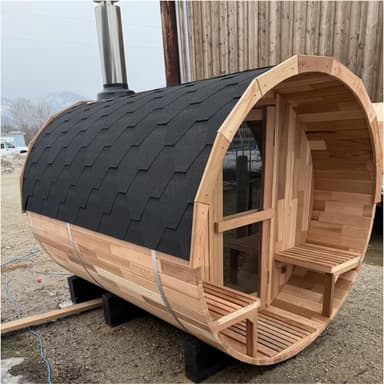
Smartmak 2-10 Person Canadian Hemlock Barrel Sauna
- Barrel shape genuinely improves heat distribution compared to box saunas
- Real red cedar and hemlock construction should last 15-plus years with care
- ETL-certified heater hits 195°F - legitimately hot for authentic steam sessions
Hemlock's Durability Reality
Hemlock is rated Class IV in European durability standards - non-durable, with a predicted service life of 5-10 years in contact with soil and 10-15 years in above-ground wet conditions without treatment. For an indoor barrel sauna in a controlled environment, 10-15 years is achievable. For an outdoor barrel, hemlock requires sealing treatments every 2-3 years to maintain that service life, and even with diligent maintenance, the structural gaps from dimensional movement are a persistent management problem rather than something that goes away with treatment.
The natural extractive content in hemlock is low - it does not have the thujaplicin protection cedar has, and it does not have the modified hydrophobicity of thermowood. What it does have is good workability, consistent availability in North America, and a substantially lower price point than cedar.
Thermo-Hemlock
Some manufacturers offer thermally modified hemlock, applying the same Thermowood process to hemlock rather than spruce. The Finnish Forest Research Institute data showing 50-80% moisture absorption reduction 1 applies to thermally modified hemlock as well. Thermo-hemlock bridges the gap between raw hemlock and cedar meaningfully - you get better dimensional stability, improved decay resistance, and the characteristic dark color of thermal modification. If you are buying a hemlock barrel sauna and have the choice between standard and thermo-treated hemlock for outdoor placement, thermo-treated is worth the upgrade cost.
Pine and Other Budget Options
Eastern white pine (Pinus strobus) and lodgepole pine (Pinus contorta) appear in the least expensive barrel sauna kits on the market, and while pine has a long history in Scandinavian sauna construction, the specific context matters enormously.
Pine in Traditional vs. Barrel Sauna Context
In traditional Finnish sauna construction, pine was used for the entire structure - the log walls, the bench frames, the ceiling. The key difference is that pine benches in traditional Finnish saunas were made from sapwood-dominant, kiln-dried Nordic pine that had been carefully selected to minimize resin content. Resin channels in pine can heat up during sauna sessions and release sticky, hot resin directly onto skin - an uncomfortable and occasionally dangerous problem. This is why sauna bench wood must be low in resin content regardless of species.
For barrel sauna staves, pine adds additional complications. Its durability rating is similar to spruce (Class IV), meaning poor rot resistance. Its resin content is generally higher than cedar, spruce, or hemlock, creating the bench-contact resin problem. And its dimensional movement (radial shrinkage 4.6%, tangential 7.2%) is not dramatically worse than the other species but is combined with a lower price point that often corresponds to lower-grade sourcing and drying practices.
Budget pine barrel kits in the $3,500-$5,000 range typically have shorter manufacturer warranties (1-2 years versus 5-10 for cedar), and real-world reports from owners suggest that outdoor pine barrels often require significant maintenance intervention within 3-5 years. For a budget indoor barrel sauna with limited outdoor exposure, pine is a serviceable choice - but the savings over hemlock are modest and the performance gap is meaningful.
Wood Properties Comparison Table
After analyzing the technical data from wood science literature, manufacturer specifications, and owner reports across multiple sources, here is how the primary barrel sauna wood species compare across the properties that matter most for this application.
| Property | Western Red Cedar | Canadian Hemlock | Thermowood Spruce | Standard Pine |
|---|---|---|---|---|
| Density (kg/m³) | 350-380 | 450-500 | 400-450 | 380-420 |
| Thermal Conductivity W/(m·K) | 0.098 | 0.12-0.15 | 0.11-0.13 | 0.10-0.12 |
| Radial Shrinkage (%) | 4.0-5.0 | 4.2 | 3.0-3.5* | 4.6 |
| Tangential Shrinkage (%) | 7.0-7.5 | 8.9 | 5.5-6.5* | 7.2 |
| T/R Ratio | ~1.5 | ~2.1 | ~1.8* | ~1.6 |
| Natural Decay Resistance | Class II (High) | Class IV (Low) | Class II-III* | Class IV (Low) |
| Natural Extractives/Oils | High | Very Low | Low (modified) | Moderate-High |
| Janka Hardness (lbf) | 350 | 500 | 400 | 380 |
| Outdoor Lifespan (years) | 15-25 | 8-12 | 10-15 | 5-10 |
| Aroma | Strong, pleasant | None | None | Resinous |
*Thermowood modification significantly alters these values from untreated spruce baseline.
This table reveals the key cedar advantages at a glance: best thermal conductivity, highest natural decay resistance, most favorable T/R ratio for dimensional stability, and longest outdoor lifespan. Hemlock's only category advantages are hardness (surface durability) and cost. Thermowood spruce improves upon raw spruce substantially and represents a legitimate outdoor alternative to cedar at a lower price point, though without the longevity.
Rot Resistance and Outdoor Durability
The decay resistance question deserves deeper examination than a table cell can provide, because the mechanisms differ between species and those differences affect your maintenance strategy and realistic expectations.
How Wood Decay Works
Wood decay is primarily caused by basidiomycete fungi that digest lignin and cellulose - the structural polymers that give wood its strength. These fungi require four conditions simultaneously: moisture above approximately 19-20% wood moisture content, oxygen, suitable temperatures (5-35°C), and a food source (the wood itself). Remove any one condition and decay stops. In practice, the only condition you can reliably control in a barrel sauna context is moisture content - and that is exactly where species differ.
Cedar's thujaplicins directly inhibit the enzymatic activity of the fungi responsible for brown rot and white rot. This is not a coating or treatment that wears away - it is part of the wood's cellular structure throughout the heartwood. When you cut cedar, you expose fresh thujaplicin-containing tissue. Hemlock and spruce contain no comparable compounds, which is why they require either thermal modification or applied preservative treatments to achieve comparable field performance.
Freeze-Thaw Cycling
One durability mechanism that deserves specific attention for outdoor barrel saunas in cold climates is freeze-thaw cycling. When water inside wood cell lumens freezes, it expands approximately 9% in volume. Over thousands of cycles across a sauna's lifespan, this hydraulic pressure slowly fractures cell walls and opens checks (cracks along the grain). Cedar's lower density and lower moisture absorption mean less water is present to freeze in the first place, resulting in significantly less freeze-thaw damage compared to hemlock or untreated spruce in cold climates.
For buyers in USDA hardiness zones 5 and colder (winters regularly reaching -15°C or below), this freeze-thaw durability advantage of cedar is arguably more important than its decay resistance. Both mechanisms contribute to cedar's longer outdoor service life in those regions.
Ground Contact and Drainage
Regardless of wood species, barrel sauna staves that sit in standing water or direct ground contact will decay faster. Proper installation on a gravel bed, concrete pad, or elevated frame matters for all wood types, but it matters even more for hemlock and spruce where the wood's natural resistance is limited. If your installation site has poor drainage or the sauna sits at grade level where snow melt pools around it, the outdoor lifespan numbers cited above should be adjusted downward for hemlock and spruce. See our barrel sauna installation guide for site preparation details that extend any wood's service life.
Heat Retention and Thermal Mass
The thermal performance of sauna wood is often discussed imprecisely in marketing materials. Let me separate the physical mechanisms so the numbers make sense.
Thermal Conductivity vs. Thermal Mass
Two distinct properties govern how wood behaves thermally in a sauna: thermal conductivity (how fast heat moves through the wood from interior to exterior) and thermal mass (how much heat energy the wood stores per unit mass or volume). These are separate properties with different implications.
Low thermal conductivity is good for sauna walls and benches - it means heat stays inside the sauna rather than conducting through to the outdoors, and it means bench surfaces stay at a comfortable touching temperature even when air temperature is high. Cedar's 0.098 W/(m·K) conductivity is lower than hemlock's 0.12-0.15, meaning cedar walls lose heat more slowly per unit temperature difference. In a well-built barrel sauna with reasonable insulation, this translates to the 15-20% longer heat retention period cited in product data.
Thermal mass works differently. Higher density woods store more heat energy per unit volume. Hemlock's higher density (450-500 kg/m³ vs. cedar's 350-380 kg/m³) means hemlock walls store more thermal energy once heated - but they also take longer to heat up and require that energy to come from the heater. For sauna applications, moderate thermal mass in the walls is generally considered beneficial because it smooths out temperature fluctuations as users open and close the door. Excessive thermal mass extends pre-heating time without proportional benefit.
Practical Heat-Up and Session Performance
For the average residential barrel sauna session (1-2 hour preheat to 80-90°C), the heater's output rating (kW) dominates heat-up time far more than wood species. A 6 kW electric heater or a properly sized wood-burning sauna stove will bring any of these wood types to temperature within similar timeframes - the difference in heat-up time attributable to wood species alone is modest.
Where wood species makes a session-by-session difference is in how long the sauna stays hot after the heater shuts off or dies down. Cedar's lower conductivity means the interior cools more slowly, which is particularly relevant for wood-fired saunas where you add a log, heat to temperature, then enjoy the session as the fire burns down. A cedar barrel stays in the optimal temperature range longer per log than a hemlock barrel.
For electric heater saunas where the heater cycles on and off to maintain temperature, the difference manifests in heater cycling frequency and total energy consumption rather than subjective comfort. Over a 10-year period of regular use, the energy cost difference between cedar and hemlock walls is real, though calculating it precisely requires knowing your local electricity rates and use frequency.
Aroma and the Sauna Experience
The sensory dimension of sauna wood is dismissed as purely subjective in technical literature, but the reality is more interesting than that framing suggests.
Cedar's Terpene Chemistry
When cedar wood is heated to sauna temperatures, the volatile terpene compounds - primarily alpha-cedrene, beta-cedrene, thujopsene, and cedrol - evaporate and enter the air. These compounds are present in concentrations that are fragrant but not irritating for most users. Cedrol in particular has been studied for biological effects: it shows measurable sedative and anxiolytic properties in animal models, likely through agonism at adenosine receptors. Whether concentrations in a sauna environment are high enough to produce clinically meaningful effects in humans is unknown - the specific sauna inhalation studies have not been done. But the relaxation enhancement that cedar sauna users consistently report is at least biologically plausible, not merely placebo.
The aroma intensity changes over a sauna's lifespan. New cedar is strongly fragrant; as the volatile fraction gradually depletes from the exposed surface layer, the scent becomes milder. Many users lightly sand cedar bench surfaces every few years to expose fresh wood and restore the aroma intensity. This is entirely optional - it does not affect structural performance - but it is a practical option cedar offers that hemlock and thermowood spruce do not.
Hemlock and Spruce - The Neutral Case
Hemlock's scentlessness is genuinely the right choice for some users. People with asthma, allergies to terpene compounds, or who simply find strong wood aromas overwhelming report significantly better comfort in hemlock saunas. For anyone who uses essential oil additives to sauna water or who prefers controlling their own aromatic environment, hemlock's neutral character is an advantage. The scent debate is one area where personal preference legitimately overrides the technical comparison.
Thermowood spruce has a slight caramelized, neutral wood smell when new that fades quickly - it does not produce the terpene compounds of cedar and does not have hemlock's clean neutrality. In practice, thermowood saunas are effectively scentless from an aromatic standpoint.
Maintenance Requirements by Wood Type
Maintenance requirements differ substantially between species, and the real total cost of ownership depends heavily on how much ongoing work you are willing to do.
Cedar Maintenance Protocol
The ideal cedar barrel sauna maintenance program is minimal: rinse with clean water periodically, wash with a mild soap (not detergents that strip oils) once or twice per year, and tighten the barrel hoops as needed when they loosen seasonally. Cedar does not require oiling, sealing, or chemical treatment for outdoor durability - its natural oils protect it. Applying exterior oil or sealant can actually trap moisture and accelerate the decay it is meant to prevent by preventing the wood from breathing.
The one cedar maintenance task that genuinely matters is hoop tension. As cedar weathers and the outermost surface dries, the staves contract slightly on the exterior, which can loosen the compression hoops. Checking hoop tension annually - typically after the first winter in cold climates - and tightening as needed prevents gap formation. Most cedar barrel saunas ship with instructions for this process; it takes 15-20 minutes per hoop and requires only a wrench.
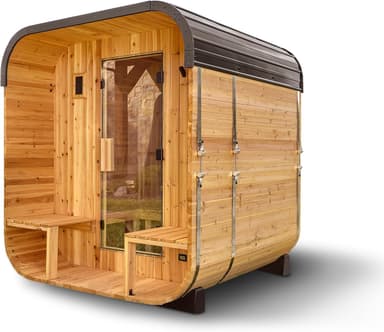
Backyard Discovery Lennon 2-4 Person Cedar Cube Sauna
- 9kW heater reaches temperature significantly faster than budget competitors
- 5-year warranty covers heater and hardware, not just the shell
- Wi-Fi preheat control adds genuine everyday convenience
Hemlock Maintenance Protocol
Hemlock barrel saunas require more active intervention to maintain outdoor performance. In outdoor installations, hemlock benefits from an application of penetrating exterior wood oil or water repellent every 2-3 years, particularly on the exterior stave surfaces and the end grain where moisture absorption is highest. End grain sealing at the time of assembly significantly extends hemlock barrel life - this is often skipped in kit assembly and becomes a source of early decay.
Hemlock is more susceptible to mold growth in humid conditions than cedar, so ensuring adequate airflow through the barrel after sessions (leaving the door ajar to dry the interior) is more important with hemlock than cedar. Surface splinters can develop in hemlock staves over time, particularly on bench surfaces - light sanding with 120-grit sandpaper addresses this and should be done as needed rather than on a fixed schedule.
Thermowood Maintenance Protocol
Thermowood products occupy a middle position. The thermal modification dramatically reduces moisture absorption, so thermowood staves move less and need less frequent treatment than raw hemlock or spruce. However, the modification eliminates the wood's natural oils entirely, so thermowood benefits from periodic application of a UV-protective oil to prevent the surface from becoming excessively brittle from UV degradation. Once every 2-3 years for an outdoor barrel is a reasonable schedule.
| Maintenance Task | Cedar | Hemlock | Thermowood Spruce |
|---|---|---|---|
| Annual cleaning | Mild soap + water | Mild soap + water | Mild soap + water |
| Exterior oil/sealer | Not required | Every 2-3 years | UV oil every 2-3 years |
| Hoop tensioning | Annual check | Annual check | Annual check |
| End grain sealing | Recommended at install | Critical at install | Critical at install |
| Bench sanding | Optional (aroma) | As needed (splinters) | Rarely needed |
| Mold treatment | Rarely needed | Occasional | Rarely needed |
| Typical annual time investment | 1-2 hours | 3-6 hours | 2-4 hours |
Price Comparison and Value Analysis
The upfront cost difference between wood types is real, and so is the long-term cost difference when you account for maintenance and replacement timelines.
Upfront Purchase Pricing
Based on current market pricing across major North American manufacturers and retailers, barrel sauna pricing by wood type falls into these approximate ranges for a 4-6 person barrel:
| Wood Type | Entry-Level Kit | Mid-Range | Premium | Typical Warranty |
|---|---|---|---|---|
| Western Red Cedar | $6,500 | $9,000-$12,000 | $15,000+ | 5-10 years |
| Canadian Hemlock | $3,500 | $5,500-$8,000 | $10,000 | 2-5 years |
| Thermo-Hemlock | $4,500 | $7,000-$9,000 | $11,000 | 3-7 years |
| Thermowood Spruce | $4,000 | $6,000-$8,500 | $10,500 | 3-7 years |
| Pine/Generic | $2,800 | $4,500-$6,000 | $7,500 | 1-2 years |
The cedar premium ranges from approximately 20% at mid-range to 50% at entry-level when compared to hemlock. This upfront difference is where most buyers stop the analysis - and it leads to a significant underestimation of hemlock's true cost.
20-Year Total Cost of Ownership
Consider a realistic 20-year comparison between a $9,000 cedar barrel and a $6,500 hemlock barrel in an outdoor setting in a northern U.S. climate:
Cedar barrel - 20-year scenario:
- ●Purchase: $9,000
- ●Annual maintenance (cleaning, hoop tightening): $50/year = $1,000 over 20 years
- ●No replacement within 20 years if maintained properly
- ●End of period: sauna still functional
- ●Total 20-year cost: approximately $10,000
Hemlock barrel - 20-year scenario:
- ●Purchase: $6,500
- ●Annual maintenance (cleaning, periodic oiling): $100/year = $2,000 over 20 years
- ●Likely replacement or major refurbishment at year 12-15 (outdoor degradation): $6,500-$9,000
- ●Total 20-year cost: approximately $15,000-$18,000
The hemlock barrel costs 50-80% more over 20 years of outdoor use, despite costing 28% less to purchase initially. This reversal is the core financial argument for cedar in outdoor applications. For indoor installations where hemlock performs closer to its upper lifespan range, the math is tighter and the hemlock value proposition is more defensible.
For a detailed look at the best options in each price range, see our guide to the best barrel saunas currently available.
Our Recommendation by Climate and Budget
After all the technical analysis, practical recommendations are what most readers need. Here is how I would advise choosing wood based on your specific situation.
For Outdoor Installation in Cold Climates (Zone 6 and Colder)
Western Red Cedar is the unambiguous recommendation. The combination of freeze-thaw durability, natural rot resistance, low thermal conductivity, and minimal maintenance requirement produces the best 20-year outcome by a wide margin. Spend the extra $2,000-$3,000 upfront and buy a clear heart cedar barrel from a reputable manufacturer. You will not refinish, you will not deal with gap problems from bowing staves, and you will still be using the sauna when your neighbor is replacing their hemlock barrel for the second time.
If your budget firmly constrains you to the $4,000-$6,000 range and you need outdoor placement in a cold climate, thermowood spruce is a better choice than standard hemlock. The thermal modification substantially improves the outdoor performance and service life of spruce relative to raw hemlock at a similar price point.
For Outdoor Installation in Mild, Humid Climates (Zone 8+, Pacific Northwest, Southeast)
Cedar remains the top choice, but the specific threat profile shifts from freeze-thaw cycling to fungal decay and UV degradation. Both cedar heartwood and thermowood products perform well in these conditions. Standard hemlock without thermal modification is particularly poorly suited to the Pacific Northwest - persistent humidity combined with mild temperatures creates ideal fungal decay conditions, and hemlock will show surface mold and structural decay much faster in this environment than in drier climates.
For Indoor or Covered Outdoor Installation
Hemlock becomes a legitimate option when the sauna is protected from direct weather exposure - inside a building, under a substantial covered structure, or in a climate-controlled setting. In these conditions, hemlock's dimensional stability (it is actually quite stable in constant indoor humidity), its scentless character for users with sensitivities, and its lower purchase price all favor the choice. A hemlock indoor barrel sauna with reasonable care can achieve 15 years of service life, making the price-to-longevity ratio competitive. The Smartmak 2-10 Person Canadian Hemlock Barrel Sauna represents this indoor hemlock use case
Sources and References
- Wood Properties of Finnish Sauna Timbers
Finnish Forest Research Institute. Silva Fennica, 2019.
Frequently Asked Questions
Cedar outperforms hemlock in barrel saunas with superior durability (15-25 years vs. 10-15 years), natural resistance to moisture, warping, and insects, plus better heat retention (15-20% longer) and a pleasant aroma, making it ideal for outdoor exposure. Hemlock is more budget-friendly, heats up faster with even distribution, offers a neutral scent for sensitive users, and suits indoor or controlled settings but requires more maintenance to prevent splintering or bowing. Choose cedar for long-term outdoor barrel saunas; hemlock for cost savings indoors.
Related Guides
Medical Disclaimer - This article is for informational purposes only and does not constitute medical advice. Consult a healthcare professional before beginning any sauna routine.