
Maintenance - 0 peer-reviewed sources
Barrel Sauna Maintenance - Seasonal Care Guide
A well-maintained barrel sauna lasts 20+ years. Here is your complete seasonal care playbook for cleaning, sealing, and protecting your investment.
Written by Erik Nordgren
Senior Sauna Reviewer
Reviewed by Jake Morrison
Installation & DIY Expert
Owning a barrel sauna is one of the more rewarding investments a homeowner can make - but the barrel shape that gives these units their iconic look and superior heat distribution also creates a maintenance dynamic unlike any other outdoor structure. The curved staves must expand and contract as a unified system, the steel or aluminum bands holding them together face seasonal stress cycles, and the exterior wood sits exposed to UV radiation, freeze-thaw cycles, and biological growth year-round. Get the maintenance right and a quality cedar or hemlock barrel sauna will serve you reliably for 15 to 25 years. Neglect it and you're looking at warped staves, leaking seams, mold colonization, and heater failures within three to five years.
After analyzing the available maintenance literature and hands-on ownership reports from dozens of barrel sauna manufacturers and users, I can tell you that the single biggest mistake owners make is treating a barrel sauna like a piece of outdoor furniture - something you cover in winter and forget about until spring. The reality is more demanding and more interesting than that. Wood moisture dynamics, microbial biology, metal fatigue, and electrical safety all intersect in a structure that gets heated to 80-100°C (176-212°F) and then sits cold and damp in a Minnesota winter. Understanding why each maintenance task matters mechanically makes you far more likely to actually do it.
This guide covers every maintenance category in the depth you need to make intelligent decisions - from the 10-minute post-session routine to the full winterization protocol. Whether you own a cedar barrel sauna, a hemlock unit, or are still researching how to choose a barrel sauna, the principles here apply across the category.
Why Maintenance Matters - Lifespan Impact
Wood is a hygroscopic material - it absorbs and releases moisture in response to ambient humidity and temperature, swelling when wet and shrinking when dry. In a barrel sauna, this cycle happens with unusual intensity. During a session, interior relative humidity can climb to 40-60% while temperatures exceed 85°C. After the session ends and the door opens, that moisture load evacuates rapidly. The wood that was swollen with steam contracts as it cools. Repeat this process hundreds of times per year across a structure held together by mechanical tension rather than fasteners, and you begin to understand why maintenance is structural, not cosmetic.
The Economics of Neglect
The lifespan difference between a well-maintained and a neglected barrel sauna is not subtle. Quality barrel saunas built from western red cedar, Nordic spruce, or thermally modified wood are engineered for 15-25 year lifespans under proper care. Owners who skip exterior wood treatment typically see surface checking (small cracks along the grain) within two to three years, gray weathering within one to two years, and moisture infiltration into end grain within three to five years. Once moisture reaches the structural stave joints and the interior, mold colonization follows, and at that point you are either spending $500-800 on professional remediation or accepting accelerated structural degradation.
A barrel sauna that costs $3,000-$8,000 new represents a per-year cost of $150-$400 over a 20-year lifespan. A neglected unit replaced at year seven represents a per-year cost of $430-$1,140. The maintenance investment of $150-$300 per year in materials and time pays back at a ratio of roughly 3:1 in extended lifespan alone, before accounting for the avoided cost of heater damage, band replacement, and interior mold remediation.
How Wood Species Affects Maintenance Intensity
Not all barrel sauna wood requires the same maintenance frequency. Western red cedar contains natural thujaplicins - antimicrobial compounds that provide inherent resistance to rot and insect damage. This means a cedar barrel sauna can tolerate somewhat longer intervals between exterior treatments than a Nordic spruce unit. Thermally modified wood (like Thermowood or Lunawood) has had its sugars and resins driven out through a high-temperature kiln process, making it more dimensionally stable and more resistant to biological attack - but also more prone to surface checking if left untreated because the wood is more brittle than natural wood.
| Wood Species | Natural Rot Resistance | UV Sensitivity | Recommended Treatment Interval | Typical Lifespan (Maintained) |
|---|---|---|---|---|
| Western Red Cedar | High | Moderate | Every 12-18 months | 20-25 years |
| Nordic Spruce | Low | High | Every 9-12 months | 15-20 years |
| Thermally Modified (Thermowood) | High | High | Every 9-12 months | 20-25 years |
| Canadian Hemlock | Moderate | Moderate | Every 12 months | 18-22 years |
| Siberian Larch | Very High | Moderate | Every 12-18 months | 20-25 years |
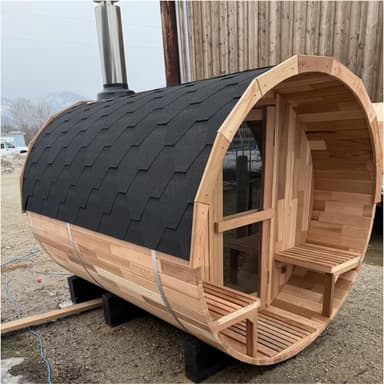
Smartmak 2-10 Person Canadian Hemlock Barrel Sauna
- Barrel shape genuinely improves heat distribution compared to box saunas
- Real red cedar and hemlock construction should last 15-plus years with care
- ETL-certified heater hits 195°F - legitimately hot for authentic steam sessions
Monthly Maintenance Checklist
Monthly maintenance on a barrel sauna takes approximately 20-30 minutes and prevents the compounding problems that make annual maintenance expensive and time-consuming. The tasks break into interior and exterior categories.
Interior Monthly Tasks
Post-session ventilation is not optional - it is the single most impactful habit in barrel sauna ownership. After every session, prop the door fully open and leave it open for a minimum of 30-60 minutes. In humid climates (the Gulf Coast, Pacific Northwest, Florida), run a portable fan positioned at the door threshold for 15-20 minutes to accelerate drying. The goal is to drop interior relative humidity below 60% before closing the door, because sustained humidity above 60% is the threshold at which mold and mildew begin colonizing wood surfaces.
Interior wipe-down should happen after every one to two uses. Use a clean microfiber cloth dampened with warm water - nothing else. The interior wood of a barrel sauna should never be treated with varnish, polyurethane, paint, or even most commercial wood cleaners. The high temperatures will volatilize any chemical sealant and the resulting vapors are both unhealthy and unpleasant. For stubborn perspiration stains on bench surfaces, a paste of baking soda and water applied with a soft brush and rinsed with warm water works well. Persistent stains that don't respond to baking soda treatment can be addressed with fine-grit sandpaper (120-150 grit) followed by 220-grit finishing.
Bench inspection during your monthly cleaning should look for raised grain, soft spots (indicating moisture infiltration or early rot), and protruding splinters. Run your hand along all bench surfaces and backrests. Any soft spot warrants investigation - probe gently with a screwdriver tip. Soft, crumbling wood means rot has established and that section of bench needs replacement before the next use.
Heater stone visual check takes 60 seconds. Look for stones that have cracked into two or more pieces. Cracked stones can fracture completely when cold water hits them during löyly (the steam-making pour), sending fragments in unpredictable directions. Remove any visibly cracked stones immediately. Stones typically last three to five years with normal use before thermal cycling causes widespread fracturing.
Exterior Monthly Tasks
Walk around the exterior once per month and look for four things: discoloration indicating biological growth (green algae, black mold), any band that appears to have shifted or loosened, checking of the stave surfaces (small cracks running with the grain), and the condition of the door seal. None of these require immediate action if caught early - they are all manageable with routine treatment - but they compound quickly if ignored for a season.
Seasonal Care Schedule
The seasonal care schedule for a barrel sauna aligns with the natural stress cycles the wood experiences. Spring and fall are the high-action seasons; summer and winter require lighter but still consistent attention.
Spring - Recovery and Treatment (March-April)
Spring is the most important maintenance window of the year for outdoor barrel saunas. After a winter of freeze-thaw cycling, the wood has experienced its maximum expansion and contraction stress. Start with a thorough exterior inspection before any cleaning or treatment.
Check every band for proper tension (see the dedicated section on band tensioning below). Inspect all stave end caps - these are the flat circular pieces at each end of the barrel - for cracking or separation. Examine the roof (if your unit has a separate roof structure) for any frost heave damage, and check that the foundation or base cradles are still level. A barrel sauna that has settled unevenly over winter will experience uneven band tension, which accelerates stave separation at the low point.
Spring cleaning should include a low-pressure exterior wash (maximum 1,200-1,500 PSI - a standard garden hose with a spray nozzle is usually sufficient and safer than a pressure washer) to remove winter grime, algae, and any tannin staining that has run from the wood. Allow the exterior to dry completely - typically 48-72 hours of dry weather - before applying any wood treatment product. Applying oil or stain to damp wood traps moisture under the finish, which is worse than no treatment at all.
Summer - Monitoring and UV Protection (May-August)
Summer maintenance is primarily about UV protection and ventilation management. UV radiation is the primary driver of surface graying in untreated wood - the lignin that gives wood its color breaks down under UV exposure, leaving the gray appearance of weathered wood. While weathered wood is not structurally compromised, it indicates that the UV protection layer has failed and that moisture infiltration will follow.
During summer, interior ventilation is also important after sessions because warm, humid air inside a closed sauna creates ideal conditions for mold. If you are in a region with high summer humidity, consider a small desiccant dehumidifier placed inside when the sauna is not in use.
Fall - Preparation and Deep Cleaning (September-October)
Fall is your second major maintenance window. The goals are: deep-clean the interior, re-treat the exterior if the spring treatment is showing wear, inspect and adjust band tension before winter (wood will shrink significantly in cold weather, requiring tighter tension), and address any issues before the ground freezes.
This is also the time to inspect and clean the heater or stove thoroughly (detailed in their respective sections below), replace sauna stones if they are showing widespread cracking, and check the door latch and hinges for smooth operation.
Winter - Monitoring and Weatherization (November-February)
In cold climates, winter maintenance is primarily about preventing damage from ice, snow load, and the freeze-thaw cycle. If you are using the sauna regularly through winter - which is both enjoyable and actually beneficial for the wood because the heating cycles drive out moisture - the main tasks are clearing snow from the roof and keeping the door seal functional.
If you are winterizing the sauna for seasonal storage (not recommended unless you absolutely must), see the dedicated winterization section. Regular winter use is generally better for the wood than abandonment.
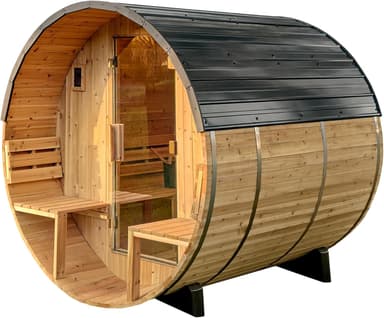
Backyard Discovery Paxton 2-4 Person Cedar Barrel Sauna
- 9kW heater reaches 170°F roughly 50% faster than budget competitors
- Barrel design eliminates dead zones with superior natural heat convection
- HDPE cradles and galvanized steel roof built for genuine year-round outdoor use
Wood Treatment and Sealing
The exterior wood treatment program is the cornerstone of barrel sauna longevity, and it is an area where product selection matters as much as application frequency.
Interior vs. Exterior - Different Rules Apply
The most important principle in barrel sauna wood treatment: the interior and exterior have opposite requirements. Interior wood must remain untreated with any film-forming product. The wood needs to breathe, release moisture after sessions, and remain chemically inert at temperatures up to 100°C. Applying varnish, polyurethane, or paint to interior wood will result in off-gassing of volatile organic compounds (VOCs) at operating temperatures - not a health situation you want in an enclosed 90°C chamber.
For the interior, the only acceptable treatments are: periodic light sanding to refresh bench surfaces, and - if the manufacturer specifically approves it - a food-grade mineral oil or sauna-specific interior wood oil applied sparingly to bench surfaces to reduce staining. Many manufacturers recommend no interior treatment at all.
The exterior is the opposite case. Untreated exterior wood on an outdoor barrel sauna will gray within six to twelve months, develop surface checking within two to three years, and begin absorbing moisture into the end grain within three to five years. Treatment is not optional - it is structural maintenance.
Choosing the Right Exterior Treatment
The exterior treatment market broadly divides into three categories: penetrating oils, film-forming stains, and UV-blocking preservatives. Each has trade-offs.
| Treatment Type | UV Protection | Water Repellency | Application Interval | Breathability | Ideal For |
|---|---|---|---|---|---|
| Penetrating Oil (tung, linseed) | Low | Moderate | Every 6-12 months | High | New wood, first treatment |
| Pigmented Penetrating Stain | High | High | Every 12-24 months | Moderate | Long-term protection |
| UV-Blocking Clear Preservative | Moderate | Moderate | Every 9-12 months | High | Maintaining natural wood color |
| Film-Forming Stain | High | Very High | Every 2-3 years | Low | Not recommended for barrels |
For barrel saunas specifically, penetrating stains with UV inhibitors outperform film-forming products because the barrel's constant expansion and contraction will crack any rigid film coating within one to two seasons, creating pathways for moisture infiltration that are worse than no treatment. A penetrating stain that moves with the wood and needs reapplication every 12-18 months is the right choice.
Application Protocol
Before applying any exterior treatment, the wood must be clean and dry. Surface moisture content should be below 15% - a wood moisture meter (available for $20-40) is worth owning for this purpose. Apply the treatment on a dry day with temperatures between 10-25°C (50-77°F). Use a brush rather than a roller or sprayer for barrel stave surfaces, working the product into the grain along the length of the stave. Apply a second coat within four hours of the first while the first coat is still slightly tacky - this ensures the two coats bond rather than sitting as separate layers.
Pay particular attention to end grain at both ends of the barrel. End grain is the primary pathway for moisture infiltration and should receive two to three coats of a penetrating end-grain sealer or two extra coats of your regular treatment product. If only one area of a barrel sauna receives treatment, it should be the end grain.
Mold and Mildew Prevention
Mold in a barrel sauna is not just an aesthetic problem - certain mold species produce mycotoxins, and breathing mycotoxin-contaminated steam in an enclosed high-temperature environment is a genuine health risk. Prevention is dramatically easier than remediation.
Understanding the Biology
Mold colonization requires four conditions: moisture, organic material (wood), temperatures between 4°C and 38°C, and oxygen. A barrel sauna provides three of these conditions permanently and the fourth - moisture - whenever it is not properly dried after use. The most commonly found mold species in sauna environments are Cladosporium, Penicillium, and Aspergillus - all of which can establish colonies within 24-48 hours on wet wood at room temperature.
The kill strategy for mold prevention is simple: eliminate the moisture window. Wood that dries below 19% moisture content within four to six hours of sauna use will not support mold colonization. This is the physiological basis for the post-session ventilation protocol - it is not about air quality, it is about dropping wood moisture content below the biological threshold before mold spores (which are omnipresent in outdoor air) can establish.
Identifying Early Mold
Early-stage mold on sauna wood appears as small gray, green, or black spots, often with a slightly fuzzy texture. It is most commonly found in three locations: under the bench supports (where moisture pools and airflow is low), around the door frame (where condensation forms on the cooler surface), and on the lowest interior stave course (where cold air meets warm, humid air). Monthly inspection of these three locations catches mold before it spreads.
Treatment for Established Mold
If you find mold colonization, do not use bleach-based products. Bleach kills the surface mold but does not penetrate the wood to kill the root structure (hyphae), and the sodium hypochlorite in bleach degrades wood lignin, accelerating breakdown. For interior mold treatment, the protocol is:
- ●Sand the affected area with 80-grit sandpaper to remove the surface colony, wearing an N95 mask
- ●Wipe with a solution of white vinegar and water (70:30 ratio) - acetic acid penetrates wood and kills hyphae
- ●Allow to dry completely (24-48 hours with ventilation)
- ●Inspect again and repeat if needed
- ●After successful treatment, run the sauna to operating temperature to drive out residual moisture
For exterior mold, a dedicated mold-killing wood wash formulated without bleach (products like Wet and Forget or Jomax) applied per manufacturer instructions is effective. Follow with your regular exterior wood treatment once the wood is dry.
Band Tensioning - The Task Everyone Forgets
Ask any barrel sauna owner what maintenance tasks they perform and most will describe cleaning, wood treatment, and heater care. Ask about band tensioning and you'll frequently get a blank look. This is the most mechanically critical and most overlooked maintenance task in barrel sauna ownership.
Why Bands Matter
Barrel sauna staves - the individual curved wood planks that form the cylindrical body - are held together entirely by circumferential tension from the metal bands (typically galvanized steel or aluminum) that encircle the barrel. There are no nails, screws, or adhesives holding the stave joints together. The barrel is an ancient tensile structure where the bands keep the staves compressed against each other, creating the water-tight and air-tight joints that make the sauna functional.
When wood dries and shrinks in cold weather or low humidity, the bands lose tension proportionally. Loose bands allow staves to separate slightly at the joints, creating gaps that permit moisture infiltration, air infiltration (reducing heat efficiency), and eventual stave movement that compounds the problem. Over time, repeated loosening and re-tightening cycles without proper management lead to permanent stave offset - where one stave rides slightly higher or lower than its neighbors - and at that point the joint can no longer seal properly.
How to Tension Bands Correctly
Most barrel saunas use bands with a carriage bolt-and-nut tensioning system at one or both ends. The correct approach:
- ●Work when the sauna is cold and has been cold for at least 24 hours - tensioning a warm sauna means you are setting tension at the expanded dimension, which will be insufficient when the wood cools
- ●Use a wrench to tighten each band nut in quarter-turn increments, working around the barrel in a pattern rather than fully tightening one band before moving to the next
- ●Tap the band with a wooden mallet after tightening - a properly tensioned band produces a clear, slightly ringing tone rather than a dull thud
- ●Check that all stave joints are flush after tensioning - if a joint has a visible gap after full tensioning, that stave may need shimming or replacement
When to Tension
Band tension should be checked: immediately after initial assembly (wood will settle in the first 30 days), again at 90 days post-installation, every spring as part of seasonal maintenance, every fall before winter contraction, and any time you notice drafts inside the sauna or see light through the stave joints. New barrel saunas typically need the most frequent tensioning in the first year - plan on monthly checks for the first six months.
Heater Maintenance - Electric
Electric heaters dominate the residential barrel sauna market because they are convenient, controllable, and require no fuel management. They also have specific maintenance requirements that, if ignored, create both safety and performance problems. If you own one of the electric heater saunas in the barrel format, this section covers everything you need to know.
Annual Electrical Safety Inspection
The high-humidity, high-temperature environment inside a barrel sauna is genuinely hard on electrical components. Every 12 months, the heater should receive a safety inspection that includes:
- ●Visual inspection of all wiring connections at the heater body for signs of discoloration, corrosion, or melted insulation
- ●Testing the GFCI (ground fault circuit interrupter) outlet or breaker that protects the circuit by pressing the test button
- ●Checking that the heater enclosure has no visible cracks or deformation
- ●Verifying that the minimum clearances between the heater and wood surfaces (specified in the heater manual, typically 100-150mm on all sides) have not been compromised by added accessories or bench modifications
This inspection should be performed by or reviewed by a qualified electrician. The cost is typically $75-150 for a service call, and it is not a task to skip for budget reasons - a heater electrical fault in an enclosed wood structure is a serious fire risk.
Stone Management for Electric Heaters
The stones in an electric sauna heater serve a dual purpose: they store thermal mass to produce steam when water is poured on them, and they protect the heating elements below from direct water contact. Both functions depend on having the right stones in the right configuration.
Remove and inspect all stones annually. Cracked stones (those that have fractured into two or more pieces) must be removed. Stones that have developed a white mineral scale from repeated water contact can be rinsed under water and scrubbed with a stiff brush - the scale is harmless mineral deposit but reduces thermal efficiency slightly. When reloading stones into the heater, place larger stones at the bottom and smaller stones at the top, and avoid fully packing the stone bed - leave 30-40% void space for water to penetrate and generate steam.
Element Inspection and Replacement
Electric heater elements have a finite lifespan - typically 8-15 years of normal use. Signs that elements need replacement include: uneven heating of the stone bed, visible corrosion or pitting on the element surface (visible when stones are removed), a burning smell on initial heat-up, or a tripped breaker on startup. Most heater manufacturers sell replacement elements and the swap is within the capability of a mechanically inclined owner, but wiring connections should be confirmed by an electrician.
Stove Maintenance - Wood-Burning
Wood-burning sauna stoves (kiuas) represent the traditional Finnish approach and remain popular among purists and off-grid users. They require more hands-on maintenance than electric heaters but are mechanically simpler and can be rebuilt almost indefinitely. If you are considering a wood-burning sauna, build the maintenance schedule below into your ownership expectations.
Ash Management and Firebox Cleaning
The firebox should be cleaned of ash after every two to three uses - not after every use, because a thin bed of ash (25-30mm) actually improves combustion by insulating the firebox floor and promoting complete burning. When ash accumulates beyond this depth, it reduces airflow and combustion efficiency, and wet ash is highly corrosive to steel.
To clean the firebox: allow the stove to cool completely (minimum 12 hours after last use), remove ash with a metal ash scoop into a metal ash bucket (never plastic - residual embers can persist for 24+ hours), and inspect the firebox walls and floor for cracks, warping, or corrosion. Any crack in the firebox that penetrates through the wall is a safety issue requiring professional repair or stove replacement.
Flue and Chimney Maintenance
This is the most safety-critical maintenance task for wood-burning sauna owners. Creosote - a byproduct of incomplete wood combustion that deposits on the inner wall of the flue - is both a combustion hazard and a flow restriction. A flue with significant creosote buildup can restrict draft enough to cause smoke backdraft into the sauna, or in severe cases, a chimney fire.
The flue should be inspected annually and cleaned whenever creosote deposit exceeds 3mm thickness. A proper chimney brush sized to your flue diameter and a set of extension rods ($40-80 in materials) allow a competent owner to perform this task, but the first inspection on a new installation and any time you see more than light gray deposits should involve a certified chimney sweep.
Burn only dry, well-seasoned hardwood with moisture content below 20%. Green wood and softwood produce significantly more creosote than dry hardwood. A wood moisture meter (the same tool used for stave moisture testing) can verify fuel quality.
Stove Body Maintenance
Cast iron and steel wood-burning stoves benefit from an annual application of high-temperature stove blacking or stove paint to prevent surface rust. Apply it to a cool stove, allow it to cure (typically one low-heat burn cycle), and the surface protection is restored. Check all door gaskets (the rope seals around the firebox and ash door) for compression and integrity - a door gasket that does not fully compress allows combustion air infiltration that defeats draft control and wastes fuel. Replacement rope gasket material costs $15-30 and the replacement process takes 30-45 minutes.
Roof and Exterior Care
Barrel saunas come in two basic roof configurations: integrated barrel designs where the curved stave structure forms the roof as well as the walls, and barrel-with-separate-roof designs where a flat or gabled roof structure sits above or extends over the barrel. Each presents distinct maintenance considerations.
Integrated Barrel Roof Care
When the roof is formed by the same stave structure as the walls, it receives the maximum UV and moisture exposure of any surface on the sauna. Water pooling on the top of the barrel is not a concern for the curve geometry, but the end grain at the top of the stave ends and any horizontal ledge at the top of door and vent openings are vulnerability points.
Treat the roof surface with the same exterior treatment schedule as the sides, but increase application frequency by one cycle - if you treat the sides annually, treat the roof every eight to nine months. Consider a roll-on UV-blocking treatment for the very top of the barrel where brush application is difficult. Snow accumulation on barrel roofs should be cleared after heavy storms - not because the barrel cannot handle the load (most are over-engineered for snow loads), but because wet snow in contact with wood for extended periods accelerates moisture infiltration.
Separate Roof Structures
Flat or gabled roof structures on barrel saunas are typically built from treated lumber with EPDM rubber, asphalt shingles, or metal roofing. These follow standard residential roofing maintenance - inspect shingles or membrane annually for damage, ensure gutters (if present) are clear, and check flashing around any flue penetrations twice yearly.
The junction between the separate roof structure and the barrel stave body is a critical detail. Water that penetrates this junction enters the end grain of the stave and can cause rot within two to three seasons. Ensure this joint is sealed with a flexible, UV-stable sealant (silicone or polyurethane) and inspect it every spring for cracking or separation.
Foundation and Cradle Maintenance
Barrel saunas typically rest on two or more curved cradle supports. These cradles need to remain level, because an unlevel barrel creates asymmetric band tension and uneven stress on the staves. Check levelness every spring with a 4-foot level placed across the barrel bottom. If settling has occurred, adjust the cradle support or add shims as needed. Cradle supports that rest directly on soil benefit from pressure-treated lumber or composite material to resist ground moisture and biological degradation.
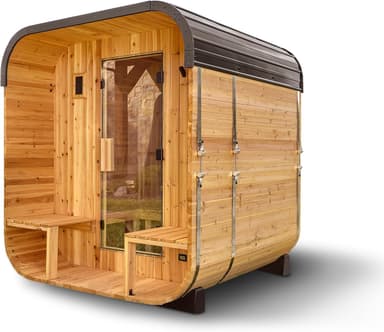
Backyard Discovery Lennon 2-4 Person Cedar Cube Sauna
- 9kW heater reaches temperature significantly faster than budget competitors
- 5-year warranty covers heater and hardware, not just the shell
- Wi-Fi preheat control adds genuine everyday convenience
Winterization Protocol
If you live in a climate where winter temperatures regularly drop below -20°C (-4°F), or if you plan to leave your barrel sauna unused for more than two to three months, a formal winterization protocol protects the investment.
The Case Against Full Winterization
Before walking through the winterization steps, I want to make an honest case for continuing to use the sauna through winter rather than winterizing it. Wood-burning and electric barrel saunas in cold climates actually fare better with regular year-round use than with seasonal abandonment. The heating cycles drive moisture out of the wood, the band tension system stays at a relatively consistent equilibrium as the wood stabilizes at winter dimensions, and you avoid the spring startup inspection load. Regular winter use in a well-maintained unit is the optimal scenario.
Full winterization makes sense for: saunas in extremely remote locations without reliable access, electric saunas where the power will be disconnected for the season, and owners who genuinely cannot perform winter monitoring visits.
Full Winterization Steps
- ●Final deep clean - Clean the interior thoroughly, allow it to dry completely with the door open for 48-72 hours, and remove all towels, buckets, and accessories that could trap moisture
- ●Drain any water features - If your sauna has a plumbed water supply for the löyly bucket, drain all lines and open any drain valves
- ●Heater preparation - For electric heaters, disconnect power at the breaker and cover the heater loosely with a dry cloth to prevent rodent nesting. For wood-burning stoves, clean the ash completely, close all dampers, and cover the flue cap securely
- ●Stone removal - Remove stones from the heater and store them in a dry indoor location. Freeze-thaw cycling of wet stones significantly accelerates cracking
- ●Band tensioning - Tighten all bands before the first hard freeze, not after. Wood shrinks approximately 0.3-0.5% in radial dimension per 10% reduction in moisture content - a 2-meter diameter barrel can shrink 6-10mm in circumference through a winter, which is significant band slack
- ●Exterior treatment - Apply a final coat of exterior treatment, paying particular attention to end grain. Cold weather slows product penetration, so apply before temperatures drop below 10°C
- ●Ventilation provision - Do NOT seal the sauna airtight for winter. Moisture trapped inside with no ventilation creates ideal mold conditions. Leave a small vent or the door slightly ajar, or drill two 20mm ventilation holes in the lower wall (these can be plugged in summer if desired)
- ●Cover consideration - If you use a breathable cover, use only purpose-made breathable sauna covers or outdoor furniture covers - never plastic sheeting, which traps moisture
Spring Startup After Winterization
Before the first use of the season after winterization: check all band tension, inspect for any rodent damage to wiring or insulation, remove the heater cover and inspect for moisture or corrosion, replace stones if they show new cracking, and run the heater to full temperature with the door open before conducting a normal sauna session. This dries the wood thoroughly and reveals any draft issues before you are inside.
When to Replace vs Repair
Every maintenance system eventually faces the question of whether the time and cost of repair justifies the outcome, or whether replacement is the smarter economic and practical choice. For barrel saunas, the answer depends on which component is failing and what the failure mode is.
Repairable Conditions
The following conditions are repairable at reasonable cost and should not trigger replacement consideration:
- ●Band corrosion or failure - Individual bands can be sourced from the manufacturer or fabricated by a local metalworker. Band replacement cost is $50-150 per band in materials plus labor
- ●Individual stave damage - A single stave with checking, surface mold, or minor rot can often be replaced. Source replacement staves from the manufacturer; matching the wood species, grade, and dimensions is important for structural integrity
- ●Bench replacement - Benches are the highest-wear interior component and are designed to be replaceable. Full bench replacement typically costs $200-500 in materials for a standard four-person barrel
- ●Door seal replacement - Door seals (silicone or foam) degrade over three to five years and are straightforward replacements costing $30-60 in materials
- ●Heater element replacement - As noted above, element replacement is within the capability of a mechanically inclined owner for $100-300 in parts
Replacement Triggers
The following conditions generally indicate that replacement of the entire unit is more economical than repair:
- ●Widespread rot across multiple staves - If more than three to four staves show active rot or soft spots, the structural integrity of the barrel is compromised and replacement of the affected section or the whole barrel is the appropriate response
- ●Warped or permanently offset staves - Staves that have permanently separated and cannot be brought into flush alignment by band tensioning have experienced irreversible dimensional change. This typically results from prolonged exposure to wet-dry cycling without treatment
- ●Heater that has exceeded safe operational life - A heater more than 15 years old with signs of electrical degradation should be replaced rather than repaired, as the cost of a new heater ($300-800) is modest relative to the safety risk of an old unit
- ●Foundation damage affecting levelness - If the ground has shifted enough that the cradle supports cannot be releveled, and the barrel has been running unlevel long enough to cause permanent band distortion, the structural repair cost can exceed replacement cost for an entry-level barrel
| Component | Repair Cost Range | Replacement Cost Range | Repair Makes Sense When |
|---|---|---|---|
| Single stave | $150-400 | Full barrel: $2,000-8,000 | 1-2 staves affected |
| All benches | $200-500 | $200-500 (same) | Always repair |
| Bands (full set) | $200-600 | N/A | Always repair |
| Door assembly | $150-400 | $150-400 | Always repair |
| Electric heater | $100-400 (elements) | $300-800 (new) | Under 10 years old |
| Wood-burning stove | $50-200 (gaskets/blacking) | $400-1,200 (new) | No firebox cracks |
| Widespread stave rot | $800-2,000+ | $2,000-8,000 | Less than 30% of staves |
Maintenance Cost Breakdown by Year
Understanding the actual annual cost of barrel sauna maintenance helps owners budget accurately and makes the case for consistent maintenance over deferred-cost approaches. The figures below are based on a standard four-person
Frequently Asked Questions
Main barrel sauna maintenance tasks include wiping the interior with a damp cloth or microfiber towel after every 1-2 uses, vacuuming dust and debris regularly, and leaving the door open to ventilate and dry the wood. Annually or twice yearly, inspect and rinse heater stones for cracks (replacing as needed), tighten barrel bands, power wash the exterior if outdoors, and re-stain or re-coat it with UV-inhibiting products suited to your climate - never stain the interior. Sit on towels during use to minimize sweat stains, and check for mold, wear, or water seepage in wet climates.
Related Guides
Medical Disclaimer - This article is for informational purposes only and does not constitute medical advice. Consult a healthcare professional before beginning any sauna routine.