
Buying Guide - 2 peer-reviewed sources
How to Choose Your First Barrel Sauna
Buying your first barrel sauna is a big decision. This guide walks you through every factor that matters so you make the right call the first time.
Written by Erik Nordgren
Senior Sauna Reviewer
Reviewed by Sarah Kowalski
Editor-in-Chief
Buying your first barrel sauna is one of those purchases that rewards careful research and punishes impulse decisions. Get it right and you have a backyard fixture that delivers genuine cardiovascular and longevity benefits - a 20-year Finnish cohort study found that regular sauna use was associated with 40% lower all-cause mortality among men who bathed four to seven times per week compared to once-weekly users 1. Get it wrong and you have a rotting cylinder on your lawn, an undersized heater that never reaches temperature, or a beautifully crafted unit that seats six people when only two will ever use it.
After analyzing dozens of models across every price tier and reviewing the construction practices of the major manufacturers, I've written this guide as the definitive resource for first-time barrel sauna buyers. This is not a listicle of affiliate links - it's a structured framework for making an informed decision across every variable that actually matters: geometry, materials, heating systems, construction quality, site prep, and ongoing costs. If you're new to the sauna world, the sauna for beginners guide pairs well with this article.
The barrel sauna market has expanded dramatically over the past decade, moving from a niche Scandinavian import to a mainstream backyard category with options ranging from $1,500 flat-pack kits to $15,000+ custom installations. That expansion has brought genuine innovation alongside a flood of low-quality products making identical marketing claims. The goal here is to help you cut through that noise with specific numbers, honest comparisons, and practical takeaways.
Why the Barrel Shape Matters
The barrel shape is not aesthetic marketing - it produces measurable thermal advantages that distinguish it from traditional cabin-style square saunas of equivalent floor area. Understanding the physics helps you evaluate competing claims and understand why you're paying more for a well-engineered cylinder than a flat-walled box.
The Geometry of Heat
A cylindrical interior eliminates the dead-air corners that accumulate in rectangular saunas. In a conventional 6x8 foot cabin sauna, the four upper corners represent a significant volume of air that must be heated before the occupant-level temperature reaches bathing range. Research on barrel saunas consistently references a 23% reduction in unused air space compared to square saunas of equivalent floor dimensions. That reduction translates directly into faster heat-up times, lower energy consumption per session, and more even temperature distribution at bench height.
The curved walls also direct convective air currents more efficiently. Hot air rising from the heater follows the interior curve rather than stratifying sharply at a flat ceiling. The result is a more consistent temperature gradient from floor to bench level - practically meaningful because a barrel sauna user sitting at bench height experiences less temperature differential between their feet and their head than they would in a comparably sized box sauna.
Structural Advantages of Stave Construction
Barrel saunas are built using the same stave-and-hoop principle as wooden barrels and wine casks - a construction technique refined over centuries specifically for managing wood movement in high-moisture environments. Each stave (vertical board) runs the full length of the barrel, and the assembly is held under compression by metal hoops. This means the structure handles the thermal expansion and contraction of repeated heat cycles by distributing stress evenly across all staves rather than concentrating it at mechanical fasteners.
This matters enormously for longevity. A rectangular sauna with corner joints, nailed walls, and a conventional roof is fighting wood movement with mechanical resistance. A barrel sauna moves with expansion and contraction as a unified system. The practical outcome is a structure that can handle decades of temperature cycling without the cracking, warping, and joint failure common in lower-quality box saunas.
Permit Implications
Because most barrel saunas are freestanding, have no permanent foundation, and are classified as accessory structures below most local square-footage thresholds, they typically avoid the building permit requirements that apply to shed-style sauna outbuildings. This is jurisdiction-dependent - always check with your local planning department - but the cylindrical form is a genuine practical advantage for homeowners who want to avoid the cost and delay of the permitting process.
Size and Capacity - The Most Common Mistake
The single most frequent error first-time buyers make is sizing to maximum theoretical capacity rather than realistic regular use. Manufacturers list capacity based on bench space, not comfort, and a "6-person" barrel sauna that seats six people tightly will feel right-sized for two to three bathers in actual practice.
How to Size Correctly
The practical rule I apply after reviewing dozens of real-world installations: buy for your realistic regular use, then add one size tier for occasional larger groups. If you and a partner will use the sauna four times a week and occasionally host two friends, a 4-person model serves you better than a 6-person model. The 4-person unit heats faster, costs less per session to run, and still accommodates four adults when needed.
Barrel sauna dimensions follow fairly standardized lengths in the market. The key variable is length (which determines capacity) while diameter remains relatively constant - typically 4 to 5 feet - because that dimension is governed by comfortable bench height and headroom.
| Capacity Label | Realistic Comfortable Use | Typical Length | Interior Bench Area |
|---|---|---|---|
| 2-person | 1-2 bathers | 4-5 feet | ~16 sq ft |
| 4-person | 2-3 bathers | 6-7 feet | ~24 sq ft |
| 6-person | 3-4 bathers | 8 feet | ~32 sq ft |
| 8-person | 4-6 bathers | 10 feet | ~40 sq ft |
Nootka Saunas' 8-foot model (94"L x 82"H x 80"W) is a practical benchmark for a family of four, while their 10-foot option serves groups of six or more. Forest Cooperage structures their lineup around three tiers - 2-person, 2-4 person, and 4-6 person - with Western red cedar stave construction in lengths from 6.5 feet to 8 feet.
Space Requirements Beyond the Footprint
The barrel footprint is only part of your space calculation. You need:
- ●Clearance on both ends - at least 3 feet for door access, ventilation, and heater clearance
- ●Lateral clearance - 18-24 inches on each side for maintenance access and air circulation
- ●Overhead clearance - if under a deck or pergola, verify the structure can handle heat and moisture
- ●Access path - account for foot traffic from your house, especially in winter when surfaces are wet
A 10-foot barrel that looks compact on paper needs roughly a 16x12 foot clear zone in practice. Underestimating this is the second most common site-planning mistake after buying the wrong size.
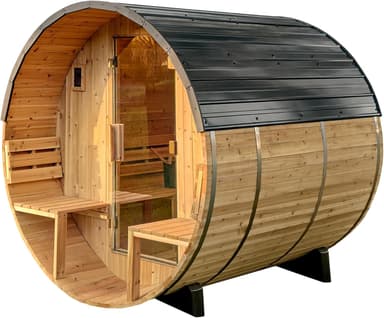
Backyard Discovery Paxton 2-4 Person Cedar Barrel Sauna
- 9kW heater reaches 170°F roughly 50% faster than budget competitors
- Barrel design eliminates dead zones with superior natural heat convection
- HDPE cradles and galvanized steel roof built for genuine year-round outdoor use
Wood Species Compared - Cedar, Spruce, Hemlock, Thermowood
Wood species is not a marketing variable - it's a functional specification that determines how your sauna performs thermally, how it smells, how it ages, and how long it lasts without significant maintenance. The four species you'll encounter in the barrel sauna market each have specific properties worth understanding.
Western Red Cedar
Western red cedar (Thuja plicata) is the dominant species in the premium barrel sauna market and for good reason. It has the best combination of properties for sauna use: low density (meaning it heats up quickly without storing excessive heat in the walls), natural rot resistance from aromatic oils, dimensional stability under repeated thermal cycling, and a scent profile that most users find pleasant and genuinely relaxing.
The aromatic oils in cedar also function as a natural antimicrobial and insect deterrent, which matters in an outdoor structure exposed to moisture. Brands like Nootka Saunas and Forest Cooperage use Western red cedar exclusively in their premium lines, and it's the benchmark against which other species are measured. For a deeper look at cedar-specific options, see our guide to cedar barrel saunas.
The primary disadvantage of Western red cedar is cost - it's among the more expensive softwood species available in North America, and that cost flows through to retail pricing. A well-constructed Western red cedar barrel sauna typically starts around $4,000-$5,000 for a 4-person model.
Nordic Spruce
Nordic spruce (Picea abies) is the traditional Scandinavian sauna wood and the primary material in European-manufactured barrel saunas from brands like Finnmark. It has slightly higher density than cedar, which means marginally slower heat-up times and slightly higher wall heat retention - a property some sauna enthusiasts prefer because it produces a more stable heat profile once temperature is reached.
Finnmark's use of 40mm thick Nordic thermo-spruce walls represents best-practice construction for this species. The thermal modification process (heating the wood to 180-230°C in a low-oxygen environment) dramatically improves spruce's moisture resistance, reduces its tendency to check and crack under thermal cycling, and darkens the color to a rich brown that many buyers find aesthetically superior to raw spruce.
Raw (unmodified) spruce in thin walls - a cost-cutting practice common in budget models - is the least durable configuration. It will grey, check, and potentially mold within three to five years in wet climates without careful maintenance.
Hemlock
Western hemlock (Tsuga heterophylla) occupies the value tier of the barrel sauna market and is used extensively by Almost Heaven Saunas and by the Smartmak product line. It's less aromatic than cedar, slightly higher in density, and in its natural state has lower rot resistance. However, when thermally modified, hemlock performs significantly better - Almost Heaven's thermowood hemlock option is worth the premium over their standard hemlock if you're in a wet climate.
Hemlock has no natural tannins that can bleed onto towels or benches, which some users prefer over cedar. Its neutral scent profile is actually an advantage for users sensitive to aromatic compounds. The primary tradeoff is longevity: an unmodified hemlock barrel in a wet Pacific Northwest climate will require more maintenance than cedar to achieve comparable service life.
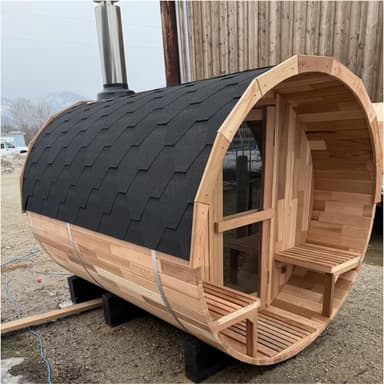
Smartmak 2-10 Person Canadian Hemlock Barrel Sauna
- Barrel shape genuinely improves heat distribution compared to box saunas
- Real red cedar and hemlock construction should last 15-plus years with care
- ETL-certified heater hits 195°F - legitimately hot for authentic steam sessions
Thermowood - The Technical Explanation
Thermal modification (thermowood process) is not a species but a treatment that can be applied to multiple wood species, most commonly spruce and hemlock in the sauna market. The process involves heating kiln-dried wood to 185-230°C in a steam/low-oxygen environment, which causes the hemicellulose component of the wood to break down and the cell structure to become hydrophobic - resistant to water absorption.
The practical results are significant: thermowood absorbs roughly 50% less moisture than untreated wood of the same species, resists biological degradation (rot, mold, insects) far better, and demonstrates dramatically improved dimensional stability under thermal cycling. The tradeoff is that the modification process slightly reduces wood strength, making thermowood boards marginally more brittle than untreated boards of the same species. For sauna stave construction, this is rarely a structural concern, but it does mean thermowood boards require care during installation to avoid cracking at fastener points.
| Wood Species | Rot Resistance | Thermal Stability | Aromatic Quality | Relative Cost | Recommended For |
|---|---|---|---|---|---|
| Western Red Cedar | Excellent (natural) | Very Good | Strong/Pleasant | High | Any climate, premium builds |
| Nordic Thermo-Spruce | Very Good (modified) | Excellent | Mild | Medium-High | European-style, year-round use |
| Hemlock (raw) | Fair | Fair | Neutral | Low | Dry climates, budget builds |
| Thermowood Hemlock | Very Good | Excellent | Neutral | Medium | Wet climates, value tier |
| Untreated Spruce | Poor-Fair | Fair | Mild | Low | Avoid outdoors |
Heater Types - Electric vs Wood-Burning vs Infrared
Heater selection is arguably the most consequential specification decision after size. It determines heat-up time, session character, operating cost, installation complexity, and whether your sauna delivers the specific physiological benefits documented in the clinical literature.
The Science of Sauna Temperature
Before comparing heater types, it's worth establishing what temperatures matter and why. The Finnish cohort research that produced the strongest longevity associations - including the 40% all-cause mortality reduction reported by Laukkanen et al. - was conducted on traditional Finnish sauna use at temperatures of 79-100°C (174-212°F) 1. The cardiovascular benefits, including improvements in vascular function and the anti-inflammatory effects from heat stress-induced heat shock proteins, appear to require sustained core body temperature elevation to approximately 38.5-39°C 2. This is critical context for the infrared debate discussed below.
Electric Heaters
Electric heaters are the most popular choice for residential barrel saunas in North America because they're convenient, controllable, and require no fuel storage or fire management. They heat via resistive elements embedded in or beneath sauna stones, which absorb and radiate heat while providing the thermal mass for producing löyly (steam) when water is poured over them.
For a 4-person barrel sauna, a 6-8 kW heater is the standard specification. A 6-person sauna requires 8-12 kW. Undersizing the heater for a given volume is a common mistake that results in sessions that never reach the 80-90°C range associated with health benefits, or that take 90+ minutes to achieve temperature.
Heat-up times for electric heaters in well-insulated barrels typically range from 30-60 minutes to reach 80°C, with premium designs like Nootka's (which benefit from their 24-gauge galvanized aluminum roofing reducing heat loss) reaching operating temperature in as little as 10-15 minutes. Electricity costs average $0.50-$1.50 per session depending on kilowattage, session length, and local rates.
For buyers who want electric, see the full category guide at electric heater saunas.
Wood-Burning Heaters
Wood-burning sauna stoves deliver the authentic Finnish sauna experience in a way no electric heater replicates. The heat quality is different - it's often described as "softer" because wood-burning stoves generate more radiant heat relative to convective heat, and the moisture dynamics of a wood-fired sauna differ from the more controlled environment of an electric heater.
The practical tradeoffs are real. Wood-burning stoves require:
- ●Active management (fire starting, stoking, ash removal)
- ●On-site wood storage
- ●No electrical infrastructure - an advantage for remote sites
- ●No thermostat - temperature is managed manually by fire intensity
- ●Longer prep time - typically 45-75 minutes to reach temperature
Heat-up times with wood-burning stoves depend heavily on wood species, moisture content of the fuel, and outdoor temperature. Finnmark's wood-burning barrel saunas specify 30-60 minutes to optimal temperature under standard conditions. In cold climates below -10°C, add 15-30 minutes.
For buyers interested in this option, the wood-burning saunas guide covers the top models in depth.
Infrared - An Honest Assessment
Infrared heaters are technically and experientially different from traditional sauna heaters, and this difference has meaningful implications for health outcomes. Infrared panels heat the body directly through electromagnetic radiation rather than heating the air first - the result is a much lower ambient air temperature (typically 45-60°C vs 80-100°C for traditional) while the body still absorbs significant heat.
The honest assessment: infrared sauna research is limited and uses different temperature protocols than the Finnish cohort studies. The mortality and cardiovascular data from Laukkanen et al. 1 and the vascular function improvements documented by Patrick and Johnson 2 were not conducted on infrared users. Whether infrared sessions at 50°C produce equivalent physiological effects to traditional sessions at 85°C is genuinely unknown. Some preliminary research on infrared is promising for specific applications (muscle recovery, certain pain conditions), but the evidence base is orders of magnitude smaller than for traditional high-temperature sauna.
Infrared heaters are simpler to install, draw less current, and require no water management. For buyers whose primary goal is heat-based relaxation rather than the specific cardiovascular and longevity benefits documented in the literature, infrared is a legitimate option. For buyers motivated by the health data, a traditional electric or wood-burning heater that achieves 80-100°C is the evidence-supported choice.
| Heater Type | Heat-Up Time | Target Temp | Operating Cost | Installation Complexity | Evidence Base |
|---|---|---|---|---|---|
| Electric (6-8 kW) | 30-60 min | 80-100°C | $0.50-$1.50/session | Moderate (requires circuit) | Strong 12 |
| Wood-Burning | 45-75 min | 80-100°C | Low (wood cost) | Simple (no electrical) | Strong 12 |
| Infrared | 10-15 min | 45-60°C | Low | Simple | Limited/Preliminary |
Wall Thickness and Construction Quality
Wall thickness is the specification buyers most commonly overlook because it doesn't show up prominently in marketing materials - but it's one of the most reliable proxies for overall construction quality and the primary determinant of thermal performance and longevity.
The 40mm Standard
The baseline for serious barrel sauna construction is 40mm (approximately 1.5 inch) stave thickness. Finnmark, which manufactures in Finland and ships to North America, uses 40mm Nordic thermo-spruce as their standard specification. This thickness provides adequate insulation for year-round use in most North American climates, sufficient structural mass for long-term dimensional stability, and enough depth for the stave tongue-and-groove joinery to hold effectively under repeated thermal cycling.
Budget models frequently use 28-32mm staves. The difference sounds small but has a compound effect: thinner walls lose heat faster (requiring more energy to maintain temperature and producing shorter usable sessions in cold weather), have less structural depth for joinery, and are more susceptible to checking and cracking over time. A 28mm barrel sauna in Minnesota winters will need supplemental heating or session curtailment when outdoor temperatures drop below -15°C.
For cold climates, 45-50mm walls are available from premium manufacturers and represent a meaningful upgrade for buyers in USDA zones 4 and below.
Finger-Jointed vs Full-Length Boards
This construction detail is a clear quality dividing line in the market. Full-length stave boards running from one end cap to the other provide structural integrity as a single unit and contain no adhesive. Finger-jointed boards - shorter pieces connected with interlocking cuts and glue - are a cost-reduction technique that introduces two problems in sauna environments: the adhesives used in finger joints can off-gas volatile organic compounds when heated, and the joints represent stress concentration points that are more likely to fail under repeated moisture and thermal cycling.
The presence of finger-jointed boards in a sauna is a dealbreaker for quality-conscious buyers. Reputable manufacturers specify this in their product descriptions because it's a selling point. If a manufacturer doesn't address joint type, ask specifically before purchasing.
Support Cradles and Ground Contact
How a barrel sauna contacts the ground is a moisture management question that directly affects longevity. Barrels resting directly on concrete or ground are vulnerable to moisture wicking up through the bottom staves - even cedar and thermowood will eventually degrade if the wood-ground interface stays wet.
Polymer (high-density polyethylene or similar) support cradles are the correct solution. They lift the barrel off the surface, allow airflow under the structure, resist moisture and rot themselves, and are adjustable for leveling on uneven ground. Metal cradles work adequately but can corrode and transfer cold to the barrel in winter. Treated lumber cradles are acceptable but introduce their own long-term maintenance requirements.
Roofing Materials
The top of a barrel sauna - a problem area because water runs toward it in rain events - should use roofing material, not raw wood. Nootka Saunas' 24-gauge galvanized aluminum roof system is the benchmark specification. It outperforms asphalt shingles (which are aesthetically poor on a curved surface and trap moisture), tin (which corrodes), and raw cedar (which degrades without annual maintenance). Some premium models use EPDM rubber roofing - a legitimate alternative with excellent longevity and flexibility.
Brand Comparison and Price Tiers
The barrel sauna market segments into three clear tiers based on manufacturing origin, materials, and construction standards. Understanding where each brand falls and why helps contextualize price differences.
Entry Tier - $1,500-$3,500
Entry-tier barrel saunas are typically manufactured in China or Eastern Europe and sold through Amazon, big-box home improvement stores, and generic e-commerce sites. They typically use hemlock or low-grade spruce in 28-32mm walls, include basic electric heaters (often undersized), and offer limited or no warranty on workmanship.
The Backyard Discovery Paxton (2-4 person, cedar) and the Smartmak hemlock line (2-10 person configurations) are representative of this segment. These products are suitable for buyers on a strict budget, in mild climates, or who want to test barrel sauna use before committing to a higher price point. Expect a service life of 5-10 years with attentive maintenance vs 15-25 years for premium construction.
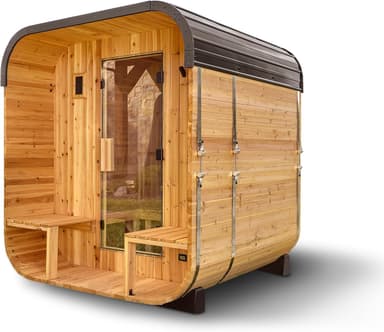
Backyard Discovery Lennon 2-4 Person Cedar Cube Sauna
- 9kW heater reaches temperature significantly faster than budget competitors
- 5-year warranty covers heater and hardware, not just the shell
- Wi-Fi preheat control adds genuine everyday convenience
Mid Tier - $3,500-$7,000
This is where the value proposition of barrel saunas becomes most compelling. Mid-tier products from brands like Almost Heaven Saunas (West Virginia-assembled), Forest Cooperage (Canadian-made, Western red cedar), and the lower end of the Finnmark lineup offer genuine quality materials and construction for a price accessible to most buyers.
Almost Heaven distinguishes itself with material flexibility - buyers can choose hemlock, red cedar, or thermally modified hemlock, and heater options are well-matched to sauna size. Forest Cooperage uses Western red cedar exclusively and offers a cleaner product, though with fewer configuration options. Wall thickness at this tier is typically 38-45mm, and workmanship warranties become meaningful (2-5 years).
Premium Tier - $7,000-$15,000+
Premium tier products from Nootka Saunas (Canadian), Finnmark's upper lines (Finnish manufactured), and custom builders using full-clear Western red cedar represent best-in-class construction. Nootka's proprietary 24-gauge galvanized aluminum roofing, their polymer cradle system, and their use of full-length (non-finger-jointed) cedar boards are specific features that justify the price premium for buyers who want a 20-30 year outdoor fixture rather than a 10-year product.
| Brand | Origin | Primary Wood | Wall Thickness | Price Range | Warranty |
|---|---|---|---|---|---|
| Smartmak | China | Hemlock | 28-32mm | $1,500-$3,500 | 1 year limited |
| Backyard Discovery | Assembled USA | Cedar/Hemlock | 30mm | $2,000-$4,000 | 1-2 years |
| Almost Heaven | USA | Cedar/Hemlock/Thermowood | 38mm | $3,500-$6,000 | 2-5 years |
| Forest Cooperage | Canada | Western Red Cedar | 40mm | $4,000-$7,000 | 5 years |
| Finnmark | Finland/Norway | Thermo-Spruce | 40mm | $4,500-$8,000 | 5 years |
| Nootka | Canada | Western Red Cedar | 44-50mm | $7,000-$15,000+ | Lifetime structural |
For a comprehensive rating of top models across all tiers, see the best barrel saunas guide.
Features Worth Paying For - And What to Skip
Not all premium features deliver proportional value, and not all entry-level omissions matter equally. After reviewing dozens of installations, here's an honest breakdown.
Worth Paying For
Changing room vestibule - A built-in changing room adds 2-3 feet to the barrel length and creates a thermal buffer between the outside and the sauna chamber. In cold climates, this buffer reduces heat loss when the door opens, provides a space to warm up before entering and cool down after, and prevents the shock of stepping directly from 90°C air to freezing outdoor air. This is a genuine functional upgrade, not aesthetic differentiation.
Interior lighting - A quality waterproof interior light with a warm color temperature (2700-3000K) meaningfully improves the experience. The sauna environment is fundamentally sensory, and harsh overhead lighting undermines the relaxation response. This is a low-cost option to add if it's not included.
Thermometer and hygrometer - Without these instruments you're guessing at both temperature and humidity, which means guessing at löyly timing and session safety. Quality analog versions are inexpensive and last decades. Any sauna offered without them should include them in the accessories package.
Exterior overhang/roof extension - An overhang over the door keeps rain out of the entry area and extends the life of the door frame. Models with flush barrel ends (no overhang) rely entirely on proper door sealing, which degrades over time.
Premium heater brand (Harvia, Huum, Tylo) - The heater is the sauna's heart. A quality sauna with a budget heater is a frustrating experience. Finnish heater brands Harvia, Huum, and Tylo have a multi-decade track record of reliability, even stone distribution, and precise thermostat performance. Upgrading to a name-brand heater is one of the highest-ROI decisions in sauna specification.
Not Worth the Premium
"Smart" WiFi controls - A sauna that takes 45 minutes to heat up does not require a smartphone app for scheduling. The convenience argument falls apart when you account for the complexity of maintaining IoT connectivity on an outdoor device exposed to moisture, heat, and temperature extremes. Standard timer/thermostat controls are more reliable and easier to replace.
Factory-applied exterior stain or sealant - You will need to re-apply exterior finish every 1-3 years regardless of what was factory-applied. Paying a premium for factory finish is paying for something you'll redo. Buy unfinished and apply your preferred treatment.
Built-in sound systems - Speakers and electronics in a high-humidity, high-temperature environment are a maintenance problem waiting to happen. Outdoor Bluetooth speakers placed near the sauna provide better sound at a fraction of the cost and survive the environment better.
Curved glass front panels - These look striking in product photography and perform adequately, but custom curved glass is expensive to replace when it chips or cracks. Standard door configurations with durable tempered glass side lites are more practical.
Foundation and Site Preparation
Site preparation is the step most buyers underinvest in, and the consequences are slow-moving but ultimately expensive. A barrel sauna placed on a poorly prepared site will experience accelerated degradation at the cradle contact points, potential moisture damage to the lower staves, and possibly structural settling that stresses the stave assembly.
Site Selection Criteria
Choose a site that:
- ●Has natural drainage or can be graded for positive drainage away from the barrel
- ●Receives some sun exposure - sunlight helps dry the barrel surface between sessions
- ●Is accessible from the house via a path that can be safely navigated in wet or icy conditions
- ●Is far enough from property lines to comply with local setback requirements (typically 5-10 feet)
- ●Has access to electrical service if using an electric heater (calculate wire run distance to the panel)
Proximity to a water source (garden hose access) is useful for maintenance and, if you're doing contrast therapy, for cold rinses. Consider the path from the sauna to a cold plunge, pool, or shower if contrast therapy is part of your intended practice.
Foundation Options
A 4-inch concrete pad is the most durable and level foundation for a barrel sauna. For a 10-foot barrel, a 12x8 foot pad provides the barrel footprint with perimeter clearance. Slope the pad 1/8 inch per foot away from the barrel to prevent water pooling. Cure time is 28 days before placing the barrel.
Compacted gravel (4-6 inches of 3/4 inch crushed stone over a weed barrier) is the preferred alternative for buyers who don't want to pour concrete. It's self-draining, adjustable for leveling, frost-resistant in most climates, and removable if you relocate the sauna. Use a level base layer of paver base or concrete pavers under the cradle points to prevent settlement.
Patio pavers are acceptable for mild climates and level sites. In freeze-thaw climates, individual pavers can heave and shift, requiring periodic releveling of the barrel.
Direct ground contact (placing the barrel on grass or soil) is the only foundation approach I advise against in all circumstances. Even with polymer cradles, the moisture environment at ground level will accelerate degradation of any wood that contacts it, and drainage is impossible to control.
For detailed installation guidance, see the barrel sauna installation guide.
Assembly - DIY vs Professional Installation
Most barrel saunas are designed for DIY assembly using basic hand tools, and most buyers with a solid weekend and a helper complete installation successfully. The relevant question is not whether you can assemble it yourself, but whether the specific model you're buying has support systems that make DIY realistic.
What DIY Requires
A typical 4-6 person barrel sauna assembly involves:
- ●Leveling and preparing the foundation (done before delivery)
- ●Setting the polymer cradles to the correct spacing for your barrel diameter
- ●Assembling the end cap frames (typically pre-cut, fastened with provided hardware)
- ●Installing the staves around the end caps, tightening the metal hoops progressively
- ●Installing interior benches (pre-cut, assemble with provided hardware)
- ●Installing the heater and connecting it to the electrical supply
- ●Installing door hardware, glass, and thermometer/hygrometer
- ●First fire-up/test heat cycle
Steps 1-6 can be completed by two adults with basic construction familiarity in 6-8 hours for a 4-person model. A 10-foot 8-person model may require a full day and three people for the stave assembly step. Step 6 - electrical connection for the heater - should be performed by a licensed electrician in all jurisdictions. This is not a DIY step even if you're comfortable with electrical work, because sauna heaters typically require a dedicated 240V circuit and the installation must be permitted in most areas.
When to Hire Professional Installers
Professional installation is worth considering when:
- ●Your site has significant grade changes requiring custom leveling
- ●The sauna is being integrated with a deck, pergola, or outbuilding
- ●You're installing a wood-burning heater that requires a chimney through a structure
- ●The manufacturer requires professional installation to maintain the warranty (rare but worth checking)
- ●You lack a second person to assist with stave assembly on a large model
Professional installation costs vary widely by region but typically run $800-$2,500 for a complete site prep and assembly service. Add electrical permits and licensed electrician costs separately.
Documentation Quality as a Proxy for Brand Quality
Assembly instruction quality is an underrated signal of overall product quality. Brands that invest in clear, step-by-step documentation with accurate part counts and real photographs (not just exploded 3D diagrams) typically invest equivalently in manufacturing tolerance and part quality. When evaluating brands, download or request their assembly manual before purchasing. Vague instructions, missing torque specifications for hoop tightening, and generic hardware diagrams are warning signs.
Long-Term Costs and Maintenance
A barrel sauna is a 15-25 year investment if properly maintained, or a 5-10 year investment if it isn't. The annual maintenance regimen is straightforward but non-negotiable for longevity.
Operating Costs by Heater Type
For electric heaters, the annual operating cost calculation is straightforward: kWh consumed per session x sessions per year x local electricity rate.
A 6 kW heater running for 2 hours per session (heat-up plus bathing time) consumes 12 kWh. At the US average residential electricity rate of $0.12/kWh, that's $1.44 per session. For three sessions per week, that's roughly $225/year in electricity for the heater alone - not including exterior lighting, interior lighting, or any other electrical loads.
Wood-burning stoves have lower per-session fuel costs in most of North America if you have access to reasonably priced firewood. A typical session requires 3-5 pounds of hardwood, costing roughly $0.30-$0.80 per session if purchasing cord wood. However, wood storage, management, and the labor of fire starting should be factored into the total cost of ownership.
Annual Maintenance Schedule
Exterior wood treatment (every 1-2 years): Apply a UV-stable exterior oil or penetrating sealant designed for high-moisture environments. Superdeck, Sikkens, and Cabot make appropriate products. Budget $50-$100 in materials and 2-3 hours per application. Skip this step and you'll see graying and surface checking within 2-3 years on cedar, faster on spruce or hemlock.
Hoop tension check (annually): Metal hoops expand and contract with seasonal temperature changes and will require retightening annually, particularly after the first full year of thermal cycling. This is a 30-minute task requiring the specific
Sources and References
- Association Between Sauna Bathing and Fatal Cardiovascular Events
Laukkanen T, et al.. JAMA Internal Medicine, 2015. - Sauna use as a lifestyle practice to extend healthspan
Patrick RP, Johnson TL. Experimental Gerontology, 2021.
Frequently Asked Questions
To choose a barrel sauna, prioritize size and capacity based on the number of users and available space, such as 2-4 person models for small groups or 6-8 person for larger ones. Select high-quality materials like Western Red Cedar or Nordic Spruce with full-length boards (no finger joints), thick 40mm walls, and minimal fasteners for durability, heat retention, and rot resistance. Match the heater (electric for convenience or wood-burning for tradition) to the sauna's volume and usage frequency, and consider location, foundation with support cradles, and extras like porches.
Related Guides
Medical Disclaimer - This article is for informational purposes only and does not constitute medical advice. Consult a healthcare professional before beginning any sauna routine.