
Installation - 0 peer-reviewed sources
DIY Barrel Sauna Kit Build - A Contractor's Guide
Thinking about building your own barrel sauna? Jake Morrison has assembled over 150 sauna kits. Here is everything he has learned.
Written by Jake Morrison
Installation & DIY Expert
Reviewed by Erik Nordgren
Senior Sauna Reviewer
Building a barrel sauna from a kit is one of the most satisfying weekend projects a contractor or serious DIYer can tackle - and one of the most frequently botched. After analyzing dozens of documented builds, reviewing manufacturer assembly manuals, and talking to builders who've assembled everything from budget cedar kits to premium Canadian hemlock units, I've found that the difference between a sauna that seals perfectly and one that leaks heat, warps within a year, or develops structural problems almost always comes down to the same handful of decisions made in the first few hours of assembly.
The barrel shape isn't decorative. The curved stave design creates a self-reinforcing structure where compression forces from the metal banding actually increase wood-to-wood seal integrity as the wood expands with heat and humidity. That physics works in your favor - but only if you understand the assembly sequence. Skip steps, rush the band tensioning, or ignore foundation leveling, and the same forces that should seal your sauna will instead pull staves out of alignment permanently.
This guide covers every stage of how to build a barrel sauna kit from the foundation prep through final electrical hookup - written for people who've swung a hammer before but may never have assembled a cooperage-style structure. Whether you're pricing out a first build or troubleshooting a partially assembled unit sitting in your driveway, you'll find specific numbers, honest timelines, and the kind of practical detail that most manufacturer instructions skip entirely.
Kit vs Pre-Built - The Real Cost Difference
The marketing materials for pre-built barrel saunas make them look like a simple delivery-and-plug-in proposition. The reality involves freight logistics, crane rentals in some cases, site access requirements, and a price premium that can range from 40% to over 100% above a comparable kit.
Let's put actual numbers on this. A quality 6-person pre-built cedar barrel sauna delivered and placed typically runs $8,000 to $15,000 depending on wood species, heater package, and regional freight costs. A comparable kit - same dimensions, same wood species - lands between $3,500 and $7,000 before your labor. One extensively documented DIY build using 43 pieces of 1"x6"x12' western red cedar S4S lumber came in at approximately $3,000 complete, including the heater, which represents roughly 25-35% of what the pre-built equivalent would cost delivered.
Where the Savings Actually Come From
The cost gap isn't just about manufacturer markup. Pre-built units require specialized transportation - most won't fit in a standard enclosed trailer. They need a delivery window with forklift or crane access if your yard has gates or obstacles. Many customers discover too late that their 8-foot barrel sauna won't clear a standard 6-foot gate without a crane lift, adding $300-$800 in unexpected costs.
Kit saunas arrive flat-packed on standard pallets. All the lumber ships at dimensional thickness, the metal banding rolls flat, and the end frames either ship as cut panels or as pre-assembled rings depending on kit quality. Two people with a pickup truck can collect most kit deliveries without specialized equipment.
| Factor | Kit Build | Pre-Built Unit |
|---|---|---|
| Average 6-person unit cost | $3,500-$7,000 | $8,000-$15,000 |
| Transportation requirement | Standard pallet/truck | Flatbed + placement equipment |
| Site access flexibility | High - components carried by hand | Low - requires crane/forklift in tight spaces |
| Labor investment | 2-3 days (experienced) | None |
| Customization options | High | Limited to manufacturer specs |
| Warranty complexity | Parts warranty | Full unit warranty |
| Foundation flexibility | Builder's choice | Often requires specific prep |
The honest tradeoff is your time. A first-time builder should budget 3-4 full days of active work plus a day of foundation prep. An experienced contractor who's assembled barrel saunas before can move through a standard kit in 2-3 days with one helper. If your hourly rate as a contractor is $75-$100, that's $1,200-$2,400 in implied labor cost - still well below the pre-built premium in most cases, and you end up knowing exactly how every joint in your structure works.
For anyone still weighing options, the how to choose a barrel sauna guide covers the full decision framework including wood species, heater types, and size selection in detail.
What Comes in a Barrel Sauna Kit
Kit quality varies enormously, and the contents list is your first diagnostic tool for assessing what you're actually getting. Premium kits pre-cut every component to final dimension. Budget kits sometimes ship lumber that requires additional ripping, dadoing, or drilling on-site - which is fine if you have the tools and expect it, disastrous if you don't.
Structural Components
The staves are the primary structural element - the curved wall boards that stack side by side to form the barrel. A standard 2 to 2.5 meter diameter barrel requires 30 to 40 staves at 70-92mm thickness. Most quality kits use western red cedar or Canadian hemlock for staves, with cedar being the preferred choice for its natural rot resistance, dimensional stability in humidity cycles, and characteristic aroma that adds to the sauna experience. If you're specifically interested in cedar construction options, the cedar barrel saunas category covers the leading models in detail.
End frames (also called end rings or cradle rings) come either pre-assembled or as interlocking segments you assemble on-site. Pre-assembled rings simplify positioning but are harder to transport. Segmented rings require careful alignment but ship flat. The floor assembly typically consists of treated timber joists and tongue-and-groove floorboards with 3-5mm drainage gaps.
Hardware and Sealing Components
Every kit should include stainless steel banding and tensioners. This is non-negotiable - galvanized or zinc-coated banding will corrode in the temperature and humidity environment of a sauna exterior, and replacement requires significant disassembly. Count the bands before you start: most 6-8 foot barrels use 4 bands, 10-12 foot barrels use 6. Premium kits include one extra band.
High-temperature silicone sealant rated for at least 500°F (260°C) should be included or specified. Standard household silicone fails at sustained sauna temperatures. The door unit - typically 8mm tempered glass in a cedar or hemlock frame - should arrive pre-hung in most quality kits, which eliminates the most technically demanding installation step. Window inserts, ventilation grilles, bench hardware, and interior lighting rough-in components round out a complete kit.
What's Never Included
No kit includes the heater connection wiring (licensed electrician required for electric units), chimney pipe for wood-burning installations, concrete for your foundation, or any fasteners for securing the unit to the foundation. Many budget kits also exclude interior benches, making the "complete kit" claim somewhat misleading. Always read the components list against this checklist before purchasing.
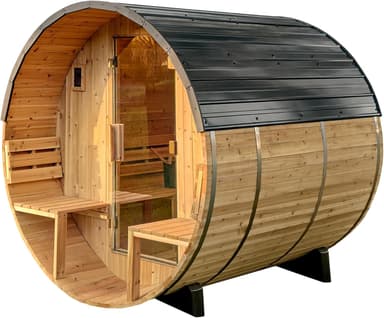
Backyard Discovery Paxton 2-4 Person Cedar Barrel Sauna
- 9kW heater reaches 170°F roughly 50% faster than budget competitors
- Barrel design eliminates dead zones with superior natural heat convection
- HDPE cradles and galvanized steel roof built for genuine year-round outdoor use
Tools You Actually Need
The tool list for barrel sauna assembly is shorter than most contractors expect - the cooperage design means you're assembling pre-machined components rather than doing finish carpentry work. That said, having the wrong tools or missing a critical one creates specific problems at specific assembly stages.
Essential Tools
A rubber mallet is the single most important specialized tool for this job. You'll use it to tap staves into position without splitting the tongue-and-groove edges. Metal hammers damage the wood compression surfaces that create your airtight seal - this isn't a suggestion to be gentle, it's structural. The fit between staves relies on undamaged edge geometry.
A level with at least 4-foot length is essential at foundation stage and again when positioning cradle bases. A short torpedo level won't catch the compound leveling errors that cause stave alignment problems 20 staves in. A measuring tape, speed square, and chalk line cover your layout work.
Power tools: an electric drill with a full bit set handles pilot holes, hardware installation, and bench anchoring. A circular saw handles any trim cuts if your site requires length adjustment. A jigsaw is necessary for cutting the vent openings, door opening adjustments, and any penetrations for electrical conduit or stovepipe. If your kit doesn't include pre-drilled band holes in the end frames, a 1/2" bit handles that.
Tools for Band Tensioning
Standard kits include a banding tool with the hardware, but if yours doesn't, a come-along or ratchet strap can provide adequate tension for initial positioning. You'll also want heavy C-clamps (minimum 4, preferably 6-8) to hold staves in position during the progressive assembly sequence before final banding.
| Tool | Purpose | Critical? |
|---|---|---|
| Rubber mallet | Stave positioning | Yes - no substitutes |
| 4'+ level | Foundation and frame leveling | Yes |
| Electric drill | Pilot holes, hardware | Yes |
| Circular saw | Length trim cuts | Situational |
| Jigsaw | Vent/penetration cuts | Yes |
| C-clamps (6-8) | Temporary stave positioning | Yes |
| Come-along / ratchet strap | Supplemental band tension | Situational |
| Banding tensioner | Final band tightening | Yes (usually included) |
| Chalk line | Layout marking | Yes |
| Speed square | Frame alignment | Yes |
| Safety glasses, gloves | General protection | Always |
One tool I've seen builders skip and regret: a laser level. If you're building on anything other than a freshly poured flat slab, a laser level speeds up cradle positioning from 45 minutes of shimming and guessing to about 10 minutes. The $30 budget models work fine for this application.
Assembly Timeline - Realistic Expectations
Every manufacturer's instruction sheet underestimates assembly time. "One weekend" is technically possible for an experienced team on a favorable site, but planning your project around that estimate sets you up for rushed decisions at the worst possible moments - specifically during stave alignment and band tensioning where patience directly determines outcome quality.
Realistic Schedule by Experience Level
Experienced contractor with one helper:
- ●Foundation prep and cure time: 1 day (plus 24-48 hour concrete cure)
- ●Cradle and floor assembly: 3-4 hours
- ●Stave installation and preliminary banding: 5-6 hours
- ●Door, window, vent rough-in: 2-3 hours
- ●Bench installation, interior finishing: 2-3 hours
- ●Heater installation and electrical rough-in: 2-4 hours
- ●Roof and exterior weatherproofing: 2-3 hours
- ●Total active build: 16-23 hours over 2-3 days
First-time builder with one helper:
- ●Foundation prep and cure: 1-2 days
- ●Total active build: 24-35 hours over 3-5 days
The concrete cure window is fixed regardless of experience level. Trying to build on partially cured concrete causes leveling errors that propagate through every subsequent stage. Plan your foundation pour at minimum 48 hours before cradle placement, 72 hours is better in cooler weather.
Weather is a real scheduling variable. Assembling staves in rain creates temporary swelling that produces false-tight fits - the wood contracts once dry and bands go slack. Cold below 40°F makes silicone sealant cure poorly. The ideal build window is 50-80°F with low humidity, which in most of North America means late spring or early fall.
Step-by-Step Assembly Process
This sequence reflects the professional assembly order that prevents the most common structural errors. Deviating from this order is possible, but each step is designed so that what you've just completed supports the next operation.
Step 1 - Foundation Preparation
Mark your footprint 30cm larger than your barrel's planned diameter in all directions. This clearance allows access for band tensioning and future maintenance. Remove topsoil to 15-20cm depth and compact the base with a plate compactor or hand tamper. Pour a 10-15cm concrete slab, or as an alternative for lighter kits, set six 16-inch square patio pavers at the cradle support points.
The paver approach is faster and fully reversible, but it demands precise leveling - each paver must be level individually and all six must be coplanar with each other. This is where the laser level earns its cost. Any single paver more than 3mm high or low creates a cradle rock that translates to stave misalignment.
Step 2 - Cradle Base Assembly
Most kits ship two semi-circular cradle assemblies - the structures that hold the barrel off the ground and set its orientation. Assemble these per manufacturer instructions, then position them at the correct spacing (specified in your kit manual - typically 1/4 and 3/4 of barrel length from each end). Level each cradle independently, then check that they're level relative to each other with a long straightedge or the laser.
Step 3 - Floor Frame Installation
Place the floor joists across the cradles. These treated timbers establish your interior floor plane and provide the attachment surface for floorboards. Install with 3-5mm gaps between floorboards - this is drainage spacing, not sloppiness. Sauna floors take significant water from foot traffic and cleaning, and standing water against solid wood accelerates rot even in cedar.
Step 4 - End Frame Positioning
Stand your end frames (or assemble segmented rings at this stage) at each end of the cradle system. Most kits have a temporary support system - typically wooden spreader bars - that holds end frames vertical while you add staves. Get these plumb in both axes before touching a single stave.
Step 5 - First Stave Installation
Start with the bottom stave - in most kits, this is a slightly wider piece that establishes the floor-to-wall transition. Set it in the bottom position between end frames and verify it's centered. From here, you'll work symmetrically outward in both directions, not spiraling around. The rubber mallet comes into continuous use from this point forward.
Step 6 - Progressive Stave Addition with Temporary Securing
Add staves in pairs, one each side working toward the top. Every three staves, drive a single screw through a temporary ledger board to hold position. This is the step where patience determines outcome - rushing stave placement creates micro-gaps that the banding can't fully close. Each stave should be hand-pressed firmly into its neighbor before the mallet contact.
Step 7 - Band Placement and Initial Tensioning
Once roughly 2/3 of the staves are in place, slide the metal bands over the assembly (this is much easier before the barrel is fully closed at the top). Position bands at the marked locations from your end frames. Apply light tension - enough to hold everything in position, not final tension. Add remaining staves. At full stave count, apply progressive band tension following the tensioning section below.
Stave Alignment and Band Tensioning
This is the section that determines whether your barrel sauna performs like a precision instrument or leaks heat like a sieve. It's also where I see the most consequential mistakes from builders who've done everything else correctly.
Pre-Tensioning Alignment Check
Before applying significant band tension, sight down the barrel from one end. Every stave edge should be flush with its neighbors at both the interior and exterior face. Any stave that protrudes inward or outward at this stage will be locked in that position by final tensioning and cannot be corrected without full disassembly. Use the rubber mallet to dress any proud staves back into alignment before tensioning.
Check the barrel for "twist" by placing a straightedge across the top of the barrel at each end frame position. Both ends should present the same rotational position - if one end has the top seam at 12 o'clock and the other has it at 11:45, you have twist that needs correction before tensioning.
Progressive Tensioning Sequence
Apply tension in a cross pattern, not sequentially. For a 4-band barrel, this means: tension band 1 to 25%, tension band 4 to 25%, tension band 2 to 25%, tension band 3 to 25%. Then return to band 1 and advance all four to 50% in the same pattern. Continue to 75%, then final tension.
This cross-pattern prevents uneven compression that bows the barrel lengthwise. Sequential tensioning - fully tensioning each band before moving to the next - is the single most common mistake in barrel assembly, and it's extremely difficult to correct after the fact.
How Tight is Tight Enough
Final band tension should close all visible gaps between staves at the exterior surface. Press your palm firmly against a stave side - you should feel no flex or give. The gap tolerance at the interior surface is different: very slight visible gaps (hairline, under 0.5mm) are normal and will close with the first heating cycle as wood expands. Gaps you can insert a business card into are too large and indicate either a damaged stave edge or insufficient tension.
Temperature affects the wood's response to tensioning. In cold conditions (under 50°F), cedar stiffens and gaps may appear adequately closed but will open further as temperature drops further. Assemble in moderate temperatures when possible, and plan for one re-tensioning check after the first three heating sessions.
Door and Window Installation
The door opening is either pre-cut by the manufacturer or cut on-site following manufacturer templates. Pre-cut is significantly preferable - the router work required for a clean 8mm glass door rabbet is beyond most circular saws, and a poorly cut opening is visible every time you use the sauna.
Hanging the Door Frame
Most quality kits include pre-hung door assemblies where the glass is already set in the frame and the hinges are pre-mortised. You're installing the complete frame unit into the rough opening, not hanging a bare slab. This involves setting the frame, checking plumb (the barrel curves - your level reads against the interior face of the opening, not the stave exterior), shimming as needed, and securing with the provided fasteners.
The critical measurement is frame reveal - the distance from the door frame's outer face to the stave's exterior face should be consistent around the entire opening perimeter. Inconsistent reveal indicates the opening isn't square to the barrel's axis, which causes the door to bind or gap unevenly at the seal.
Window Installation
Barrel sauna windows are typically fixed units - 8mm tempered glass is standard - that slide into pre-routed channels in the stave assembly. The channel must be clean and free of sawdust before installation. Apply a thin bead of high-temperature silicone sealant (rated 500°F minimum) to the channel, set the glass, and secure the stop molding. Don't fully cure the silicone before checking that the glass is level and properly seated - you have about 20-30 minutes of working time.
Ventilation Openings
Cut vent openings with the jigsaw after stave installation, following the template in your kit instructions. The standard placement is one lower vent near floor level (fresh air intake) and one upper vent near the peak or in the end wall (exhaust). This creates convective airflow that prevents CO buildup in wood-burning installations and maintains the air quality that makes the sauna comfortable. Never skip or block the lower intake vent - it's both a comfort issue and a safety requirement.
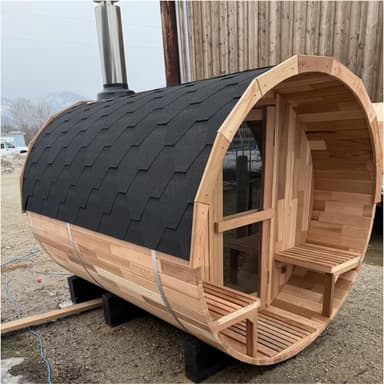
Smartmak 2-10 Person Canadian Hemlock Barrel Sauna
- Barrel shape genuinely improves heat distribution compared to box saunas
- Real red cedar and hemlock construction should last 15-plus years with care
- ETL-certified heater hits 195°F - legitimately hot for authentic steam sessions
Heater Placement and Connection
Heater selection and placement are the two variables that most directly determine your sauna's performance - more than wood species, more than insulation, more than bench layout. Getting this wrong is expensive and sometimes dangerous.
Sizing the Heater
The standard calculation for barrel sauna heaters is 1kW per 45 cubic feet (approximately 1.27 cubic meters) of interior volume. A 6-foot by 6-foot diameter barrel with end walls has roughly 170 cubic feet of interior space, suggesting a 3.5-4kW heater minimum. Most builders size up one step - a 4.5-6kW unit in this space reaches target temperature (180-195°F / 82-90°C) faster and maintains it with less cycling. Undersized heaters run continuously, stress the heating elements, and never fully heat the stones for proper löyly steam response.
For wood-burning installations, wood-burning saunas covers the specific models designed for barrel installation with their heat output ratings. For electric installations, electric heater saunas provides a comparable reference.
Clearance Requirements
This is where cutting corners creates genuine fire risk. Wood-burning stoves require minimum clearances to combustible surfaces on all sides - typically 12 inches to walls and 18 inches to ceiling for most units, though specific stove certifications may specify different values. Check your stove's installation manual, not this guide, for the exact clearances required for your specific unit.
Electric heaters have smaller clearance requirements but still need minimum distances from benches, walls, and anything a user might contact. The NEC and your local jurisdiction's electrical code specify these minimums. Having a licensed electrician review your heater placement before finalizing the interior layout costs an hour of their time and prevents expensive rework.
Electrical Connection Requirements
Electric heater installation requires a dedicated circuit, proper grounding, and in most US jurisdictions, a GFCI breaker for any electrical installation in a wet location - which a sauna legally qualifies as. This is not a DIY gray area in most jurisdictions. The electrical rough-in (running conduit, pulling wire to the junction box) can be done by the builder; the actual heater connection and panel work requires a licensed electrician in most states and all Canadian provinces.
| Heater Type | Installation Complexity | Clearance Requirements | Ongoing Fuel Cost | User Involvement |
|---|---|---|---|---|
| Electric 240V | Moderate (electrician required) | Lower | Higher (electricity) | Minimal - dial/timer |
| Wood-burning | High (chimney + fire clearances) | Higher | Lower (firewood) | Active - fire management |
| Propane | Moderate-High (gas line) | Moderate | Moderate | Minimal |
Roof and Weatherproofing
The barrel shape is self-draining for rain, which is one of its practical advantages over traditional rectangular sauna buildings. But "self-draining" doesn't mean "waterproof without treatment," and the end walls, door frame perimeter, and stave joints all require specific weatherproofing attention.
End Wall Sealing
The end walls - typically tongue-and-groove cedar panels assembled in the circular end frames - are the primary water vulnerability in a barrel sauna. The joints between end panels and the end frame ring must be sealed with exterior-grade, UV-stable sealant. Silicone works, but many builders prefer a flexible polyurethane sealant for exterior end walls because it accepts stain or paint while silicone doesn't, giving you more finishing options.
The bottom of each end wall where it meets the cradle is the single most common rot initiation point I've observed in barrel saunas that have been installed for 3-5 years. Water that runs down the end wall exterior pools here. Apply a continuous bead of sealant at this joint and inspect it annually.
Rooftop Treatment
The curved exterior of the barrel needs periodic treatment to maintain wood integrity and appearance. Bare cedar weathers to a gray color within 2-3 seasons - which is acceptable aesthetically and doesn't compromise structural integrity, but the wood does benefit from a UV-blocking exterior treatment every 2-3 years to prevent surface checking.
Many builders add a rain canopy or pergola over the barrel sauna, especially in high-rainfall climates. This dramatically reduces weathering rate and keeps the entry area usable in rain. If you're building for an outdoor barrel sauna installation in the Pacific Northwest or similar high-precipitation zones, budget for this addition.
Band Protection
Stainless steel bands are inherently corrosion-resistant but benefit from an annual inspection and light application of a metal protectant at the tensioner hardware. The tensioner mechanism - particularly the bolt threads - is the most corrosion-vulnerable component in the entire assembly. A seized tensioner bolt means you can't re-tension the bands after seasonal wood movement without cutting the band, which means full replacement.
Common Assembly Mistakes
After analyzing dozens of documented builds and the repair histories that follow them, the failure patterns are consistent. Most problems trace to the same handful of decisions.
Skipping the Foundation Level Check
The single most consequential error is an out-of-level foundation. A cradle system that's 5mm out of level in 6 feet creates a barrel that's visibly tilted, but more importantly, it creates uneven stave compression where one side is under more tension than the other. This leads to premature gap opening on the low-tension side and possible band slip on the high-tension side. Spend whatever time it takes to get the foundation right before touching a stave.
Sequential Band Tensioning
Already covered in the tensioning section, but worth repeating here because it's so common: tensioning bands sequentially rather than using a progressive cross-pattern bow the barrel structure. This mistake is essentially invisible until you heat the sauna and watch gaps open non-uniformly.
Using the Wrong Sealant
Standard silicone from the hardware store has a temperature rating around 250-300°F (121-149°C). Interior sauna surfaces reach 180-195°F regularly and can exceed that near the heater. Thermal cycling causes standard silicone to harden, crack, and lose adhesion within 1-2 seasons. Use only high-temperature silicone rated for 500°F+ on any interior joints.
Ignoring Stave Organization
Staves that look identical often aren't. Most manufacturers machine subtle taper variations into individual staves to account for the geometry change from the flat bottom section to the curved sides. Mixing these up doesn't make assembly impossible, but it creates micro-gaps at the stave joints that are difficult to close with normal band tension. Sort and label all staves before assembly starts, following the manufacturer's numbering system.
Installing Benches Before Checking Clearances
Interior bench height and distance from the heater are regulated in some jurisdictions and affect safety in all of them. Install the heater and verify all clearances before final bench installation. A bench that's 8 inches too close to the heater can't be easily repositioned after it's anchored to curved walls.
Neglecting Drainage
Sauna floors absorb significant moisture during use and cleaning. Floor boards installed without adequate gaps (minimum 3-5mm) trap water and develop rot within 2-3 years even in rot-resistant cedar. Some builders apply a clear tung oil or sauna-specific floor treatment to the underside of floorboards before installation to reduce moisture absorption at the most vulnerable surface.
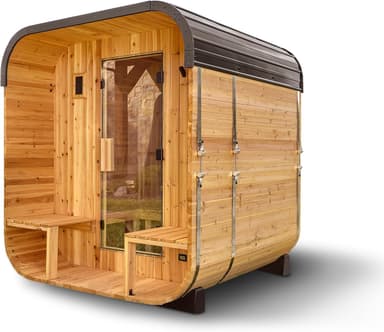
Backyard Discovery Lennon 2-4 Person Cedar Cube Sauna
- 9kW heater reaches temperature significantly faster than budget competitors
- 5-year warranty covers heater and hardware, not just the shell
- Wi-Fi preheat control adds genuine everyday convenience
When to Call a Professional
This guide is written for capable contractors and serious DIYers, but there are specific stages where professional involvement isn't just recommended - it's required by code or genuinely safety-critical.
Electrical Work
The heater connection, panel work, and GFCI circuit installation for electric saunas requires a licensed electrician in virtually every North American jurisdiction. This isn't a situation where you can check the work yourself and verify it's correct - the consequences of improper grounding or protection in a wet heat environment include electrocution. Budget $300-$600 for an electrician to complete the connection and provide the documentation your homeowner's insurance will want.
Permits and Inspections
Many jurisdictions require a building permit for permanent outdoor structures including barrel saunas. The threshold varies - some require permits for any structure over 100 square feet, others at 200 square feet, some exempt detached accessory structures entirely. Check with your local building department before starting. Operating an unpermitted structure that's discovered during a home sale creates significant legal complications.
Wood-burning sauna stoves may require a separate fire clearance inspection. This is jurisdictionally variable but common in areas with fire risk management programs. Your local fire marshal's office can clarify requirements in 10 minutes.
Structural Concerns
If your assembled barrel develops significant gap patterns that don't respond to re-tensioning, or if you observe cracking in stave edges during assembly, stop and contact the manufacturer before proceeding. Stave cracks during assembly indicate either a materials defect or an assembly error that requires diagnosis before the structure is complete. Continuing to add tension over a cracked stave risks catastrophic band failure.
For comprehensive guidance on all aspects of barrel sauna selection and installation, the barrel sauna installation guide covers the permitting and site preparation questions in detail. If you're new to sauna use entirely and working through the health benefits and protocol questions, sauna for beginners provides the foundational context.
Our Kit Recommendations
After working through the technical requirements this guide covers, here's how to map kit selection to your specific situation.
For First-Time Builders
First-time builders should prioritize kit completeness and pre-machined components over price. Every dollar saved on a budget kit that ships staves requiring additional cuts on-site costs multiple dollars in tool rental, time, and frustration. Look for kits that include pre-hung door assemblies, pre-drilled band locations in end frames, and a detailed assembly manual with actual photographs rather than line drawings.
The Backyard Discovery Paxton is engineered specifically for accessible DIY assembly with cedar construction and a 2-4 person capacity that's manageable for a solo build. It's a realistic starting point for first-time builders who want a kit designed with assembly simplicity as a design criterion.
Backyard Discovery Paxton 2-4 Person Cedar Barrel Sauna
- 9kW heater reaches 170°F roughly 50% faster than budget competitors
- Barrel design eliminates dead zones with superior natural heat convection
- HDPE cradles and galvanized steel roof built for genuine year-round outdoor use
For Larger Groups and Higher Frequency Use
If you're building for regular use by 4-6 people, or planning a higher-frequency heating schedule (daily rather than weekly), prioritize wall thickness and heater capacity over initial cost. Thicker staves (90mm+) maintain heat better, require less heater cycling, and hold dimensional stability better across years of thermal cycling. The Smartmak Canadian Hemlock barrel in the 2-10 person range handles this use case, with hemlock's density providing good thermal mass characteristics.
Smartmak 2-10 Person Canadian Hemlock Barrel Sauna
- Barrel shape genuinely improves heat distribution compared to box saunas
- Real red cedar and hemlock construction should last 15-plus years with care
- ETL-certified heater hits 195°F - legitimately hot for authentic steam sessions
Matching Kit to Climate
Climate determines several key specifications. In wet climates (Pacific Northwest, the Southeast, most of Canada), prioritize rot-resistant cedar over hemlock and plan for end wall weatherproofing to be a regular maintenance item. In freeze-thaw climates (the Upper Midwest, New England), band re-tensioning every spring after the freeze season is standard maintenance - plan for it. In arid climates, wood checking (surface cracking from low humidity) is the primary maintenance concern, and periodic sauna-safe oil treatment of exterior surfaces is worthwhile.
The best barrel saunas guide provides a comprehensive comparison of currently available kits across all these variables, updated regularly as new models and manufacturers enter the market.
Building a barrel sauna from a kit is genuinely achievable for any contractor comfortable with basic construction sequencing, but the physics of cooperage construction penalize shortcuts in specific and costly ways. The foundation must be level before a single stave goes up. The stave sorting must happen before assembly starts. The band tensioning must follow the cross-pattern sequence. The electrical connection must involve a licensed professional.
Get those four things right, and the barrel sauna's design does the rest. The self-reinforcing compression structure means that a properly assembled barrel actually becomes more airtight over the first several heating sessions as the wood expands into the stave gaps and the metal banding settles into its final position. Your finished structure should last 15-25 years with routine maintenance - annual band inspection, periodic wood treatment, and consistent drainage management.
The $3,000-$7,000 all-in cost for a quality kit build versus $8,000-$15,000 for a pre-built equivalent represents real money, and the knowledge of how your structure works - every joint, every band, every clearance dimension - is worth something too. When a stave gap opens three years from now because seasonal wood movement slacked a band, you'll know exactly what to do and exactly why it works. That's the real return on the time investment this build requires.
Frequently Asked Questions
To build a barrel sauna kit, start by preparing a level foundation with gravel or concrete, then unpack and assemble the base or floor frame, securing it with anchors. Next, install the wooden staves around the base using a rubber mallet for a snug fit, slide on steel bands and tighten them evenly to form the barrel shape, then add the pre-hung door, roof, benches, and heating system per manufacturer instructions (electric or wood-burning, with professional electrical work if needed). Always follow local codes for ventilation, fire safety, and sealing to prevent heat loss.
Related Guides
Medical Disclaimer - This article is for informational purposes only and does not constitute medical advice. Consult a healthcare professional before beginning any sauna routine.