
Buying Guide - 2 peer-reviewed sources
Barrel Sauna for Beginners - Everything You Need to Know
Never owned a sauna before? No problem. This guide covers everything from basic terminology to picking your first barrel sauna without overspending.
Written by Sarah Kowalski
Editor-in-Chief
Reviewed by Erik Nordgren
Senior Sauna Reviewer
If you've ever stepped into a barrel sauna for the first time, you already know the feeling - that immediate, enveloping warmth that seems to come from every direction at once, the scent of cedar filling your lungs before you've even settled onto the bench. Barrel saunas have become the gateway sauna for millions of North Americans, and for good reason: they're visually striking, relatively affordable as a first purchase, and they deliver a genuine Finnish-style heat experience without requiring a dedicated outbuilding or permanent construction.
But the decision to buy or use one deserves more than a glossy product photo and a five-star review. After analyzing 30+ studies on sauna physiology and reviewing hundreds of owner reports across forums, retail platforms, and manufacturer documentation, I've built this guide to give beginners a complete, honest picture - the real science behind what happens to your body at 170°F, the practical differences between a $5,000 kit and a $15,000 pre-assembled unit, and the specific mistakes that send first-time buyers back to square one within two years.
Whether you're considering your first session at a public facility or actively pricing out a backyard installation, every section below is designed to move you from curious to genuinely informed. Let's start at the foundation.
What Is a Barrel Sauna - The Basics
A barrel sauna is exactly what the name suggests - a sauna built in the shape of a horizontal cylinder, like a wine barrel scaled up to human proportions. The structural logic dates back centuries to cooperage (barrel-making), and the modern version translates that technique into outdoor wellness infrastructure. Milled staves - typically 2x4 planks of cedar, hemlock, or spruce - are fitted around circular end walls and drawn tight with galvanized or stainless steel hooping rings. The result is a self-reinforcing structure that requires no nails or adhesives in the primary assembly.
The Geometry and What It Means for Heat
The cylindrical geometry is both the barrel sauna's defining aesthetic feature and its most consequential engineering constraint. Because the walls curve, hot air naturally rises toward the apex of the cylinder - which, in a typical 7-foot diameter model, sits roughly 3.5 feet above bench level. This creates a pronounced top-to-bottom temperature gradient. In practical terms, the air near the ceiling can reach 180-200°F while the floor stays 60-120°F cooler. For a beginner lying on the lower bench, this means your head may be at 175°F while your feet experience something closer to 110°F.
This stratification contrasts with rectangular cabin saunas, where flat ceilings and consistent wall angles allow for more deliberate control of heat distribution through bench placement and ventilation positioning. It's not that barrel saunas are bad at heating - they're simply different, and understanding that difference shapes every decision from bench positioning to session length.
Materials and Construction Quality
The wood species matters more than most beginners realize. Western red cedar is the gold standard for barrel sauna staves: it's naturally rot-resistant, dimensionally stable through temperature swings, and releases a distinctive aromatic compound (thujaplicin) that contributes to the characteristic sauna scent. Canadian hemlock is denser, holds up better to repeated wetting, and is typically less expensive - a meaningful consideration when comparing kit prices. Spruce is common in European models and performs well but requires more diligent maintenance in wet climates.
Typical exterior dimensions for commercially available models run 6 to 8 feet in length and 6 to 7.5 feet in diameter. Interior usable space is significantly smaller than these numbers suggest - curved walls narrow effective bench width, and standing headroom rarely exceeds 6 feet even in larger models. A "4-person" designation from most manufacturers assumes seated occupants with close tolerance; realistically, 2-3 people use the space comfortably. The minimum healthy air volume per bather recommended by Finnish sauna standards is 105 cubic feet (3 cubic meters); many 4-person barrel models provide only 200-300 cubic feet of total interior volume, leaving little margin when fully occupied.
For an overview of top-rated models across price points, see our guide to the best barrel saunas.
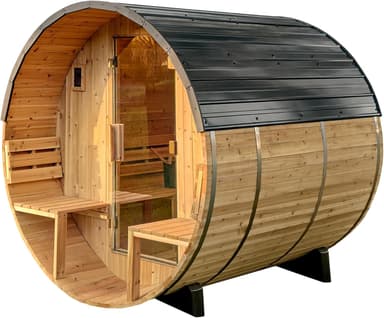
Backyard Discovery Paxton 2-4 Person Cedar Barrel Sauna
- 9kW heater reaches 170°F roughly 50% faster than budget competitors
- Barrel design eliminates dead zones with superior natural heat convection
- HDPE cradles and galvanized steel roof built for genuine year-round outdoor use
Types of Saunas Explained
Before you commit to any sauna purchase or routine, it helps to understand where barrel saunas sit within the broader world of sauna types. Each category differs meaningfully in temperature range, humidity, heat source, and physiological effect.
Finnish Traditional Sauna
The Finnish sauna - which the barrel sauna closely mimics - operates at 160-212°F (70-100°C) with relative humidity between 10-20% in dry phase, spiking to 40-60% when water is poured over the stones (löyly). This combination of high dry heat punctuated by steam bursts is the experience most people associate with "real" sauna. The heat source is a kiuas - a wood-burning or electric stove topped with a substantial mass of rocks that absorb and radiate heat. This is the modality studied in most sauna health research, including the landmark Laukkanen cardiovascular studies.
Infrared Sauna
Infrared saunas operate at much lower air temperatures - typically 120-150°F - and use electromagnetic radiation to heat body tissue directly rather than heating the air first. Proponents argue this penetrates tissue more deeply; critics note that the lower ambient temperature produces a categorically different physiological response than traditional sauna. The research base for infrared is thinner and more mixed than for traditional Finnish sauna. For beginners who are heat-sensitive or have cardiovascular concerns, infrared may represent a gentler entry point, but it is not interchangeable with traditional sauna in terms of effects.
Steam Room
Steam rooms maintain temperatures of 110-120°F with near-100% relative humidity. The wet heat feels more oppressive than dry sauna at the same temperature because humidity impairs the body's ability to cool itself through sweat evaporation. Steam rooms are common in commercial gym settings but are not typically what buyers mean when they discuss home sauna installation.
Smoke Sauna (Savusauna)
The oldest Finnish sauna tradition, the smoke sauna burns wood directly in a firebox without a chimney, allowing smoke to fill the room and heat the stones over several hours. The room is then ventilated before use. Smoke saunas produce exceptionally soft, humid heat and a distinctive smoky aroma that many Finns consider the pinnacle of sauna experience. They are not practical for most beginners given their complexity, build requirements, and the hours-long preparation process.
Comparison Table - Sauna Types at a Glance
| Type | Air Temp | Humidity | Heat-Up Time | Beginner-Friendly |
|---|---|---|---|---|
| Finnish Traditional (barrel) | 160-200°F | 10-60% | 30-45 min | Moderate |
| Infrared | 120-150°F | Low | 10-20 min | High |
| Steam Room | 110-120°F | ~100% | 10-15 min | Moderate |
| Smoke Sauna (Savusauna) | 150-185°F | 20-40% | 3-5 hours | Low |
| Hybrid (IR + traditional) | 140-170°F | Variable | 20-30 min | High |
How a Sauna Session Works
Understanding what actually happens during a sauna session - physiologically, mechanically, and socially - removes the anxiety that many beginners bring to their first experience and helps you use the sauna more effectively from day one.
The Physiological Sequence
Within the first two to three minutes of sitting in a 170°F sauna, your skin temperature begins rising rapidly. Core body temperature follows more slowly, typically increasing 1-2°F over a 10-20 minute session. The hypothalamus interprets the rising temperature as a systemic heat stress signal and triggers a cascade: cutaneous blood vessels dilate to move heat toward the skin surface, sweat glands activate (a healthy adult can produce 0.5-1 liter of sweat per hour in sauna conditions), and cardiac output increases to support the elevated circulatory demand. Heart rate commonly rises to 100-150 beats per minute - roughly equivalent to moderate aerobic exercise 1.
This cardiovascular response is central to why regular sauna use correlates with measurable health outcomes. The heat stress and subsequent cooling cycle constitutes a hormetic stimulus - controlled stress that prompts adaptive physiological responses. Research demonstrates a good safety profile for this type of exposure in healthy adults beginning a regular sauna practice 2.
The Löyly Ritual
Löyly (pronounced roughly "loy-loo") is the Finnish word for the steam created when water is ladled onto the hot stones of the kiuas. A proper löyly requires 2-4 ounces of water per pour - enough to produce a burst of steam without flooding the stone bed. The steam instantly raises perceived heat without dramatically changing the thermometer reading; experienced users describe the sensation as a wave of enveloping warmth moving across the upper body. Beginners often make the mistake of pouring too much water at once, which floods the stones, drops their surface temperature, and can cause them to crack over time if the heater is not designed for heavy water use.
The stones themselves matter - a heater loaded with 20-30 lbs of stones has a different thermal mass and steam quality than one loaded with 200-300 lbs. Larger commercial-grade kiuases with substantial stone loads produce a softer, more sustained steam; small electric heaters with minimal stone volume produce sharper, more aggressive steam that dissipates quickly.
Cooling and Recovery
The cool-down phase is not optional - it's physiologically essential and arguably the part where much of the benefit is generated. Stepping outside or into cold water after a session triggers vasoconstriction, rapidly drops skin and eventually core temperature, and stimulates norepinephrine release (associated with mood elevation and attention). Many experienced users practice contrast therapy: alternating between sauna and cold water immersion (50-60°F), repeating 2-4 cycles per session. Beginners should start with ambient air cooling or a cool (not ice-cold) shower before attempting full cold plunge contrast therapy.
Temperature and Duration for Beginners
The most common beginner mistake is treating the sauna like a test of endurance - staying in as long as possible to prove heat tolerance. This approach produces nausea, dizziness, and a negative first experience that can put people off sauna entirely. Evidence-based guidance points in a different direction.
Starting Temperature
For a first session, target 150-165°F (65-74°C). This is warm enough to produce meaningful sweating and cardiovascular response but low enough that most people can remain comfortable for 10-15 minutes. Many barrel saunas run hotter than their thermostat suggests due to the top-of-cylinder heat concentration, so position yourself on the lower bench initially and verify temperature with a quality sauna thermometer placed at sitting head height.
Duration Guidelines
The research that informs current recommendations - including Laukkanen et al.'s work published in Mayo Clinic Proceedings - suggests that sessions of 15-20 minutes at a time represent a meaningful dose for health benefits 1. For beginners, I recommend starting at 5-10 minutes per round and building from there over several weeks. The key signal is not the clock but your body: when you are sweating freely and beginning to feel genuine warmth saturation, that's your cue to exit - regardless of how much time has elapsed.
Building Up Over Time
| Week | Sessions/Week | Target Temp | Duration/Round | Rounds |
|---|---|---|---|---|
| 1-2 | 2 | 150-160°F | 5-8 min | 1 |
| 3-4 | 2-3 | 155-170°F | 8-12 min | 1-2 |
| 5-8 | 3 | 165-175°F | 12-15 min | 2 |
| 9-12 | 3-4 | 170-185°F | 15-20 min | 2-3 |
Evidence suggests 2-3 sessions per week is the minimum frequency to accumulate cardiovascular benefits, with studies showing measurable improvements in endothelial function and blood pressure regulation at this dose 1. Hussain and Cohen's comprehensive review confirmed that regular dry sauna bathing carries a good safety profile for healthy adults when standard precautions are observed 2.
The Cooling Interval
Between rounds, allow 5-15 minutes for cooling. During this time, your heart rate returns toward baseline, your body temperature normalizes, and you rehydrate. This interval is not wasted time - the oscillation between heat stress and recovery is the mechanism through which many adaptations occur. Rushing back in before adequate cooling increases cardiovascular load unnecessarily.
Health Benefits Overview
Sauna health research has accelerated substantially over the past two decades, largely driven by Finnish epidemiological studies with long follow-up periods and large sample sizes. Here's an honest account of what the evidence supports and where it remains preliminary.
Cardiovascular Health
The most strong evidence concerns cardiovascular outcomes. The Laukkanen group's prospective studies tracked Finnish men over 20 years and found dose-dependent reductions in cardiovascular mortality associated with sauna frequency 1. The proposed mechanisms - reduced arterial stiffness, improved endothelial function, blood pressure reduction through nitric oxide pathway activation, and autonomic nervous system conditioning - are physiologically plausible and supported by shorter-term mechanistic studies.
The same research found a 40% lower cardiovascular mortality rate among men who used sauna 4-7 times per week compared to once weekly. The effect was present even at 2-3 sessions per week, which is the frequency most beginners can realistically achieve 1. It is worth noting these studies were conducted in Finnish men with a specific cultural context around sauna use; direct extrapolation to other populations requires some caution.
Mental Health and Stress
Sauna use triggers measurable changes in neurotransmitter and neuromodulator levels. Beta-endorphins rise during heat exposure; norepinephrine spikes sharply during cold water immersion following sauna. Dynorphin, which normally produces dysphoric sensations during heat stress, paradoxically upregulates opioid receptor sensitivity in ways that enhance endorphin effect. The practical result, reported consistently by users and supported in preliminary research, is an elevated mood lasting several hours following a session. Hussain and Cohen's review highlighted stress reduction and improved mood as reliable subjective outcomes of regular sauna use 2.
Muscle Recovery
At temperatures above 160°F, heat shock proteins (HSPs) are upregulated in muscle tissue. HSPs act as molecular chaperones - they repair damaged proteins and support muscle fiber integrity under stress. For athletes and people engaged in regular resistance training, sauna use within a few hours post-exercise may accelerate recovery, reduce delayed onset muscle soreness (DOMS), and potentially support muscle protein synthesis. This is a biologically plausible mechanism with moderate supporting evidence, though the optimal timing and dose remain under investigation.
What the Evidence Does NOT Support
I want to be direct about the limits of current research. Sauna use is not a substitute for exercise - it produces cardiovascular stress but does not meaningfully build aerobic capacity in healthy individuals. Claims that sauna "detoxifies" the body by sweating out heavy metals are not well supported by the quantities involved; the liver and kidneys remain the primary detoxification organs. Weight lost during sauna is almost entirely water weight and returns with rehydration. Any protocol that has health claims should be discussed with a physician before starting, particularly for individuals with hypertension, cardiac conditions, or who are pregnant.
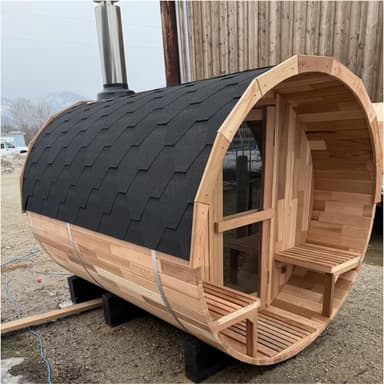
Smartmak 2-10 Person Canadian Hemlock Barrel Sauna
- Barrel shape genuinely improves heat distribution compared to box saunas
- Real red cedar and hemlock construction should last 15-plus years with care
- ETL-certified heater hits 195°F - legitimately hot for authentic steam sessions
Sauna Etiquette and Best Practices
Sauna culture has a deep set of norms - some rooted in safety, some in social tradition, and some in simple practicality. As a beginner, knowing these before your first session prevents awkward moments and, more importantly, protects you and others.
In Public or Commercial Saunas
Shower before entering - this is non-negotiable in Finnish tradition and remains the standard in serious sauna facilities worldwide. Sweat and body products in the sauna contaminate the benches and degrade the air quality for everyone. Wear a towel or sit on one; direct skin contact with wooden benches is acceptable in Finnish tradition but many commercial facilities require coverings for hygiene reasons. Keep conversation quiet and respect the meditative quality of the space. Never bring food, alcohol, or strong fragrances (cologne, lotion) into the sauna.
When managing löyly in a shared sauna, always ask other occupants before pouring. Not everyone shares the same heat tolerance, and a sudden steam burst can be physically overwhelming for someone already at their limit.
In Your Private Barrel Sauna
Private sauna creates more flexibility, but discipline still matters for safety. The never-alone rule deserves emphasis for beginners: until you know your personal heat tolerance well, have someone nearby (outdoors is fine) who can check on you if you've been in for longer than expected. Alcohol and sauna are a dangerous combination - vasodilation from both simultaneously can produce rapid blood pressure drops, fainting, and falls onto hot surfaces.
Keep the stove area clear of towels, wooden accessories, and clothing. Barrel saunas with wood-burning stoves require particular attention to chimney clearances (typically 16-36 inches from combustibles depending on stove design) and should never be left completely unattended while burning.
What to Wear and Bring
The gear list for sauna is blessedly short, but each item serves a specific purpose.
Clothing
In private or traditional Finnish saunas, no clothing is the norm - swimwear traps sweat against skin and impairs the body's cooling function. In shared commercial settings, a swimsuit or wrapped towel is standard and often required. Avoid synthetic fabrics entirely in high-temperature saunas - polyester and nylon retain heat against skin and can cause burns or discomfort at temperatures above 170°F. If you choose to wear something, natural fibers (cotton or linen) perform best.
Footwear for the transition between sauna and shower area matters more than most beginners anticipate - the wooden decking outside a barrel sauna becomes slippery when wet and cold. Rubber-soled sandals are the practical choice.
What to Bring
- ●Two towels minimum: one to sit on, one to dry off post-session
- ●A water bottle (at minimum 16-20 oz per session, more in heat)
- ●A ladle and bucket if your barrel sauna doesn't include them
- ●A sauna thermometer/hygrometer to monitor actual conditions
- ●An essential oil if you use aromatherapy - eucalyptus added to the löyly water is traditional and pleasant, but use sparingly (2-3 drops per pour maximum)
What NOT to bring: jewelry, metal accessories, electronics, or anything you'd be upset to see warped, cracked, or damaged by extreme heat and humidity cycling. The interior of a barrel sauna at operating temperature is genuinely hostile to most consumer materials.
Hydration and Safety
Heat stress and sweating create fluid and electrolyte losses that beginners consistently underestimate. A 20-minute session at 170°F can produce 0.5-1 liter of sweat - more than most people drink in a morning. Managing this is not complicated but it requires intention.
Pre-Session Hydration
Arrive at your sauna session already well-hydrated. Drink 16-20 oz of water in the hour before your session. Avoid coffee, alcohol, or diuretics in the two hours prior - all of which begin the session from a deficit. If you've exercised earlier in the day, add electrolytes (sodium, potassium, magnesium) to your pre-sauna hydration rather than plain water alone.
During and Post-Session
Bring water into the sauna and sip it during cool-down intervals between rounds. Attempting to drink during the highest heat phase is less effective because gastrointestinal blood flow is reduced during peak heat stress. Post-session rehydration should begin immediately - aim for 20-40 oz over the 30-60 minutes following your final round. Sports drinks or electrolyte solutions are appropriate here if you've had a long or particularly sweaty session.
Contraindications and Medical Cautions
The following groups should consult a physician before beginning sauna use and should not start without medical clearance:
- ●Individuals with known cardiovascular disease, including recent myocardial infarction, unstable angina, or congestive heart failure
- ●Those with uncontrolled hypertension (blood pressure consistently above 160/100 mmHg)
- ●Pregnant women (traditional guidance advises avoidance; evidence is insufficient to recommend safe parameters)
- ●Individuals with active fever or infection
- ●Anyone taking medications that impair thermoregulation (certain antihypertensives, diuretics, anticholinergics)
Hussain and Cohen's review confirmed that for healthy adults without contraindications, the safety profile of regular sauna bathing is good - but emphasizes that the healthy adult population is the one being studied 2. When in doubt, the conversation with your physician takes 5 minutes and could prevent a serious incident.
Choosing Your First Sauna - Size Guide
The size decision for a first barrel sauna involves more variables than most product pages acknowledge. Capacity ratings, footprint, installation requirements, and long-term usage patterns all feed into a choice you'll live with for 7-15 years.
Capacity vs. Realistic Use
Manufacturer capacity ratings are almost universally optimistic. A "6-person" barrel sauna realistically accommodates 4 people comfortably; a "4-person" model is best suited to 2-3. This matters because the interior volume affects both comfort and air quality - at minimum healthy standards (105 cubic feet per bather), a 300 cubic foot interior barrel sauna safely serves 2-3 occupants maximum [research data from sauna standards].
For most households where sauna is primarily solo or couples use with occasional guests, a 6-foot diameter by 6-8 foot long model provides adequate space without the footprint, cost, and heating demands of larger units.
Exterior Space Requirements
Beyond the sauna itself, account for:
- ●A level foundation (gravel pad minimum 4 inches deep, extending 12 inches beyond the footprint on all sides)
- ●Change room or covered transition space (a changing area adjacent to the barrel is highly desirable in cold climates - a simple lean-to roof suffices)
- ●Setback requirements from property lines and structures (typically 5-10 feet minimum; check local codes)
- ●Clearance for the door swing (at least 3 feet in front of the entrance)
- ●Wood storage if choosing a wood-burning heater (a cord of wood occupies roughly 4 feet x 4 feet x 8 feet)
For detailed placement and installation guidance, see our barrel sauna installation guide.
Size Comparison Table
| Model Size | Realistic Capacity | Interior Volume | Footprint | Best For |
|---|---|---|---|---|
| 4 ft diameter x 6 ft | 1-2 persons | ~75 cu ft | Compact | Solo use, small yards |
| 6 ft diameter x 6 ft | 2-3 persons | ~170 cu ft | Medium | Couples, occasional guests |
| 7 ft diameter x 8 ft | 3-4 persons | ~310 cu ft | Large | Family, entertaining |
| 8 ft diameter x 8 ft | 4-5 persons | ~400 cu ft | Very large | Group use, commercial |
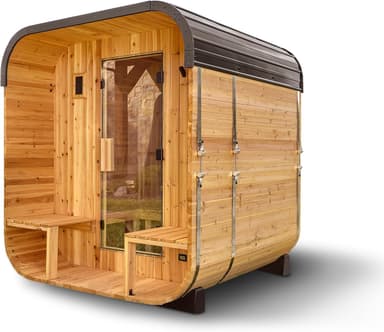
Backyard Discovery Lennon 2-4 Person Cedar Cube Sauna
- 9kW heater reaches temperature significantly faster than budget competitors
- 5-year warranty covers heater and hardware, not just the shell
- Wi-Fi preheat control adds genuine everyday convenience
If you're specifically interested in cedar barrel saunas for their durability and aesthetic, our dedicated guide covers the top models in detail. For placement in northern climates or exposed locations, outdoor barrel saunas with additional weatherproofing features deserve consideration.
Electric vs Wood-Burning for Beginners
The heater choice is arguably the most consequential decision in a barrel sauna purchase - it affects convenience, operating cost, maintenance burden, heat quality, and regulatory compliance. Both options work well for beginners in different contexts.
Electric Heaters
Electric heaters are the default recommendation for most beginners for straightforward reasons: they're simple to operate (dial or digital control, automatic shutoff), don't require fuel management, heat the sauna in 20-40 minutes with no supervision, and integrate with smart home systems in modern versions. The Harvia series (6kW, 8kW, 9kW models depending on sauna volume) and Finlandia units are the most widely used in North American barrel saunas, with a strong service history.
The sizing rule is approximately 1 kW per 45-50 cubic feet of interior volume for adequate heating in moderate climates. In consistently cold climates (average winter temperatures below 20°F), add 15-20% to that calculation to account for heat loss through uninsulated barrel walls.
Operating costs run $1.50-$3.00 per session depending on local electricity rates, session length, and ambient temperature. In cold climates, this can add up to $50-100 per month for regular users - a real consideration in the total cost of ownership [owner report data].
One practical note on installation: electric heaters require a dedicated 240V circuit with appropriate amperage (a 6kW heater draws 25 amps; a 9kW heater draws 37.5 amps). This is standard residential wiring for most North American homes but requires an electrician if you don't already have a suitable circuit at your installation location. Budget $300-700 for electrical work if needed.
For model-specific comparisons, see our guide to electric heater saunas.
Wood-Burning Stoves
A wood-burning stove in a barrel sauna produces what many enthusiasts consider the most authentic Finnish sauna experience - the crackling fire, the smell of burning wood, and a heat quality that experienced users describe as "softer" and more humid than electric. Stoves like the Kuuma Split 5 or the Harvia M3 are purpose-built for sauna use with integral stone beds and controlled combustion. They produce excellent löyly when loaded with 100-200 lbs of kiuas stones.
The tradeoffs are substantial. You need to start a fire 45-90 minutes before your session - there's no pushing a button and walking away. You need dry, seasoned hardwood stored accessibly nearby. You need a properly installed chimney with correct clearances from combustibles (typically 18-36 inches depending on stove type and local codes). You're responsible for fire safety management during every session.
In remote or off-grid locations where running a 240V circuit would be prohibitively expensive, or for sauna enthusiasts who genuinely enjoy the ritual of fire management, wood-burning is an excellent choice. For most urban and suburban beginners, electric provides a more accessible entry point.
For more on wood-burning models and their specific requirements, see our wood-burning saunas guide.
Side-by-Side Comparison
| Factor | Electric | Wood-Burning |
|---|---|---|
| Startup time | 20-40 minutes | 45-90 minutes |
| Session prep effort | Low (press button) | High (fire management) |
| Operating cost | $1.50-$3.00/session | $0.50-$1.00/session (wood cost) |
| Installation complexity | Requires 240V circuit | Requires chimney, clearances |
| Heat quality | Clean, consistent | Variable, "softer" |
| Maintenance | Annual element check | Regular ash removal, chimney cleaning |
| Best for | Beginners, urban/suburban | Enthusiasts, rural/off-grid |
| Regulatory compliance | Straightforward | Requires fire code review |
Budget Planning
A realistic budget for a first barrel sauna extends well beyond the purchase price listed on a product page. Having analyzed purchase patterns and owner cost reports, I can give you a comprehensive picture of what you're actually committing to.
Purchase Price Tiers
Entry-level kits (2-person, basic electric, unassembled) from brands like Almost Heaven Saunas or SaunaFin start at $4,000-$7,000. This gets you the barrel structure and a heater, but typically excludes shipping, foundation work, electrical installation, and accessories. Mid-range models (4-person, quality heater, glass door, pre-drilled for assembly) run $8,000-$15,000. Premium options - larger capacity, wood stove integration, added roof structure, tempered glass - start at $16,000 and extend well beyond $25,000 for fully custom builds.
The used market is worth considering. Barrel saunas disassemble relatively easily for transport, and well-maintained 3-5 year old units appear regularly for $2,500-$5,000. Inspect the staves carefully for warping, checking (cracks along the grain), and darkening at joints that suggests moisture penetration. A stave that has started to check will continue to do so, and replacement staves are often difficult to source from original manufacturers.
Full Cost of Ownership - First Year
| Cost Category | Low Estimate | High Estimate | Notes |
|---|---|---|---|
| Sauna purchase | $4,000 | $15,000 | Kit to mid-range assembled |
| Shipping | $400 | $1,200 | Weight 800-2,000 lbs |
| Foundation (gravel pad) | $200 | $800 | DIY vs. professional |
| Electrical installation | $0 | $700 | If circuit exists vs. new run |
| Accessories (thermometer, bucket, ladle, towels) | $100 | $400 | |
| Year 1 operating costs | $300 | $1,200 | Energy, wood if applicable |
| Maintenance (sealant, hardware check) | $50 | $200 | |
| Year 1 Total | $5,050 | $19,500 |
Ongoing annual costs average $500-$1,500 in cold climates due to energy demand from uninsulated walls - a figure that meaningfully affects the 10-year cost of ownership calculation. In mild climates (California, Pacific Northwest lowlands), energy costs are substantially lower, improving the value proposition of barrel designs.
Resale value drops 30-50% after five years of use, reflecting wear on staves, hoop hardware, and heater components. For buyers who may relocate, the portability of barrel saunas - they can be disassembled and moved - is a genuine advantage over permanent cabin structures.
For a comprehensive framework for making this purchase decision, see our how to choose a barrel sauna guide.
Your First Month - Building a Routine
The gap between a first sauna session and a sustainable regular practice is wider than most beginners expect. The first session is often either overwhelming (too hot, too long, not enough water) or underwhelming (too cautious, too short, no real sweat response). Building a routine requires progressive exposure over 4-6 weeks, combined with the framework from the Temperature and Duration section above.
Week 1-2 - Orientation
Your primary goal in the first two weeks is not to maximize heat stress - it's to learn your own response patterns. How quickly do you begin sweating? At what point do you feel the urge to exit? How does your heart rate and breathing change at different bench levels? Take a lower bench position. Set a timer for 8 minutes. Exit before you feel uncomfortable. Cool down for 10 minutes and drink water. Do this once or twice per week.
Pay attention to how you feel in the hour and evening following a session. Most people notice improved sleep quality and a relaxed, slightly elevated mood. These subjective markers, more than any thermometer reading, confirm you're using the sauna correctly.
Week 3-4 - Building Duration and Frequency
Add 2-3 minutes to your session duration and attempt your first two-round session: 10 minutes in, 10 minutes cooling, 10 minutes in. Add a third session to the week if your schedule allows. Begin experimenting with löyly - start with a single 2-oz pour and observe the steam response before adding more.
Evidence suggests 2-3 sessions per week is the threshold at which measurable cardiovascular adaptations begin to accumulate over months 1. Hitting this frequency during weeks 3-4 establishes the habit structure that makes it sustainable.
Week 5-8 - Refinement
By week five, most beginners have developed genuine heat tolerance and can sustain 15-20 minute rounds at 165-175°F. This is the zone where the session starts feeling less like endurance and more like ritual. Introduce contrast cooling - a cold shower between rounds initially, progressing to cold water immersion if that appeals to you.
Explore the variations that experienced sauna users find most effective: post-exercise sessions for muscle recovery, evening sessions for sleep quality, or morning sessions for mood and cognitive clarity. The physiological effects differ somewhat by timing, though individual response varies considerably.
Tracking Progress
A simple log in the first month pays dividends: record date, duration, temperature, number of rounds, how you felt during and after, and sleep quality that night. Within four weeks, patterns emerge that tell you more about your personal sauna response than any general guideline can. Some people respond intensely to a single 15-minute session; others need two or three rounds to feel the characteristic post-sauna clarity. You won't know until you track.
Common First-Month Mistakes
The top mistakes I see new sauna users make are consistently the same:
- ●Staying too long in the first 1-2 sessions, producing
Sources and References
- Cardiovascular and Other Health Benefits of Sauna Bathing
Laukkanen JA, et al.. Mayo Clinic Proceedings, 2018. - Clinical Effects of Regular Dry Sauna Bathing
Hussain J, Cohen M. Evidence-Based Complementary Medicine, 2018.
Frequently Asked Questions
For beginners, the main barrel saunas are compact 2-3 person kits like the Almost Heaven Salem (6x4 ft), starting around $4,000 with a basic electric heater and simple seating. These models heat evenly to 170-195°F thanks to their rounded shape, assemble easily in half a day with basic tools, and require a level base like concrete or gravel. They're ideal for outdoor DIY setups without advanced skills, though professional assembly is an option.
Related Guides
Medical Disclaimer - This article is for informational purposes only and does not constitute medical advice. Consult a healthcare professional before beginning any sauna routine.