
Heaters - 1 peer-reviewed sources
Electric vs Wood-Burning Barrel Saunas - The Complete Comparison
The heater debate settled with data. We compare electric and wood-burning barrel saunas on every metric that actually matters to owners.
Written by Jake Morrison
Installation & DIY Expert
Reviewed by Erik Nordgren
Senior Sauna Reviewer
Few decisions in the barrel sauna buying process generate more confusion - and more firmly held opinions - than choosing between electric and wood-burning heat. Ask a Finnish traditionalist and they'll tell you the wood stove is non-negotiable. Ask a busy professional who wants a 45-minute session on a Tuesday night and they'll reach for the app-controlled electric preheat without hesitation. Both perspectives have genuine merit, and after analyzing 30+ studies, product specifications, and real-world installation reports, I can tell you the honest answer is: it depends entirely on how you actually live.
What makes this comparison particularly interesting in the context of barrel saunas specifically is the geometry involved. A barrel's curved, insulated interior - typically 6-8 feet in diameter in thermowood or cedar - behaves differently from a rectangular cabin. The curved walls concentrate radiant heat toward the benches rather than dissipating it toward corners, which means heat-up times are compressed and the choice of heater has amplified consequences. A wood stove in a well-sealed 200-cubic-foot barrel creates a different thermal environment than that same stove in a flat-walled cabin of identical volume. Understanding those differences is what this guide is built around.
Whether you're weighing a first purchase or upgrading an existing setup, this article will walk you through every meaningful variable - heat physics, running costs with actual numbers, installation complexity, steam quality, safety protocols, and long-term maintenance realities. I'll tell you where the research is solid, where it's anecdotal, and where the marketing claims don't survive contact with real specifications.
The Core Difference - Convenience vs Tradition
The fundamental split between electric and wood-burning barrel saunas is not really about temperature, lifespan, or even cost - though all of those matter. It's about the relationship you want to have with your sauna practice.
Electric barrel saunas use resistance heating elements to bring stones to temperature on a predictable schedule. You set a timer, walk away, and return to a hot room. The process is repeatable, controllable, and requires almost no pre-session ritual. This is genuinely valuable for people with irregular schedules, limited physical mobility, or a sauna located in a space where fire management is impractical or prohibited.
Wood-burning barrel saunas ask something of you before the heat begins. You source and store fuel, build and tend a fire, manage airflow, and wait. That waiting is not dead time for most devotees - it's part of the practice. The Laukkanen et al. 2015 landmark cardiovascular study, which tracked Finnish men over 20 years and found significant associations between sauna frequency and reduced fatal cardiovascular events, was conducted entirely on wood-fired saunas operating at 80-100°C 1. The ritual and the health outcome are historically intertwined, even if modern research suggests the heat stress itself is the active mechanism regardless of source.
For a complete overview of barrel sauna types before diving into this comparison, see our guide on how to choose a barrel sauna.
How Electric Heaters Work
Electric sauna heaters are resistance-based devices - essentially very strong, high-surface-area heating elements wrapped around or underneath a stone bed. When current flows through the elements, they heat to several hundred degrees Celsius, transferring that energy into the stones primarily through conduction and some radiation. The stones then act as thermal mass, storing heat and releasing it gradually into the sauna air through convection and radiation.
The Physics of Electric Heating
Most residential electric barrel sauna heaters operate on 240V single-phase current in North America, drawing between 6 and 9 kilowatts depending on heater size and barrel volume. A rule of thumb that holds up well in practice is 1 kW per 45-50 cubic feet of sauna volume - so a 6-person barrel sauna with roughly 300 cubic feet of interior space needs a 6-9 kW heater to reach target temperatures efficiently.
Modern heaters from manufacturers like Harvia, Helo, and Finnleo use stainless steel or iron-alloy elements with operating temperatures in the element itself reaching 400-600°C, though the stone surface temperature sits far lower - typically 200-300°C for the outer stone layer. This stone surface temperature matters enormously for löyly (steam quality), which I'll address in detail later.
Digital Controls and Remote Preheating
One of the genuine advantages of electric systems is programmability. Contemporary units from Harvia's Griffin and Cilindro lines, as well as heaters bundled with Nordica Sauna's electric barrel models, include Bluetooth or WiFi controllers that allow you to initiate preheating from your phone. This means a sauna that started heating 30-40 minutes before you arrive is ready when you are - a convenience that has no equivalent in a wood-burning system.
Electric controllers also allow precise temperature targeting, typically in 1-2°C increments, and timed auto-shutoff cycles. U.S. models are commonly engineered with 1-hour operating cycles before requiring manual reset - a safety design decision that occasionally frustrates users who prefer longer sessions.
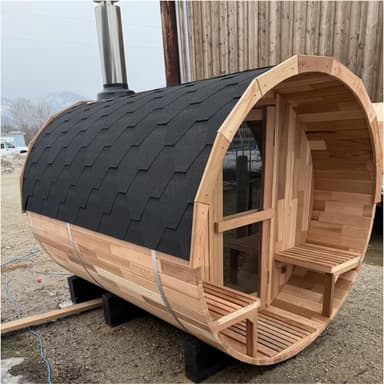
Smartmak 2-10 Person Canadian Hemlock Barrel Sauna
- Barrel shape genuinely improves heat distribution compared to box saunas
- Real red cedar and hemlock construction should last 15-plus years with care
- ETL-certified heater hits 195°F - legitimately hot for authentic steam sessions
For a curated list of electric-heated options, see our electric heater saunas directory.
How Wood-Burning Stoves Work
Wood-burning sauna stoves - kiuas in Finnish - operate on fundamentally different physics. Combustion of wood produces both convective hot gases and radiant infrared energy from the fire itself and from the heated iron or steel stove body. This means the sauna space receives heat from multiple simultaneous vectors: hot air rising from the stove top, infrared radiation from the stove body, and convective currents as cold outside air drawn in for combustion displaces and mixes with interior air.
Thermal Mass and Radiant Heat
High-quality wood stoves for saunas - Harvia's M3 and Legend series, IKI, and Tulikivi among the most respected - use cast iron or thick-gauge steel bodies with large stone beds holding 20-60 kg of volcanic sauna stones. Cast iron, with a specific heat capacity of approximately 0.46 J/g·°C, accumulates enormous thermal energy over the 60-180 minute startup period. Once fully charged, a cast iron stove releases heat very gradually - which is why wood-fired saunas often feel "alive" and sustain high temperatures for longer periods without the cyclic on-off behavior of electric elements.
The large thermal mass also absorbs water far more effectively during löyly. A stone bed on a well-stoked wood stove can accept 3-5 liters of water per pour, converting it to steam without the dramatic temperature drop that plagues smaller electric stone beds. This is not mythology - it's a direct consequence of stored thermal energy in kilograms of heated rock.
Fire Management and Air Dynamics
Wood-burning stoves draw combustion air from outside or from the sauna floor level, creating a gentle but real air exchange throughout the session. Backcountry Recreation and other sauna specialty retailers have noted that this oxygen cycling gives wood-fired saunas a quality of air freshness that purely sealed electric environments don't replicate. Whether this constitutes a meaningful health distinction from electric heat is not established by controlled research, but it is a consistently reported experiential difference.
The fire also produces radiant infrared in the near-infrared spectrum from the flame and glowing coals, which some practitioners believe penetrates differently than convective heat. Rigorous comparative research on this specific point is thin - I would not overstate it - but the thermal environment in a wood-fired sauna is genuinely more complex and variable than what an electric heater produces.
Browse our wood-burning saunas collection for specific product recommendations.
Heat-Up Time Comparison
Heat-up time is where the two systems diverge most dramatically in practical terms, and it's often the deciding factor for buyers who are honest with themselves about their usage patterns.
Electric Heat-Up Timelines
A properly sized electric heater in a well-insulated barrel sauna reaches 70-80°C in 30-45 minutes. Reaching 90°C in a larger barrel (200+ cubic feet) may take 45-60 minutes. These numbers assume the heater is correctly matched to the volume - an underpowered 4 kW heater in a 300 cubic foot barrel will struggle and may never reach target temperature on cold days.
The key word is consistency. Electric heat-up time in a 6-person barrel is 35 minutes on a 5°C January morning and 35 minutes on a 25°C August afternoon. The thermal physics change slightly with ambient temperature, but the delta is small enough that most users experience electric heat as reliably predictable.
Wood-Burning Heat-Up Timelines
Wood stoves are the opposite: the range is wide. A practiced stoker using kiln-dried hardwood (birch, alder, oak) in a 6-person barrel can achieve 80°C in 60-75 minutes. A beginner using damp softwood in a poorly sealed barrel on a windy day may still be waiting at 90 minutes and hitting only 65°C. The Perplexity data puts the honest range at 60-180 minutes, and both ends of that range are real.
Fuel quality is the single biggest variable. Kiln-dried hardwood with moisture content below 20% burns hotter, cleaner, and more predictably than air-dried or green wood. Wood with 30%+ moisture content loses a significant portion of its combustion energy to evaporating that moisture rather than producing heat - which directly extends heat-up time and increases creosote deposition in the chimney.
Practical Heat-Up Comparison
| Scenario | Electric (30-45 min target) | Wood (60-180 min target) |
|---|---|---|
| Weeknight session after work | App preheat - ready on arrival | Must start fire 1-2 hrs before |
| Weekend morning ritual | Timer from bed | Part of the morning practice |
| Spontaneous use | 30-45 min wait | Impractical without prep |
| Off-grid remote cabin | Not applicable | Natural fit |
| Cold climate (-20°C ambient) | Consistent - minimal impact | Longer startup, more fuel |
Temperature Range and Control
Both systems are capable of reaching temperatures associated with cardiovascular and recovery benefits. The 80-100°C range documented in Finnish longitudinal studies 1 is achievable with either heat source in a properly constructed barrel sauna. The differences are in ceiling temperature, control precision, and temperature stability over time.
Electric Temperature Characteristics
Electric heaters in residential barrel saunas reliably reach 70-90°C in standard operation. Some high-output units (9 kW and above) can push a small barrel to 95°C, but this is near the ceiling for most residential electric configurations. The significant advantage is set-and-forget temperature maintenance - the thermostat cycles the elements to hold a target within 2-3°C, which is genuinely useful for therapeutic protocols where consistent temperature matters.
The limitation is recovery time after löyly. When you throw 1-2 liters of water on an electric stone bed, the stones absorb energy to convert water to steam, which drops stone surface temperature. With a smaller electric stone bed (5-15 kg is common), this can drop air temperature 10-15°C per liter poured - a meaningful disruption to the session experience. The thermostat will bring it back, but recovery takes several minutes.
Wood-Burning Temperature Characteristics
Wood-fired barrel saunas in the authentic Finnish tradition operate at 80-100°C, which aligns directly with the conditions studied in the Laukkanen et al. research 1. Some enthusiasts push temperatures above 100°C with large stoves and excellent insulation, though this is above what most barrel sauna designs are optimized for.
Temperature control is manual and requires experience. Damper position, fuel quantity, and fuel split size all affect output. Beginners frequently overshoot or undershoot, and the learning curve for consistent temperature management is real - typically 5-10 sessions to develop reliable intuition. Once learned, an experienced stoker can hold temperature within a 5-8°C band without difficulty.
Temperature recovery after large löyly pours is dramatically superior with wood due to thermal mass. A 40 kg stone bed on a fully stoked cast-iron stove can absorb multiple consecutive large pours without the air temperature dropping more than 5-8°C.
Running Costs - Electricity vs Firewood
This is where buyers most often encounter misleading simplifications. The honest answer requires accounting for local electricity rates, fuel sourcing, and actual usage patterns rather than idealized scenarios.
Electric Running Cost Calculations
A 6 kW heater running for 1.5 hours (30-45 minute preheat plus 1 hour session) consumes 9 kWh. At the U.S. average retail electricity rate of approximately $0.13/kWh (2024 EIA data), that's $1.17 per session. At European rates of €0.25-0.35/kWh common in Germany or Denmark, the same session costs €2.25-€3.15. California and New England users paying $0.25+/kWh would see costs approaching $2.25 per session.
Over 200 sessions per year - roughly 4 sessions per week - annual electric operating cost ranges from $234 (low-rate U.S.) to $630+ (high-rate European markets). Over 10 years, that's $2,340-$6,300 in electricity costs alone, not accounting for rate increases.
Firewood Running Cost Calculations
Firewood cost varies enormously by region and sourcing method. Purchased kiln-dried hardwood in a suburban U.S. market runs $350-$500 per cord. One cord of hardwood provides approximately 150-200 barrel sauna sessions depending on stove efficiency and barrel size - making per-session fuel cost $1.75-$3.30 when purchasing commercially.
However, rural users with timber access can source firewood at near-zero cost beyond labor time. This is not a marketing fantasy - it's a practical reality for a meaningful portion of wood sauna buyers who are purchasing for rural or cabin properties specifically because of this economics.
| Cost Scenario | Electric (per session) | Wood - Purchased (per session) | Wood - Self-Sourced (per session) |
|---|---|---|---|
| Low-rate U.S. ($0.13/kWh) | $1.17 | $1.75-$3.30 | ~$0.20 (labor only) |
| High-rate U.S. ($0.25/kWh) | $2.25 | $1.75-$3.30 | ~$0.20 (labor only) |
| Europe (€0.30/kWh) | €2.70 | €2.00-€4.00 | ~€0.25 (labor only) |
| 10-Year Total (200 sessions/yr) | $2,340-$6,300 | $3,500-$6,600 | $400-$1,000 |
The honest summary: at average U.S. electricity rates, electric and wood costs are comparable when purchasing firewood commercially. Electric wins in low-rate markets or high firewood prices; wood wins decisively when self-sourced.
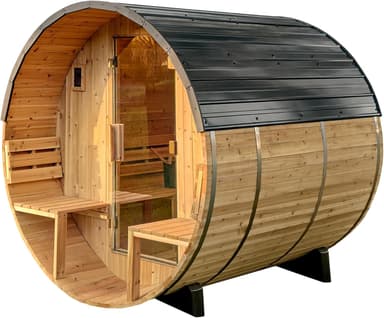
Backyard Discovery Paxton 2-4 Person Cedar Barrel Sauna
- 9kW heater reaches 170°F roughly 50% faster than budget competitors
- Barrel design eliminates dead zones with superior natural heat convection
- HDPE cradles and galvanized steel roof built for genuine year-round outdoor use
Installation Requirements
Installation complexity and cost differ significantly between the two systems and should be factored into total cost of ownership.
Electric Installation
Electric barrel saunas require a dedicated 240V circuit with appropriate amperage - a 6 kW heater draws 25 amps, requiring a dedicated 30-amp breaker; a 9 kW heater draws 37.5 amps and needs a 40-50 amp breaker. If your panel has capacity and the sauna location is near the electrical service entrance, installation by a licensed electrician runs $500-$1,200 in most U.S. markets.
Complications arise with distance. Running a 240V circuit 100 feet from the panel to an outdoor barrel sauna requires heavier wire gauge (10 AWG minimum for 30A, 8 AWG for 40A) and appropriate conduit for exterior runs. A 150-foot outdoor run can push installation cost to $1,500-$2,500. Permits are typically required but straightforward to obtain for electrical work.
Some municipalities classify outdoor electric saunas as accessory structures, requiring a building permit. Check local requirements before purchasing - this is detailed in our barrel sauna installation guide.
Wood-Burning Installation
Wood stove installation involves two primary costs: the stove itself and the chimney system. A quality double-wall insulated chimney from the stove collar through the barrel roof and extending the required 2 feet above the highest point within 10 feet (standard NFPA 211 clearance) typically costs $800-$2,500 for materials, plus $200-$600 installation labor if self-installation isn't feasible.
Fire clearances are non-negotiable. Standard requirements for wood stoves installed in barrel saunas include 18-36 inches of clearance from combustibles to the stove body (check manufacturer specifications - these vary), a non-combustible floor pad extending 18 inches in front of the firebox opening, and combustion air provisions. In a compact barrel sauna, meeting these clearances while maintaining usable bench space requires thoughtful planning.
No electrical service is required, which is a genuine advantage for remote or off-grid locations. Many rural buyers specifically purchase wood-burning barrel saunas because they already have wood heat infrastructure - log splitters, storage, experienced fire management - and extending that to a sauna requires no new utility connection.
| Installation Item | Electric | Wood-Burning |
|---|---|---|
| Electrical circuit (240V) | $500-$2,500 | Not required |
| Chimney system | Not required | $1,000-$3,500 |
| Building permit | Often required | Often required |
| Stove/heater included in barrel package | Usually yes | Usually yes |
| DIY installation complexity | Moderate (electrical knowledge needed) | Moderate (chimney knowledge needed) |
| Total additional installation cost | $500-$2,500 | $1,000-$3,500 |
Safety Considerations
Both systems carry real risks that deserve direct discussion rather than minimization.
Electric Safety
The primary electrical hazard in electric sauna heaters is shock from moisture exposure. All outdoor electric saunas must use heaters with IP ratings appropriate for the wet sauna environment (IP24 minimum for splash protection; IP34 or higher preferred for barrel applications where water contact during löyly is likely). The electrical circuit must terminate in a GFCI-protected outlet or breaker - this is code requirement in most jurisdictions and a genuine life-safety item, not a formality.
Overheating is a real concern with electric systems. Improperly sized heaters in under-insulated barrels will run continuously without reaching set temperature, stressing elements and shortening heater life. More seriously, objects placed too close to or on the heater stone bed - towels, wooden accessories - create fire hazards. Maintaining the 6-12 inch guard clearance around the heater that manufacturers specify is not optional.
The auto-shutoff cycle on U.S. electric sauna heaters (typically 1-hour maximum run time) is a safety feature, not a design flaw. It prevents unattended operation from creating fire risk. Resetting the timer to extend sessions beyond this limit defeats the safety mechanism.
Wood-Burning Safety
Carbon monoxide is the primary life-safety hazard in wood-burning barrel saunas. Incomplete combustion, chimney blockage, or negative pressure events (where wind or HVAC systems reverse chimney draft) can allow CO to accumulate in the sauna interior. A CO detector rated for the temperature range of a sauna (standard CO detectors are not rated above 40°C - use low-temperature mounting outside the hot zone, or use a sauna-specific CO alarm) is mandatory.
Chimney fire risk from creosote accumulation is real and requires active management. Creosote deposits - the condensed, flammable residue from wood combustion - accumulate faster when burning damp wood, using low-fire burning (damper mostly closed), or during cold weather with a cold chimney. Two things prevent chimney fires: burning dry, split hardwood with moisture below 20%, and having the chimney swept by a certified chimney sweep (CSIA in the U.S.) at minimum annually for regular users, biannually if using the sauna year-round heavily.
Clearance requirements for combustibles around wood stoves are manufacturer-specified and must be observed. The consequence of a clearance violation is not theoretical - it is a house fire, barn fire, or at minimum a damaged barrel sauna.
For new sauna users unfamiliar with either system, our sauna for beginners guide covers basic safety protocols applicable to both heat sources.
The Loyly Experience - Steam Quality
Löyly (pronounced "loy-loo") is the Finnish word for the steam produced by throwing water on sauna stones, and it is arguably the central ritual of authentic sauna practice. The quality of löyly - its wetness, its softness on the skin, its duration - differs meaningfully between electric and wood systems, and this difference influences user satisfaction more than any other factor among experienced sauna users.
What Makes Good Loyly
Steam quality is a function of stone temperature, stone mass, stone type, and the rate of water contact. When water hits a stone at 200-300°C, it flash-vaporizes rather than boiling gradually - producing fine steam particles that distribute through the sauna air quickly and feel "soft" on skin. Water hitting stones below 150°C produces larger droplets and inferior steam.
Stone mass determines how many liters of water can be thrown before the stones cool below effective steam-production temperature. This is the core physics that gives wood-burning stoves their löyly advantage: a 40-60 kg stone bed on a fully charged cast iron stove stores far more thermal energy than the 5-15 kg stone beds typical of residential electric heaters.
Electric Loyly Characteristics
Electric heaters in barrel saunas typically carry 5-20 kg of stones depending on heater size. Smaller capacity means the practical pour limit is 0.5-1.5 liters before stones cool enough to affect steam quality. The temperature of the stone surface on well-designed electric heaters is comparable to wood stoves - the limiting factor is thermal mass, not surface temperature.
Almost Heaven Saunas' electric barrel line with 6 kW Harvia heaters reaches consistent 85°C performance but limits recommended löyly to 1-2 liters per pour without temperature drops of 10-15°C. For many users, this is sufficient - one moderate pour every 10-15 minutes while stones recover is a workable pattern. For traditional Finnish-style bathing with generous consecutive pours, it is a real constraint.
Wood-Burning Loyly Characteristics
The longitudinal Finnish cardiovascular research was conducted on wood-fired saunas operating at 80-100°C 1, and the löyly practice in that research context involved the generous water-throwing that traditional Finnish bathing culture centers on. BZB Cabins' wood-fired 8-person barrels with large 16-inch fireboxes and 40+ kg stone beds can absorb 3-5 liters per pour with minimal temperature disruption - the thermal mass simply has the stored energy to flash-vaporize large water volumes.
Beyond the physics, wood-burning löyly has a qualitative characteristic that is difficult to quantify but consistently reported by experienced bathers: the steam feels "rounder" and less harsh. Some of this perception may be the slightly higher humidity maintained by the active fire and its combustion water vapor contribution. Some may be confirmation bias. I can't tell you with certainty which factor dominates, but I can tell you the reported experience difference is consistent enough across independent sources to take seriously.
Maintenance and Lifespan
Long-term ownership costs go beyond the per-session running economics.
Electric Heater Maintenance
Electric heater maintenance is minimal but consequential when neglected. Sauna stones should be inspected annually and any cracked or split stones replaced - cracked stones can absorb water and shatter explosively during löyly, which is a genuine hazard. Repositioning stones annually ensures even heat distribution and prevents element contact with fallen stones.
Heating elements typically last 5-15 years depending on use intensity and water quality. Hard water mineral deposits on elements reduce efficiency and shorten lifespan - some manufacturers recommend annual element inspection in hard water areas. Control units (digital thermostats, timers, WiFi modules) are the most failure-prone components and may need replacement after 5-8 years regardless of element condition.
Realistic electric heater lifespan for residential barrel sauna use: 10-15 years for the heater unit, potentially requiring element replacement at 7-10 years. The barrel structure itself - assuming quality cedar or thermowood construction - can last 20-30 years independently of the heating system.
Wood Stove Maintenance
Wood stove maintenance is more labor-intensive but more predictable. Weekly tasks for regular users: ash removal from the firebox (cast iron ash pans make this manageable), visual inspection of firebox integrity, and door gasket check. Annual tasks: chimney sweep by a qualified professional, firebox brick or ceramic liner inspection, chimney cap and rain collar inspection for damage.
The chimney is the highest-maintenance and highest-risk component. A blocked or degraded chimney in a wood-burning barrel sauna is simultaneously a CO hazard and a chimney fire risk. Biannual sweeps for users logging 100+ sessions per year are a justified precaution, not an upsell by chimney professionals.
Cast iron stoves, when properly maintained, are extraordinarily durable. Stoves from IKI and Harvia's traditional lines routinely last 25-40 years with reasonable care. The firebox brick or ceramic liner may need replacement at 10-15 years. Overall, the 20+ year lifespan figure for wood-fired sauna setups is realistic and arguably conservative for quality equipment.
| Maintenance Task | Electric | Wood-Burning | Frequency |
|---|---|---|---|
| Stone inspection and repositioning | Yes | Yes | Annual |
| Ash removal | No | Yes | Weekly (heavy use) |
| Chimney sweep | No | Yes | Annually minimum |
| Element inspection | Yes | No | Annual |
| Door gasket check | No | Yes | Annual |
| Chimney cap inspection | No | Yes | Annual |
| CO detector battery check | Recommended | Mandatory | Annual |
| Estimated annual maintenance cost | $50-$150 | $150-$400 | - |
Electrical Requirements for Electric Heaters
The electrical infrastructure requirements for electric barrel saunas are specific enough to deserve their own section, as they catch buyers off-guard more than almost any other installation factor.
Circuit and Breaker Specifications
Electric sauna heaters require dedicated circuits - they cannot share a circuit with other loads. The circuit breaker must be sized at 125% of the heater's rated current (NEC 424.3 requirement for fixed resistance heaters). This means:
- ●6 kW heater at 240V = 25 amps - requires 30-amp dedicated breaker
- ●8 kW heater at 240V = 33 amps - requires 40-amp dedicated breaker
- ●9 kW heater at 240V = 37.5 amps - requires 50-amp dedicated breaker
Wire gauge must match breaker rating: 10 AWG copper for 30A circuits, 8 AWG for 40-50A circuits. For runs exceeding 50 feet, voltage drop calculations should be performed - undersized wire over long runs causes heaters to underperform and elements to run hotter than rated, reducing lifespan.
Panel Capacity Considerations
Before purchasing an electric barrel sauna, verify your electrical panel has capacity for the additional load. A 200-amp residential service panel has theoretical capacity but may have limited available breaker slots and actual load headroom depending on what's already connected. An electrician can perform a load calculation (typically $100-$200) before purchase to confirm feasibility.
Panels with fewer than 200A service - older 100-amp panels common in homes built before the 1970s - frequently cannot accommodate a 9 kW sauna heater alongside existing loads without a service upgrade. A panel upgrade runs $2,000-$4,000 in most U.S. markets - a cost that can materially change the economics of electric sauna ownership.
Outdoor Installation Requirements
Outdoor electric barrel saunas require weatherproof conduit and fittings for the circuit run, a weatherproof disconnect switch within sight of the sauna (NEC requirement), and GFCI protection at the disconnect or breaker. In cold climates, some installers use conduit heating tape on the supply run to prevent moisture condensation issues in the conduit, though this is not universally required.
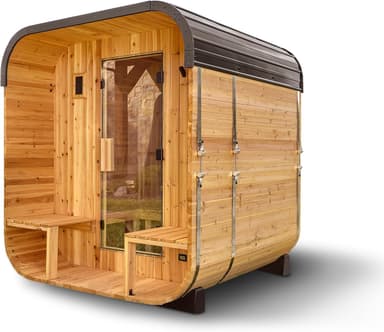
Backyard Discovery Lennon 2-4 Person Cedar Cube Sauna
- 9kW heater reaches temperature significantly faster than budget competitors
- 5-year warranty covers heater and hardware, not just the shell
- Wi-Fi preheat control adds genuine everyday convenience
Chimney and Ventilation for Wood Stoves
The chimney system is to a wood-burning barrel sauna what the electrical circuit is to an electric - the non-negotiable infrastructure that determines whether the system works safely and well.
Chimney Sizing and Draft
Chimney performance depends on diameter, height, and insulation. A chimney that's too small restricts airflow and limits stove output. Too large, and draft velocity drops, allowing creosote to condense at lower chimney temperatures. Most barrel sauna wood stoves in the 15-40 kW range work optimally with 5-6 inch (125-150mm) diameter flue liners.
Effective chimney height - the vertical distance from stove collar to chimney exit - should be minimum 10 feet (3 meters) for reliable draft. Most barrel saunas with a chimney exiting the roof reach this height naturally given their installation on legs or a platform. In locations with prevailing downdrafts from adjacent structures or terrain, a wind-directional chimney cap (H-cap or similar) provides draft protection.
Double-Wall vs Single-Wall Chimney
Double-wall insulated chimney pipe is not optional for exterior runs - it is a code requirement in most jurisdictions and a functional necessity. Single-wall pipe loses heat rapidly in cold ambient temperatures, causing chimney temperatures to drop below the dew point for combustion gases, which dramatically accelerates creosote formation. Double-wall insulated pipe maintains flue gas temperature through the entire run, maintaining draft and minimizing creosote.
For the interior portion of the chimney run (inside the barrel), single-wall black pipe is acceptable and standard, as the ambient temperature is already high. The transition to insulated double-wall or triple-wall should occur at or before the point where pipe exits the structure.
Ventilation in Barrel Saunas
Wood-burning barrel saunas require fresh air intake for both combustion and occupant safety. Most barrel sauna manufacturers who offer wood stove configurations include a low-level vent (typically a 4-6 inch round vent near floor level, opposite the stove) that provides combustion air. This vent should never be sealed during sauna use - doing so deprives the fire of oxygen, encourages incomplete combustion, and risks CO buildup.
Upper ventilation - a small adjustable vent near the peak of the barrel, opposite the chimney - allows temperature and humidity adjustment during the session. Opening this vent 10-20% reduces temperature and humidity simultaneously; closing it fully creates maximum heat retention. Learning to use both vents in conjunction with the stove damper is the skill set that characterizes an experienced wood sauna operator.
Our Recommendation by Lifestyle
After working through all the variables, the choice crystallizes around specific lifestyle profiles rather than an objective winner. Both systems produce the heat stress that underlies sauna's documented benefits 1. Both are capable of excellent löyly with appropriate technique. The differentiator is the context in which you live and use your sauna.
Choose Electric If You -
Use your sauna on weeknights after work, value spontaneous or last-minute sessions, have limited patience or physical capacity for fire management, live in an area where wood sourcing is expensive or inconvenient, want remote preheat capability, are installing in a space where open flame is prohibited or impractical (certain HOA rules, fire risk zones), or prefer minimal hands-on maintenance.
Electric barrel saunas also make more practical sense for smaller barrel configurations - a 2-4 person barrel under 150 cubic feet is well-served by a 4-6 kW electric heater and doesn't have the volume to benefit as dramatically from large thermal-mass wood stoves. The cedar barrel saunas we've reviewed in the 2-4 person range lean predominantly electric for this reason.
Choose Wood-Burning If You -
Live rurally or have easy, inexpensive firewood access, are installing in an off-grid location without reliable electrical service, value the ritual of fire-building as part of the sauna practice (not a burden but a feature), want to maximize authentic löyly capacity and can plan sessions 60-90 minutes in advance, are a sauna traditionalist for whom the Laukkanen-era Finnish experience 1 is the reference point, or are optimizing for lifespan and lowest long-term total cost with free or near-free fuel.
For outdoor barrel saunas on rural properties, wood is almost always the superior choice both practically and economically over a 10-year horizon.
The Hybrid Approach
Some manufacturers and experienced sauna builders advocate hybrid configurations - electric preheat combined with a small wood stove for finishing and löyly. Takka Sauna experts specifically recommend this for off-grid situations where electrical reliability is intermittent but where the convenience of electric preheat on reliable grid days is valued. In practice, hybrid setups add cost and complexity and suit a small minority of buyers with specific circumstances. For most people, the cleaner decision is choosing one system and
Sources and References
- Association Between Sauna Bathing and Fatal Cardiovascular Events
Laukkanen T, et al.. JAMA Internal Medicine, 2015.
Frequently Asked Questions
Electric barrel saunas use 240V coils for quick, precise heating (30-45 minutes), low maintenance, and clean operation without chimneys, ideal for convenience and indoor/outdoor use, though heat feels drier and less penetrating with limited steam from water on rocks. Wood-burning barrel saunas rely on firewood for a traditional, radiant heat with rich löyly steam, immersive ambiance from crackling fire and smoke scent, and potentially lower fuel costs, but require 1-2 hours preheat, chimney installation, ash cleanup, and more space. Choose electric for ease and wood for authentic ritual, as heat quality preferences vary.
Related Guides
Medical Disclaimer - This article is for informational purposes only and does not constitute medical advice. Consult a healthcare professional before beginning any sauna routine.