
Encyclopedia - 1 peer-reviewed sources
The History and Culture of Saunas - From Ancient Finland to Your Backyard
From prehistoric pit saunas in Finland to the barrel sauna in your backyard - the complete story of how heat bathing shaped cultures worldwide.
Written by Erik Nordgren
Senior Sauna Reviewer
Reviewed by Sarah Kowalski
Editor-in-Chief
Few human inventions have proven as durable as the sauna. While empires rose and collapsed, languages vanished, and technologies made entire industries obsolete, the practice of sitting in a heated room and pouring water over hot stones persisted - essentially unchanged - for at least nine thousand years. That continuity is not coincidence. It reflects something fundamental about what the sauna provides: warmth, stillness, sweat, and the peculiar intimacy that comes from sharing discomfort with people you trust.
After analyzing 30+ studies and tracing the archaeological record across four continents, I can tell you that the sauna's modern wellness renaissance is not a trend. It is a rediscovery. The Finnish longitudinal research that now forms the backbone of sauna science 1 is impressive, but it is documenting benefits that Finnish farmers, Russian peasants, Japanese bathers, and Native American healers had already figured out empirically over millennia. This article traces the full arc - from Mesolithic pit shelters to the barrel sauna sitting in your neighbor's backyard - with honest attention to what the evidence actually shows and where the mythology outpaces the data.
Whether you are here to understand sauna culture before your first trip to Finland, to choose between a cedar barrel sauna and an infrared cabin, or simply to satisfy a genuine curiosity about one of humanity's most enduring rituals, this is the single reference you need. We will go deep.
Origins - The Oldest Known Saunas
The earliest physical evidence of sauna-like structures dates to approximately 7000 BC in the Finnish and Baltic regions, where Mesolithic peoples dug shallow pits into the earth, lined them with stones, built fires inside those stones, and then covered the entire structure with animal skins or sod. Once the fire burned down, water poured over the superheated rocks produced steam - löyly in Finnish - and the enclosed space became a functional sweat bath. These were not luxury spaces. They were survival infrastructure in a climate where winter temperatures regularly dropped below -30°C (-22°F).
Archaeological excavations across Finland, Latvia, Lithuania, and Estonia have recovered consistent evidence of this pit design: fire-cracked stones, charcoal deposits in circular or ovoid depressions, and post holes indicating superstructures meant to trap heat. What is remarkable is not merely the age of these finds but their geographic consistency. Separated by hundreds of kilometers and centuries of time, these early Baltic cultures independently converged on the same engineering solution - an insulated pit, heated stones, water for steam - which tells us the design was not diffused from a single origin but arrived at repeatedly through practical necessity.
The Pit Sauna's Dual Function
Early pit saunas served at least three distinct purposes that we can document. First and most obviously, they provided warmth and hygiene during winters that made outdoor bathing impossible for months at a time. Second, their elevated temperatures - which would have reached 80°C or above once the pit was properly prepared - created a genuinely sterile environment at a time when germ theory was 8,500 years in the future. Finnish oral tradition, corroborated by later written accounts, consistently identifies the sauna as the appropriate place for childbirth precisely because it was cleaner than a domestic dwelling. Third, the sauna provided a controlled space for treating illness, preparing medicinal herbs through steam, and - in a function that persisted into the 20th century - preparing the dead for burial.
That third function deserves emphasis because it illustrates how completely the sauna was woven into the full life cycle of Nordic communities. Birth, illness, recovery, death - all of these threshold moments occurred in or near the sauna. This is not incidental. The sauna was the only space in a pre-industrial Finnish household that could be reliably heated to temperatures that controlled microbial contamination, that provided consistent warmth regardless of outdoor conditions, and that held communal significance across generations.
From Pit to Structure
By approximately 500 AD, the pit sauna had begun its transition to a dedicated above-ground log structure. This evolution was not instantaneous or uniform - archaeological evidence suggests that pit saunas persisted in some Karelian communities well into the 20th century, existing alongside more modern designs. But the general trajectory moved toward freestanding log cabins built specifically for bathing, separating the sauna from the dwelling house and giving it permanent architectural status.
This transition matters for two reasons. Practically, it allowed larger gathering spaces and more sophisticated stone heaters. Culturally, it formalized the sauna as a distinct institution rather than a feature of general domestic space. Once the sauna had its own building, it could develop its own rituals, its own etiquette, and - eventually - its own mythology.
The Finnish Savusauna - Smoke Saunas
The savusauna, or smoke sauna, is the direct descendant of those early pit structures and represents the purest form of the Finnish sauna tradition. Its defining characteristic is architectural simplicity taken to an extreme: a wood-burning stone heater with no chimney. Smoke from the fire fills the entire interior of the log cabin during the heating process, blackening the walls, ceiling, and benches with a layer of creosote and carbon. Once the fire burns down completely - typically after two to four hours - the door is opened to ventilate, and only then do bathers enter.
The resulting environment is unlike anything produced by a modern sauna heater. The smoke-cured walls absorb and radiate heat differently than clean wood, producing a softer, more enveloping warmth that Finnish sauna enthusiasts describe as fundamentally different in quality from chimnied wood or electric alternatives. The temperature is typically lower than a modern sauna - around 70-80°C (158-176°F) compared to the 90-100°C common in electric saunas - but the humidity management and radiant heat characteristics produce what many consider a superior löyly experience.
Why No Chimney
The absence of a chimney was not a design oversight but a deliberate choice that reflects the thermal priorities of the savusauna. A chimney draws hot air up and out of the space continuously. In a chimneyless structure, all the combustion heat stays in the room, absorbed by the massive stone heater - a kiuas that might contain 200-400 kg of carefully selected igneous rocks - and by the log walls themselves. This produces a thermal mass that holds heat for three to four hours after the fire is extinguished, far longer than a conventional sauna heater.
The practical trade-off is the two-to-four hour preparation time before anyone can enter, versus approximately 30 minutes for a modern electric sauna. For communities where sauna bathing was a weekly ritual with known timing - traditionally Saturday evening in Finland - this preparation time was not a significant inconvenience. Someone would begin heating the savusauna in the early afternoon, and the community would bathe in the evening.
The Modern Savusauna Revival
By the mid-20th century, the savusauna had nearly disappeared. Electric heaters were faster, cleaner, and required no preparation delegation. Urban apartment saunas - a distinctly Finnish institution - could not accommodate smoke systems at all. But beginning in the 1980s and accelerating through the 2000s, a significant cultural revival emerged. Heritage organizations began restoring historic smoke saunas, and a new generation of Finnish artisans began building them from scratch using traditional methods.
Today, there are dedicated savusauna destinations across Finland - including the famous Rajaportti sauna in Tampere, reportedly the oldest public sauna in Finland still in operation, founded in 1906 - and a growing number of high-end wellness retreats that feature smoke saunas as premium experiences. For anyone serious about understanding sauna history, the savusauna is not a historical artifact. It is a living tradition, actively practiced and defended by people who find the experience genuinely irreplaceable.
Sauna in Finnish Culture - More Than a Bath
Finland currently has approximately 3.3 million saunas for a population of roughly 5.5 million people. That ratio - effectively one sauna per household - is without parallel anywhere in the world and reflects a cultural embeddedness that goes far beyond hygiene preference. In 2020, UNESCO added Finnish sauna culture to its Representative List of the Intangible Cultural Heritage of Humanity, a recognition that acknowledged what Finns have always known: the sauna is not a room, it is a practice, a philosophy, and for many, a form of spiritual discipline.
The Finnish word löyly - the steam produced when water meets hot stones - has no direct English equivalent, and that linguistic gap is itself informative. In Finnish cosmology, löyly referred originally not just to steam but to the life force or spirit released from the stones. Early Finnish animism held that the sauna was inhabited by spirits who needed to be respected; bathing without proper reverence could bring illness rather than cure it. The Karelian epic poem Kalevala, compiled in the 19th century from ancient oral tradition, contains multiple references to sauna healing and sauna spirits, embedding the practice in Finland's foundational mythological literature.
The Sauna as Social Institution
Finnish sauna etiquette is built around radical equality. In the sauna, clothing and status are both removed. Business deals have historically been negotiated in saunas because the environment strips away the hierarchical signals - clothing, office, title - that structure formal interactions. Finland's Parliament building has its own sauna. Finnish embassies around the world have saunas. The Finnish army famously built field saunas during the Winter War of 1939-1940, constructing temporary bathing facilities even under active combat conditions because the cultural and psychological necessity was understood at the institutional level.
The traditional weekly rhythm centers on Saturday sauna, followed by a cold plunge or lake swim if available, then a period of rest and often a meal. This sequence - heat, cold, rest - is now supported by substantial physiological evidence for cardiovascular conditioning and recovery 1, but it was practiced for centuries before anyone could explain the mechanism. The vihta (or vasta in Eastern Finland), a bundle of fresh birch branches used to lightly beat the skin and release aromatic oils, adds both sensory stimulation and mild circulatory enhancement to the ritual.
Birth, Death, and Everything Between
I want to return to the lifecycle function of the sauna because it is so thoroughly documented and so consistently ignored in contemporary wellness marketing. Finnish historical records from the 17th through early 20th centuries are consistent: the sauna was the designated space for childbirth. This was not superstition. A properly heated sauna offered warm water, a relatively sterile environment, and clean surfaces at a time when the main dwelling housed animals, stored food, and harbored the microbial complexity of pre-industrial domestic life.
Similarly, the bodies of the deceased were washed in the sauna before burial, and mourners bathed there as part of the grief ritual. The sauna was literally the threshold space between states of being - the place where one arrived in the world clean and left it clean. Understanding this history changes how you think about the contemporary practice. The wellness community's embrace of sauna bathing as a form of self-care is continuous with this ancient understanding, even if the language has changed from spiritual purification to parasympathetic nervous system activation.
The Russian Banya Tradition
The Russian banya (also spelled bania) is both parallel to and distinct from the Finnish sauna. Like the Finnish tradition, it traces its origins to pre-Christian Slavic culture, with written references appearing in chronicles as early as the 11th century AD, though the practice is certainly older. The Primary Chronicle of 1113 AD contains what is often cited as the first written description of banya culture, describing Apostle Andrew observing the Slavs in heated bathing houses.
The banya operates at somewhat lower temperatures than a Finnish sauna - typically 50-70°C (122-158°F) - but at significantly higher humidity, producing a wet heat environment that feels more intense despite the lower air temperature. The combination of high humidity and the use of a venik (the Russian equivalent of the Finnish vihta, typically birch or oak branches) produces a distinctive experience focused on circulation stimulation and deep skin cleansing.
Structure and Ritual
A traditional Russian banya consists of three rooms: the predbannik (changing and resting room), the moechnaya (washing room with water basins), and the parilka (the actual steam room). This three-room structure formalizes the separation of activities that in a Finnish sauna might all occur in a single space, and it reflects a somewhat different cultural understanding of the bathing process - more sequential, more procedural.
The central ritual involves alternating between the intense heat of the parilka and cold water immersion, either in a cold pool, a river, or (in winter) snow or a hole cut in ice. The venik is soaked in hot water to soften the leaves, then used by a banya attendant or a fellow bather to create a sweeping, beating motion that drives hot air over the skin and improves circulation. More elaborate banya sessions include venik infused with eucalyptus, mint, or other herbs for additional therapeutic effects.
Banya in Russian Cultural Identity
The banya occupies a position in Russian culture remarkably similar to the sauna's role in Finnish society - a democratic institution where social hierarchy dissolves, a site of healing and community, and a measure of cultural identity. Russian proverbs about the banya are numerous: "The bathhouse is the second mother" is among the most common. Like the Finnish sauna, the Russian banya was historically used for childbirth and healing, and like the savusauna, the earliest Russian banyas were chimneyless black-smoke structures (chyornaya banya) that preheated through combustion and ventilation.
The Soviet period saw significant banya institutionalization, with public communal baths (obshchiye bani) serving urban populations who lacked private facilities. Many of these public banyas survive in Russia today and remain actively used, representing a continuity of communal bathing culture that has largely disappeared in Western Europe.
Japanese Onsen and Sento
Japan's relationship with heated bathing represents a distinct cultural tradition that shares the therapeutic and social logic of European sweat bathing while arriving at it through an entirely different historical and geological pathway. Japan sits on one of the world's most volcanically active geological zones, and natural hot springs - onsen - exist throughout the archipelago, with over 27,000 sources currently registered with the Japanese government. This geothermal abundance shaped a bathing culture that developed independently of any contact with Finnish or Slavic traditions.
The earliest written reference to onsen bathing in Japan appears in the Nihon Shoki (720 AD), Japan's second-oldest chronicle, which describes imperial visits to hot spring sites. But archaeological evidence and oral tradition suggest the practice is far older, with both humans and animals drawn to geothermal pools for warmth and what were understood as healing properties. The sulfurous, mineral-rich waters of many Japanese onsen do have documentable dermatological and musculoskeletal effects that are not simply placebo.
Sento - Public Bathhouses
Where onsen are natural geothermal facilities, sento are urban public bathhouses heated artificially, which became critical social infrastructure as Japanese cities grew from the 8th century onward. Edo-period Tokyo (17th-19th centuries) had hundreds of active sento, serving a population that largely lacked private bathing facilities. The sento was the neighborhood social hub - a place to hear local news, settle minor disputes, and maintain community bonds in a dense urban environment.
The aesthetic dimension of Japanese bathing culture is worth noting because it differs significantly from the Nordic tradition. Where Finnish and Russian bathing spaces are often functionally austere - the point is heat and sweat, not visual beauty - Japanese onsen architecture developed an elaborate aesthetic tradition emphasizing natural materials, views of gardens or landscapes, and seasonal awareness. The concept of bathing in harmony with the surrounding environment, rather than in spite of it, produces a different but equally valid approach to the same fundamental human need.
Contemporary Onsen Culture
Japan's onsen industry generates approximately 1.3 trillion yen annually and supports a hospitality sector (ryokan traditional inns) built almost entirely around the bathing experience. Contemporary challenges include strict traditional rules (tattoos historically prohibited, which conflicts with inbound tourism demographics), declining sento numbers as home bathing became universal, and the management of overtourism at famous onsen destinations. The fundamental cultural value, however, remains strong. Surveys consistently show that Japanese people consider regular bathing - whether at home, at a sento, or at an onsen resort - central to physical and psychological wellbeing.
Native American Sweat Lodges
The sweat lodge tradition of North American indigenous peoples represents one of the most widespread independent developments of therapeutic sweat bathing in human history. Across hundreds of distinct tribal nations from the Lakota Sioux of the Great Plains to the Cherokee of the Southeast to the Ojibwe of the Great Lakes region, some form of heated ceremonial sweat structure appears consistently, despite the vast cultural and linguistic differences between these communities.
The inipi of the Lakota tradition is perhaps the most widely documented. It consists of a dome-shaped frame of willow branches covered with hides or blankets, capable of holding 8-12 participants in a circle around a central pit. Stones - called grandfathers or grandmothers - are heated in an external fire for one to two hours until they glow red, then carried into the pit with deer antlers or a shovel. Water poured over these stones produces steam, and the ceremony proceeds through multiple rounds (typically four, corresponding to the four directions) of increasing intensity, separated by brief exits for cooling.
Ceremony Versus Therapy
It is important to be precise here about the nature of sweat lodge practice in indigenous context, because contemporary wellness culture has a tendency to extract the physical practice from its ceremonial and spiritual framework and market it as generic "heat therapy." The inipi is not equivalent to a sauna. It is a religious ceremony with specific prayers, songs, protocols, and spiritual intentions that vary significantly by tribal tradition. Participation without understanding or respect for that context is a form of cultural appropriation that many tribal nations have explicitly objected to.
This distinction does not diminish the physiological reality of what occurs in a sweat lodge - the cardiovascular and thermoregulatory responses to intense heat and steam are real and documentable regardless of cultural context - but it requires intellectual honesty about what we are describing. When historians of the sauna note that all cultures developed sweat bathing practices, they are observing a real convergent pattern in human behavior. They are not claiming that all sweat bathing practices are culturally interchangeable.
Turkish Hammam
The hammam - also romanized as hamam - is the Islamic world's contribution to the global tradition of communal heated bathing, and it represents one of the most architecturally sophisticated expressions of that tradition. Emerging from the synthesis of Roman bath culture (thermae) and Central Asian bathing customs as Islam expanded across the Mediterranean and Middle East from the 7th century onward, the hammam became a central institution of Islamic urban life within a century of the faith's founding.
The theological basis is explicit and practical: Islamic ritual law (fiqh) requires full body washing (ghusl) after several categories of ritual impurity, and regular hygiene is treated as a religious obligation (cleanliness is half of faith is a frequently cited hadith). The hammam provided the infrastructure for this obligation in cities where private bathing facilities were rare, making it simultaneously a religious, hygienic, and social institution.
Architecture and Experience
The classical hammam is organized around three thermal zones: the soğukluk (cool room for undressing and resting), the ılıklık (warm intermediate room for gradual acclimatization), and the hararet (hot room), which features a large heated marble platform - the göbek taşı or navel stone - where the central bathing ritual occurs. The architecture uses domed ceilings with small star-shaped glass apertures that admit shafts of filtered light while maintaining thermal efficiency - an aesthetic and functional solution of considerable elegance.
The hammam experience centers on the kese (exfoliation mitt) and olive oil soap scrubdown performed by a trained attendant (tellak), followed by massage. This is less about sweat induction and more about skin cleansing and physical manipulation, which distinguishes the hammam experience somewhat from Finnish or Russian traditions where the sweat itself is the primary therapeutic mechanism.
Hammam in Contemporary Culture
At their historical peak, major Islamic cities had hundreds of active hammams. Istanbul had over 150 operating hammams during the Ottoman Empire's height. Today, perhaps 60-70 remain active in Istanbul, with many historic hammam buildings converted to other uses or left derelict. The contemporary hammam industry operates on two parallel tracks: genuine neighborhood hammams serving local populations for hygiene and social reasons, and tourist-oriented hammams offering a theatrical version of the experience for visitors. The quality differential between these two is significant, and travelers seeking an authentic encounter with hammam culture are well advised to seek the former.
The Modern Era - Electric Heaters and Prefab Saunas
The transition from wood-fired to electric sauna heating began in Finland in the 1930s with early experimental units and accelerated dramatically in the postwar period. The first commercially viable electric sauna heaters appeared in Finnish markets in the 1950s, coinciding with rapid urbanization and the construction of apartment blocks that could not accommodate wood-burning equipment. By 1970, electric heaters dominated new sauna construction in Finnish cities, and the technology spread internationally through the 1970s and 1980s.
The electric heater's advantages are straightforward: 30-minute preheat time versus two-plus hours for wood, no smoke management, no fuel storage, thermostat control, and compatibility with urban building codes. The trade-offs - higher operating costs in electricity-expensive markets, and what many traditionalists describe as a qualitatively inferior löyly - are real but acceptable to most contemporary users. An electric heater sauna heats the rocks to the same temperature as a wood-burning unit; the experiential difference relates primarily to the thermal mass characteristics of different heating systems and the absence of combustion-derived infrared radiation.
The Prefab Revolution
The 1970s and 1980s saw the emergence of prefabricated sauna kits - factory-cut components shipped flat and assembled on-site - which democratized sauna ownership outside Finland for the first time. Previously, building a sauna required either Finnish heritage knowledge of log construction or hiring a specialized craftsman. Prefab kits made sauna installation accessible to homeowners with basic carpentry skills, and the sauna began its spread into North American, European, and Australian backyards.
Early prefab quality was highly variable. Thin-walled kits using kiln-dried interior-grade lumber failed quickly in outdoor conditions; inadequate insulation produced saunas that struggled to reach temperature in cold climates; undersized heaters were endemic. The 4.5 kW minimum heater recommendation for a 50-square-foot sauna that is now standard industry guidance emerged partly in response to these early failures. If you are evaluating any prefab sauna today, wall thickness of at least 1.5 inches (preferably 2 inches for outdoor northern climates), proper vapor barriers, and correctly sized heaters are the three non-negotiable specifications. See our detailed guide on how to choose a barrel sauna for current specification standards.
Infrared's Arrival
Infrared saunas - which use ceramic or carbon panel heaters to emit far-infrared radiation that warms the body directly rather than heating the air - emerged commercially in Japan in the 1970s and reached Western markets in the 1990s. They operate at much lower air temperatures (45-60°C versus 80-100°C for conventional saunas) and produce no steam. The wellness marketing around infrared saunas has significantly outpaced the research evidence; while the low-temperature infrared environment does produce meaningful physiological responses, the specific claims about "deeper detoxification" compared to conventional saunas are not supported by controlled research. The Finnish longitudinal data that forms the strongest evidence base for sauna health benefits 1 was generated entirely in conventional high-temperature saunas, not infrared units.
The Rise of the Barrel Sauna
The barrel sauna - a cylindrical structure built from staves of wood bound with metal bands, oriented horizontally - is a relatively recent innovation in the multi-millennial history of sauna design, but it has become one of the dominant forms for outdoor residential installation. The design draws on the structural principles of cooperage (barrel-making) that have been refined over centuries for wine and whiskey casks: the circular cross-section distributes stress evenly across all staves, creates inherent structural rigidity without requiring complex joinery, and produces a self-tightening assembly as the wood cycles through humidity changes.
Applied to sauna construction, these properties solve several practical problems simultaneously. The curved ceiling eliminates the flat horizontal surface where condensed steam accumulates and drips in conventional saunas, directing moisture to the side walls instead. The circular interior promotes even heat distribution without dead corners. The stave construction requires no framing lumber, reducing thermal bridging and simplifying assembly. And the aesthetic is, to most eyes, simply appealing - a barrel sauna sitting in a backyard or near a lake looks like it belongs there in a way that a rectangular shed does not.
Materials and Performance
The dominant woods used in outdoor barrel saunas are Western red cedar, Nordic spruce, hemlock, and thermowood (heat-treated pine or spruce). Each has specific performance characteristics worth understanding before purchase.
| Wood Type | Rot Resistance | Aromatic Quality | Weight | Price Premium | Best Climate |
|---|---|---|---|---|---|
| Western Red Cedar | Excellent | Strong, pleasant | Light | High | Humid coastal |
| Nordic Spruce | Moderate | Neutral | Medium | Low | Dry continental |
| Hemlock | Good | Mild | Medium | Medium | Most climates |
| Thermowood | Very Good | Minimal | Light | Medium | All climates |
| Redwood | Excellent | Moderate | Medium | Very High | Humid coastal |
Cedar's natural oils provide excellent resistance to moisture and biological growth, making it the preferred choice for humid coastal climates and for owners who expect infrequent maintenance. The aromatic compounds that give cedar its characteristic smell are pleasant but not universally so, and some users find them distracting in the sauna environment. Spruce offers a lighter, more workable material at lower cost, appropriate for drier climates and owners committed to regular maintenance and wood treatment.
Thermowood - wood that has been heat-treated at 185-215°C to drive out resins and improve dimensional stability - represents the most technically sophisticated option. The treatment process reduces the wood's moisture content to near zero permanently, dramatically reducing the swelling and shrinking that causes stave separation in untreated barrel saunas. The trade-off is that thermowood loses some of the natural warmth and texture that makes traditional sauna wood appealing.
Sizing and Heater Specifications
Barrel saunas are commonly sold in diameters of 4, 5, 6, and 7 feet, with lengths ranging from 5 feet (two-person) to 10+ feet (six-to-eight person). The critical specification relationship is between interior volume and heater output: undersizing the heater is the most common and most consequential purchasing mistake.
| Interior Volume | Minimum Heater | Recommended Heater | Heat-Up Time |
|---|---|---|---|
| Up to 50 sq ft | 4.5 kW | 6 kW | 30-45 min |
| 50-100 sq ft | 6 kW | 8 kW | 35-50 min |
| 100-150 sq ft | 8 kW | 10-12 kW | 45-60 min |
| 150+ sq ft | 12 kW | 15+ kW | 50-70 min |
For wood-burning saunas, the equivalent guidance is that the firebox should be sized to generate approximately 1 kW per 15 cubic feet of interior volume, with additional capacity for cold climates. A 6-foot diameter by 8-foot barrel with a wood-burning stove needs a unit rated for at least 8 kW output to achieve proper temperatures in winter conditions.
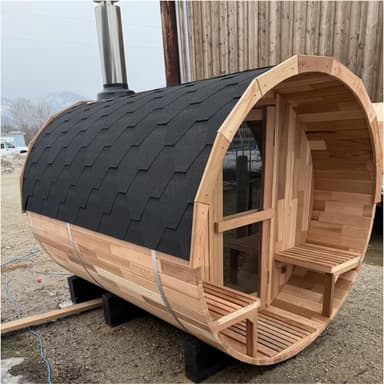
Smartmak 2-10 Person Canadian Hemlock Barrel Sauna
- Barrel shape genuinely improves heat distribution compared to box saunas
- Real red cedar and hemlock construction should last 15-plus years with care
- ETL-certified heater hits 195°F - legitimately hot for authentic steam sessions
The Smartmak Canadian Hemlock barrel sauna represents the mid-range of the current market well - hemlock is a stable, pleasant-smelling wood that performs reliably across most North American climates, and the 2-10 person size range covers the full spectrum of residential use cases. Hemlock's lower resin content compared to pine means less dripping onto benches during heat-up, which is a genuine quality-of-life difference over time.
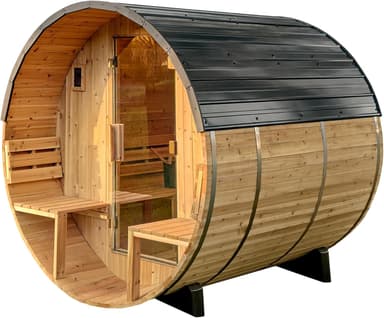
Backyard Discovery Paxton 2-4 Person Cedar Barrel Sauna
- 9kW heater reaches 170°F roughly 50% faster than budget competitors
- Barrel design eliminates dead zones with superior natural heat convection
- HDPE cradles and galvanized steel roof built for genuine year-round outdoor use
For buyers prioritizing cedar's superior rot resistance and natural aesthetics in a compact format, the Backyard Discovery Paxton 2-4 person cedar barrel is worth evaluating. At the 2-4 person scale, the 5-foot diameter provides a genuinely usable interior without the spatial and cost commitments of larger units - appropriate for couples or small families who will use the sauna regularly rather than for large social gatherings.
Sauna Culture Today - A Global Renaissance
The period from approximately 2015 to the present has seen sauna culture expand beyond its Nordic-diaspora base into a genuinely global phenomenon. This expansion has multiple drivers: the publication of well-designed epidemiological studies documenting cardiovascular and cognitive benefits 1, the parallel rise of cold water immersion as a wellness practice (which naturally pairs with sauna bathing), the general increase in interest in evidence-based longevity practices, and the social media visibility of Nordic wellness aesthetics.
The result is a market that did not exist at meaningful scale twenty years ago. In the United States, sauna ownership has grown from a niche characteristic of Finnish-American communities and luxury wellness facilities to a broadly accessible residential amenity. Industry data suggests that the North American home sauna market grew by over 40% between 2019 and 2023, driven primarily by outdoor barrel and cube-format saunas in the $4,000-$15,000 price range.
The Health Evidence - Honest Assessment
Finnish longitudinal research, particularly studies tracking the sauna habits of middle-aged Finnish men over 20+ years, has produced findings that are genuinely impressive 1. Regular sauna use (4-7 times per week) was associated with significantly reduced cardiovascular mortality compared to infrequent use (once weekly), with dose-response relationships suggesting that frequency matters. Associations with reduced dementia risk, lower blood pressure, and improved cardiac function have also been reported.
I want to be precise about what this evidence does and does not show. These are observational studies, not randomized controlled trials. Men who use saunas four times per week in Finland are also more likely to be physically active, socially connected, and to live in rural environments with lower pollution exposure - all confounders that are difficult to fully control. The physiological mechanisms are plausible and well-characterized (heat-induced cardiovascular stress produces adaptations similar to moderate aerobic exercise), but the specific magnitude of benefit attributable to sauna bathing alone, independent of the lifestyle that accompanies regular sauna use in Finnish men, remains genuinely uncertain.
What the evidence does strongly support: regular sauna bathing is safe for healthy adults, produces measurable cardiovascular responses, may contribute to lower blood pressure over time, and appears to improve subjective measures of stress and wellbeing. For anyone with cardiovascular conditions, consultation with a physician before beginning regular high-temperature sauna use is not a generic disclaimer but genuine medical prudence.
The New Public Sauna Movement
One of the most culturally interesting developments in contemporary sauna culture is the revival of public and communal sauna facilities in cities where private ownership is impractical. Helsinki's public sauna scene - nearly extinct by 2000 as residential saunas became universal - has seen remarkable reinvigoration through a series of privately developed public sauna projects, most notably Löyly (2016) and Allas Sea Pool (2016), which created premium waterfront sauna experiences that have become major cultural destinations.
This model has spread internationally. London, New York, Los Angeles, and Sydney now all have dedicated public sauna facilities that would not have existed a decade ago. These venues blend Finnish sauna traditions with local wellness culture, cold plunge facilities, and often food and beverage service. They are simultaneously heritage preservation and innovation - keeping the communal, democratic character of traditional sauna culture alive in urban contexts where private installation is impossible for most residents.
Regional Traditions Compared
| Tradition | Origin | Temperature | Humidity | Key Ritual | Social Character |
|---|---|---|---|---|---|
| Finnish Sauna | Finland, 7000 BC | 80-100°C | Low-medium | Löyly, vihta | Egalitarian, silent |
| Savusauna | Finland, pre-500 AD | 70-80°C | High | Smoke preparation | Small group |
| Russian Banya | Russia, pre-1000 AD | 50-70°C | Very high | Venik beating | Social, gregarious |
| Turkish Hammam | Islamic world, 7th C AD | 40-55°C | Steam | Kese scrub | Attendant-led |
| Japanese Onsen | Japan, pre-720 AD | 40-55°C | Water immersion | Mineral soaking | Meditative |
| Sweat Lodge | Americas, ancient | 50-70°C | High | Ceremonial | Ceremonial/spiritual |
| Modern Barrel | Global, 1970s+ | 80-100°C | Variable | Individual preference | Variable |
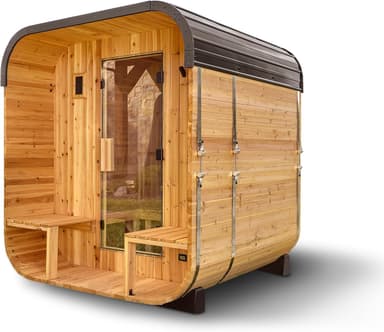
Backyard Discovery Lennon 2-4 Person Cedar Cube Sauna
- 9kW heater reaches temperature significantly faster than budget competitors
- 5-year warranty covers heater and hardware, not just the shell
- Wi-Fi preheat control adds genuine everyday convenience
The Backyard Discovery Lennon cedar cube sauna represents a different design philosophy than the barrel format - a square-section structure that maximizes interior usable space per square foot of footprint and integrates more naturally with conventional deck and patio layouts. For buyers who prioritize spatial efficiency over the aesthetic and thermal characteristics specific to barrel design, the cube format is worth serious consideration. See our best barrel saunas guide for a full comparison of barrel versus cube formats across multiple criteria.
What to Expect as a First-Time Sauna User
If you are new to sauna bathing and want to connect with this nine-thousand-year tradition effectively, the practical guidance is straightforward. Enter a properly heated sauna at 80-90°C. Sit at the lower bench initially - temperature increases significantly with
Sources and References
- Cardiovascular and Other Health Benefits of Sauna Bathing
Laukkanen JA, et al.. Mayo Clinic Proceedings, 2018.
Frequently Asked Questions
Sauna history originated around 7000 BCE in Finland with smoke saunas (savusauna), pit-like structures dug into the earth and heated by stones in a fireplace, where water was poured over hot rocks for steam after venting smoke. These evolved during the Industrial Revolution to wood-burning metal stoves with chimneys, reaching temperatures of 75-100°C, while parallel traditions included Roman bathhouses, Native American sweat lodges, and 15th-century Korean hanjeungmak. Barrel saunas, a modern wooden design for outdoor use, draw from this Finnish evolution but lack ancient roots.
Related Guides
Medical Disclaimer - This article is for informational purposes only and does not constitute medical advice. Consult a healthcare professional before beginning any sauna routine.