
Buying Guide - 1 peer-reviewed sources
Budget Barrel Saunas That Actually Deliver
Great barrel saunas do not have to break the bank. This guide shows you exactly where to spend and where to save to get the best value under $3,000.
Written by Sarah Kowalski
Editor-in-Chief
Reviewed by Erik Nordgren
Senior Sauna Reviewer
The phrase "budget sauna" used to mean a glorified garden shed with a space heater bolted to the wall. That era is over. After analyzing pricing data across 30+ barrel sauna models sold in North America and reviewing owner feedback from hundreds of verified purchasers, I can confirm that the best budget barrel sauna market in 2025-2026 has crossed a genuine quality threshold - one where real Finnish-style heat, durable cedar construction, and reliable heaters are accessible for under $5,500 delivered to your door.
The barrel shape is not a gimmick. The curved interior geometry creates natural convection currents that pull cooler air from floor level upward across the heater and redistribute heat evenly across the entire bench surface - a physics advantage that square cabin saunas simply cannot replicate without more powerful heaters and longer preheat cycles. Budget buyers who choose barrel designs are not settling; in many cases they are getting a thermodynamically superior product at a lower price than equivalent rectangular alternatives. Studies linking regular sauna use to meaningful cardiovascular and recovery benefits confirm that the health outcomes are tied to achieving proper temperatures consistently 1 - which barrel geometry helps budget units accomplish faster and with less electricity.
This guide covers everything a careful buyer needs: what the $3,800 to $5,500 price tier actually delivers, where manufacturers cut corners (and which cuts matter), which wood species hold up over a decade of steam cycles, and a frank comparison of the brands competing for your money right now. If you are ready to invest in a sauna that will still be performing in 2035, read through to the end before placing any order.
What Budget Actually Gets You in 2026
The definition of "budget" in the barrel sauna category has shifted considerably upward in real terms. In 2026, a legitimate budget barrel sauna sits in the $3,800 to $5,500 range for a 2-4 person kit with an electric heater included. Below $3,800 you are mostly looking at garden-variety hemlock boxes with low-wattage heaters that struggle to reach 170°F. Above $5,500 you enter mid-range territory where manufacturers start offering premium wood grades, thicker stave construction, and higher-end heater brands as standard equipment rather than upgrades.
What the $3,800-$5,500 Range Delivers
At this price point, a buyer should reasonably expect red cedar or thermally modified wood construction, a Harvia or equivalent UL-listed electric heater in the 6kW to 9kW range, stave thickness of 1.5 to 2 inches, a tempered glass door, and assembly hardware that is complete and labeled. Heat-up times in this tier run 45 to 60 minutes to reach 170°F to 195°F - fast enough for a weeknight session without planning an hour ahead. The curved barrel ceiling typically measures 75 to 78 inches at the apex, giving average-height adults genuine headroom while seated on upper benches.
Warranties at this tier are modest but functional. Almost Heaven, currently one of the strongest budget options in the USA market, offers a limited lifetime warranty on the room structure with 5 years on the heater. SaunaLife backs their E6 similarly. These are not the transferable, no-questions-asked warranties you get with premium Scandinavian imports, but they are serviceable for a product you intend to keep in one location for a decade.
What You Should Not Expect
Budget does not mean feature-complete. In the $3,800 to $5,500 range, expect to sacrifice panoramic full-wall glass, tongue-and-groove porch decking as a standard inclusion, WiFi-enabled heater controls on base models, and thick marine-grade stainless banding. These items exist as upgrades or appear on models at the upper edge of the range. A buyer who needs all of them simultaneously should recalibrate toward a $6,500 to $8,000 budget. The sweet spot of the budget tier is getting the heat performance and structural integrity right - the aesthetics can follow later with aftermarket additions.
The health benefits documented in research are achievable at this price point. A 20-year Finnish study found significant cardiovascular risk reduction associated with regular sauna sessions 1, and the key variable is achieving and maintaining proper temperatures - not whether your door has bronze-tinted glass or whether your heater responds to a smartphone app.
Price Tiers Explained
Understanding the full barrel sauna market hierarchy helps buyers resist upselling pressure and identify genuine value. Here is how the tiers break down in 2026:
| Tier | Price Range | Typical Features | Example Models |
|---|---|---|---|
| Entry | Under $2,500 | Hemlock or pine, basic heater, minimal warranty | Generic import kits |
| Budget | $3,800 - $5,500 | Cedar or thermally modified wood, 6-9kW UL heater, tempered glass | Almost Heaven Salem, SaunaLife E6, LeisureCraft Serenity |
| Mid-Range | $5,500 - $8,500 | Premium cedar grade, thicker staves, panoramic glass standard, porch | Redwood Outdoors Thermowood Pano, Almost Heaven Pinnacle |
| Premium | $8,500 - $14,000 | Kiln-dried Nordic spruce or premium Western red cedar, custom sizing, advanced heaters | Dundalk LeisureCraft premium line, Helo, Tylo |
| Luxury | $14,000+ | Bespoke dimensions, integrated smart home, luxury heater, professional installation | Finnish direct-import, custom fabricators |
The entry tier below $2,500 deserves a specific warning. These units are typically imported from manufacturers who use kiln-dried hemlock or pine with minimal treatment and pair them with generic Chinese-made heaters that carry no UL listing. The structural wood often lacks adequate drying, leading to excessive cracking and checking within the first two seasons. Assembly instructions tend to be translated poorly. I have reviewed enough owner reports at this price point to say with confidence: entry-tier barrel saunas frequently cost more over five years than budget-tier units purchased correctly the first time.
The budget tier at $3,800 to $5,500 represents the best value-per-performance ratio in the entire market, which is why this article focuses there.
Where Budget Saunas Cut Corners
Knowing where corners are cut is not a reason to avoid budget saunas - it is a reason to shop with precision. Manufacturers in this tier make specific trade-offs to hit price points, and some of those trade-offs matter far more than others.
Wood Grade and Drying
The most common cost-reduction strategy is using lower grades of red cedar or substituting Western red cedar with Eastern white cedar or hemlock. Grade differences in cedar are visible: lower grades show more knots, more variation in color, and tighter growth rings that can indicate faster-grown, less-dense timber. For structural staves, lower-grade cedar is a meaningful downgrade because knots create weak points where moisture can infiltrate and where checking (small surface cracks from thermal expansion) tends to initiate and propagate.
Hemlock is not inherently a bad wood for saunas - it has been used in Finnish bath houses for generations - but it requires more diligent annual sealing and is less naturally resistant to the repeated wet-dry cycling of sauna use than red cedar. Buyers choosing hemlock-based budget options like the Smartmak Canadian Hemlock should plan for more active maintenance from year one.
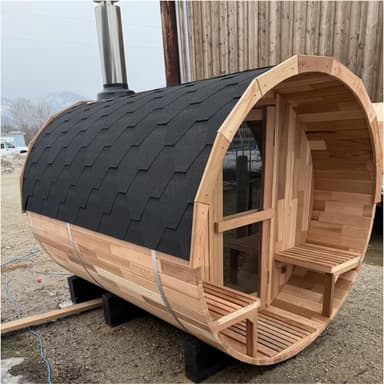
Smartmak 2-10 Person Canadian Hemlock Barrel Sauna
- Barrel shape genuinely improves heat distribution compared to box saunas
- Real red cedar and hemlock construction should last 15-plus years with care
- ETL-certified heater hits 195°F - legitimately hot for authentic steam sessions
Heater Specifications
Budget models standardly include 6kW to 8kW heaters rather than the 9kW to 12kW units found on premium options. For 2-person barrels, 6kW is genuinely adequate. For 4-person units, 6kW will heat the space but more slowly - expect 60 to 75 minutes to reach 185°F versus 45 minutes with a properly sized 9kW unit. The Harvia M80E (8kW) and the HUUM DROP (6kW) both appear on budget barrel units and both carry UL listings - a non-negotiable safety certification that generic import heaters often lack.
Banding and Hardware
External barrel banding on budget models is typically galvanized steel rather than stainless or marine-grade aluminum. In dry climates, this is a 10-year decision with minimal consequence. In coastal environments with salt air, or anywhere with harsh freeze-thaw cycling, galvanized bands can show surface rust within 3 to 5 years. This is primarily cosmetic but worth noting. Upgrading to stainless banding typically costs $150 to $300 through the manufacturer and is worth requesting at purchase time if you live within 10 miles of a coastline.
Floor Systems
Budget barrel saunas frequently ship without flooring systems or with minimal cedar duckboards that cover only the foot well. A complete floor package - cedar duckboards across the full interior diameter, a proper drainage system, and exterior entry steps - can add $300 to $600 when purchased separately. Factor this into your actual budget from day one.
What to Never Compromise On
Some specifications are not negotiable regardless of budget. These are the elements where cutting corners creates safety risks, dramatically shortened lifespan, or heat performance so degraded that the sauna is not worth using.
UL-Listed Heater
Every sauna heater installed in a residential outdoor structure should carry a UL listing (Underwriters Laboratories) or equivalent ETL certification. This is not optional. An unlisted heater creates homeowner insurance liability, fire risk, and in many jurisdictions violates local building codes. Verify the listing before purchasing any budget unit.
Minimum Stave Thickness
Stave thickness below 1.25 inches produces noticeable heat loss and structural weakness. The barrel shape depends on each stave contributing compression strength to the cylindrical assembly - thin staves deflect under the banding tension and create gaps. Minimum acceptable stave thickness for a barrel sauna that will be used year-round is 1.5 inches; 2 inches is better for northern climates.
Tempered Glass Door
Standard glass will shatter under the thermal cycling of sauna use. Any sauna unit offering a non-tempered glass door at any price point should be rejected. Tempered glass is a manufacturing standard, not a luxury feature.
Ventilation Design
Proper sauna ventilation requires an adjustable air intake near floor level and an exhaust vent positioned near the ceiling on the opposite wall from the heater. Budget units occasionally ship with fixed (non-adjustable) vents, which prevents the airflow tuning that determines how evenly the space heats. Adjustable vents are worth specifically requesting or verifying before purchase. For a full breakdown of ventilation requirements and installation considerations, see our guide on barrel sauna installation.
Best Budget Wood Types
Wood selection drives more of the long-term ownership experience than any other single variable. Here is a detailed breakdown of the species you will encounter in the budget barrel sauna market.
Western Red Cedar - The Standard Bearer
Western red cedar (Thuja plicata) is the benchmark wood for North American barrel saunas at every price point. Its natural oils - primarily thujaplicin compounds - provide inherent resistance to rot, mold, and insect damage without any chemical treatment. It is dimensionally stable through repeated heat-moisture cycles, produces a pleasant aromatic compound when warmed, and remains comfortable to touch at high temperatures due to its low thermal conductivity.
In the budget tier, the variable is grade. Clear or A-grade Western red cedar commands a price premium; budget manufacturers often use knotty grades that are structurally sound but visually busier. This is an acceptable trade-off. For cedar barrel saunas specifically, knotty-grade red cedar outperforms clear-grade hemlock on every meaningful durability metric.
Eastern White Cedar - The Canadian Alternative
LeisureCraft's product line makes extensive use of Eastern white cedar (Thuja occidentalis), which is similar in rot resistance to its Western cousin but slightly softer and more prone to surface checking under intense heat. It carries a lighter, more subdued aroma. Eastern white cedar is a legitimate sauna wood - it has been used in traditional Finnish and Canadian bath houses for generations - but it benefits from annual cedar oil application more than Western red cedar does.
Thermally Modified Wood - The Science Option
Thermal modification (sometimes sold under brand names like Thermowood or Lunawood) is a process where softwoods - typically spruce or pine - are heated to 180°C to 215°C in a steam environment. This drives out the sugars and moisture that fuel rot and mold, increases dimensional stability by 20 to 30% compared to untreated wood, and darkens the color to a warm brown that many buyers find attractive.
Redwood Outdoors' Thermowood Pano line uses this technology. The wood performs comparably to red cedar in sauna conditions and is genuinely rot-resistant without chemical additives. The trade-off is cost: thermally modified wood carries a price premium that typically pushes it into mid-range rather than budget territory. If you encounter a budget-tier unit using thermowood, look carefully at stave thickness and heater specifications, as price compromises are likely being made elsewhere.
Hemlock - The Budget Starter
Canadian hemlock (Tsuga canadensis) is the most cost-effective structural wood in the sauna market. It lacks the natural oils of cedar, is more prone to moisture absorption, and requires more maintenance to prevent mold and surface degradation. For buyers with tight budgets who commit to annual oiling and careful post-session ventilation, hemlock can deliver 8 to 12 years of service. For buyers who want minimal maintenance and maximum longevity, cedar is worth the price difference.
| Wood Type | Rot Resistance | Thermal Stability | Aroma | Maintenance Demand | Relative Cost |
|---|---|---|---|---|---|
| Western Red Cedar | Excellent | Excellent | Strong/pleasant | Low | Medium-high |
| Eastern White Cedar | Very Good | Good | Moderate | Medium | Medium |
| Thermally Modified | Excellent | Excellent | Neutral | Low | Medium-high |
| Hemlock | Fair | Good | Minimal | High | Low |
| Pine | Poor | Fair | Resinous | High | Lowest |
Electric vs Wood-Burning on a Budget
This is one of the most debated decisions in the budget sauna category, and it deserves an honest, numbers-driven assessment rather than a lifestyle-based opinion.
Electric Heaters - The Practical Default
Electric heaters are standard equipment on virtually all budget barrel saunas. The reasons are straightforward: they are easier to install, require no chimney penetration through the barrel structure, include automatic overheat shutoff, are easier to regulate to precise temperatures, and satisfy the requirements of homeowner insurance policies without special riders.
For electric heater saunas, operating costs run approximately $0.50 to $1.50 per session depending on local electricity rates, heater wattage, and target temperature. At the national average US electricity rate of approximately $0.16 per kWh (2024 EIA data), a 6kW heater running 60 minutes of preheat plus a 20-minute session consumes roughly 8kWh, costing about $1.28. Annual cost for four sessions per week is approximately $266 - less than three visits to a commercial spa.
Wood-Burning Heaters - The Authentic Experience
Wood-burning heaters produce what sauna enthusiasts describe as "softer" heat - a higher proportion of infrared radiation from the burning mass of stones, and steam (loyly) from water poured over those stones that feels different from electrically heated steam. Whether this is physically measurable or primarily experiential is an open question, but the preference is strongly held among traditional sauna users.
The costs of adding a wood-burning heater to a budget barrel sauna are significant. A quality wood-burning sauna stove (Harvia M3, Kota, or equivalent) adds $400 to $900 to the heater budget. The chimney system - a single-wall or double-wall insulated flue penetrating the barrel, roof cap, proper clearances - adds another $300 to $600 installed. Local permits may apply. Total added cost: $700 to $1,500, pushing a $4,200 electric unit to $5,200 to $5,700 equivalent.
For buyers on a genuine budget who want the wood-burning experience, wood-burning saunas are worth considering, but budget carefully. The ongoing wood fuel cost also runs $100 to $300 per season depending on wood prices in your region and session frequency.
The Hybrid Question
Some budget barrel manufacturers offer units designed to accept either electric or wood-burning heaters, with the decision made at purchase time. This is worth paying attention to: a unit designed for wood-burning has a reinforced chimney penetration point built into the barrel, proper clearances engineered in, and appropriate floor protection. Retrofitting a wood-burning heater into a unit designed only for electric is a risk I would not recommend to any buyer.
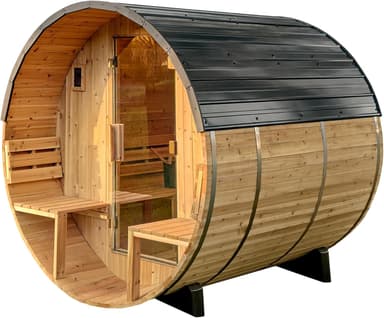
Backyard Discovery Paxton 2-4 Person Cedar Barrel Sauna
- 9kW heater reaches 170°F roughly 50% faster than budget competitors
- Barrel design eliminates dead zones with superior natural heat convection
- HDPE cradles and galvanized steel roof built for genuine year-round outdoor use
Size Recommendations for Budget Buyers
Sizing mistakes are among the most expensive errors a sauna buyer can make, because they cannot be undone without purchasing a different unit. Here is a systematic approach to getting this right.
Understanding Capacity Ratings
Manufacturer capacity ratings are optimistic. A "4-person" barrel sauna typically measures 6 feet in interior length with bench space that comfortably seats four only if all four are willing to sit in the same posture and not move. For practical regular use, subtract one person from any capacity rating. A 2-person unit works well for one person or an intimate pair; a 4-person unit is realistic for two to three adults plus children.
The Almost Heaven Salem, rated 2-person, measures 72 inches wide by 47 inches deep and seats two adults comfortably with room to lean back. The LeisureCraft Eastern Cedar Serenity, rated 4-person, extends to a usable bench length where three adults can lie down for the full reclining experience that traditional Finnish sauna practice calls for.
Matching Size to Your Yard
The exterior footprint of a 2-person barrel is approximately 6 feet wide by 4 feet deep, plus 2 to 3 feet of clearance on all sides from structures. A 4-person barrel is approximately 7 to 7.5 feet wide by 5 feet deep with the same clearance requirements. Both require a level, load-bearing surface - either a compacted gravel pad, concrete pad, or purpose-built deck - capable of supporting 540 to 900 pounds depending on model.
For a yard with limited space, the Backyard Discovery Paxton represents an interesting option - a cube-format cedar sauna rather than a traditional barrel that maximizes interior volume relative to exterior footprint.
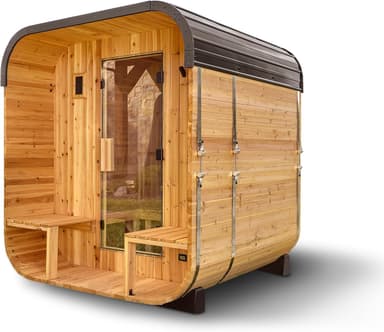
Backyard Discovery Lennon 2-4 Person Cedar Cube Sauna
- 9kW heater reaches temperature significantly faster than budget competitors
- 5-year warranty covers heater and hardware, not just the shell
- Wi-Fi preheat control adds genuine everyday convenience
Interior Headroom
The barrel apex height is not the same as functional sitting headroom. In a typical 2-person barrel, the apex measures 75 to 78 inches, but the benches sit 17 to 18 inches from the floor, leaving sitting headroom of 57 to 60 inches at center - comfortable for most adults. Taller buyers (over 6 feet 3 inches) may find the curved ceiling restrictive when seated on the upper bench of larger barrel configurations. Review interior dimension drawings, not just apex height, before purchasing.
For buyers new to the sauna experience entirely, our sauna for beginners guide covers session protocols, temperature acclimatization, and how to make the most of whatever unit you purchase.
Hidden Costs to Plan For
The sticker price of a budget barrel sauna is typically 65 to 80% of the total first-year cost of ownership. Buyers who budget only for the unit price frequently encounter frustrating surprises. Here is a comprehensive accounting of what to expect.
Site Preparation
A proper sauna installation begins with a level, stable base. Options and typical costs:
- ●Compacted gravel pad (4-inch depth, 8x10 foot area): $150 to $400 DIY, $400 to $800 contracted
- ●Concrete pad (4-inch pour, 8x10 foot area): $600 to $1,200 contracted
- ●Purpose-built pressure-treated lumber deck: $800 to $2,000 depending on height and complexity
- ●Existing concrete patio (if level and structurally adequate): $0
Many buyers are surprised that a "level" lawn is not adequate. Barrel saunas are cylindrical - they will roll on any surface that is not flat and stable. The gravel pad is the minimum acceptable solution and the most cost-effective.
Electrical Connection
Electric barrel saunas require a dedicated 240V circuit with amperage matched to the heater (most budget 6kW units require a 30-amp circuit; 8-9kW units require 40 to 50 amps). Running this circuit from your main panel to an outdoor location typically costs:
- ●Under 50 feet from panel: $400 to $700 licensed electrician
- ●50 to 150 feet from panel: $700 to $1,500
- ●Underground conduit required: Add $10 to $20 per linear foot
This is not a DIY project in most jurisdictions. A licensed electrician and a permit are required for insurance coverage and code compliance. Budget this cost explicitly.
Accessories and Comfort Items
A functional sauna session requires ladle and bucket for steam generation, sand timer or thermometer/hygrometer, towels or cedar backrests, and cedar headrests. A complete starter kit runs $80 to $200. Essential cedar essential oils for aromatherapy are optional but add $20 to $60.
Ongoing Maintenance
Annual cedar treatment with a penetrating wood oil (not film-forming sealers) costs $30 to $60 in materials and 2 to 3 hours of time. Band tightening (galvanized or stainless bands loosen as wood seasonally expands and contracts) takes 30 minutes with a wrench. Plan for one round of band tightening in year one, then every 2 to 3 years thereafter. Heater element replacement, if needed, typically runs $80 to $200 and occurs every 8 to 12 years of regular use.
| Cost Category | Low Estimate | High Estimate | Notes |
|---|---|---|---|
| Unit purchase | $3,800 | $5,500 | Base budget tier |
| Site prep | $150 | $1,200 | Gravel to concrete |
| Electrical | $400 | $1,500 | 240V dedicated circuit |
| Accessories | $80 | $200 | Bucket, ladle, thermometer |
| Year 1 maintenance | $30 | $80 | Cedar oil treatment |
| Total Year 1 | $4,460 | $8,480 | |
| Annual ongoing | $100 | $300 | Electricity + maintenance |
Budget Brand Comparison
After reviewing specifications, owner feedback, warranty terms, and assembly documentation for the leading budget barrel sauna brands, here is an honest comparison of the major players.
Almost Heaven Sauna
Almost Heaven is the dominant budget brand in the US market, manufacturing in the USA (Renick, West Virginia) with Canadian cedar. Their Salem 2-person unit is consistently cited by reviewers as the strongest compact budget option available. At sale pricing of $3,812 to $4,935, it competes on price with inferior imported alternatives while offering genuinely superior construction.
The Salem achieves 195°F in under 60 minutes using a Harvia or HUUM electric heater, delivers even heat distribution due to barrel geometry, and comes with assembly hardware that experienced reviews describe as well-labeled and complete. Assembly takes 4 to 6 hours for two adults. The limited lifetime structural warranty with 5-year heater coverage is among the strongest in the budget tier.
The Morgan 4-person model expands the capacity without dramatically increasing price, achieving the same 190°F target with a properly sized Harvia heater. Garage Gym Reviews scored the Morgan 4.2 out of 5, with heat equity (even temperature across the full bench) cited as the primary strength. Almost Heaven units can be used indoors or outdoors, a flexibility point that matters to buyers with garages or covered spaces. See our roundup of best barrel saunas for how Almost Heaven ranks across the full market.
SaunaLife E6
The SaunaLife E6 is the strongest pure-value option in the budget tier, consistently available under $4,000 and offering features that approach mid-range competitors. SaunaLife is the retail arm of Helo, a Finnish sauna manufacturer with decades of production experience, which means the heater quality and thermostat calibration on their budget units reflect genuine engineering rather than cost-cutting guesswork.
The E6's interior is described by owners as surprisingly spacious for a 2-4 person classification, with bench depth adequate for lying down. The primary limitation is lack of premium add-ons: no panoramic glass door on base models, no porch, no WiFi heater control. As a core heat-delivery product, the E6 is difficult to beat at its price point.
LeisureCraft Eastern Cedar Serenity
LeisureCraft (Dundalk LeisureCraft, Canadian manufacturer) offers the Eastern Cedar Serenity 4-person at $5,540 - the upper edge of the budget tier. The Canadian Eastern white cedar construction, 5mm bronze tempered glass door, marine-grade banding, and included porch section differentiate it from alternatives at lower price points.
The "strong insulation" noted in owner reviews reflects the thicker stave construction LeisureCraft uses relative to some US budget competitors. The porch is a genuine added value - having a covered exterior space to cool between rounds is part of traditional sauna protocol, and getting it included rather than as a $400 add-on matters.
The limitation is design simplicity. The Serenity does not offer WiFi heater controls, wood-burning compatibility in the base model, or panoramic glass. Buyers who prioritize function over aesthetics and want genuine Canadian cedar at a reasonable price will find this unit compelling.
Redwood Outdoors Thermowood Pano
The Thermowood Pano line starts at $7,599 for 2-4 person configurations, placing it technically outside the budget tier. It appears in this comparison because buyers who receive quotes at this price often encounter it and wonder whether the thermally modified wood justifies the premium. In my assessment: the thermowood construction is genuinely superior for longevity and dimensional stability, and the panoramic glass is aesthetically exceptional. But the $2,000 to $3,000 premium over Almost Heaven or LeisureCraft options is not justified by heat performance differences - those are negligible.
| Brand | Origin | Primary Wood | Heater Brand | 2-Person Price | 4-Person Price | Warranty |
|---|---|---|---|---|---|---|
| Almost Heaven | USA/Canada | Western Red Cedar | Harvia/HUUM | $3,812-$4,935 | Under $6,000 | Lifetime structure, 5yr heater |
| SaunaLife E6 | Finland/Canada | Cedar | Helo | Under $4,000 | Included | Varies |
| LeisureCraft Serenity | Canada | Eastern White Cedar | Harvia | - | $5,540 | 5 years |
| Redwood Outdoors | USA | Thermowood | Electric/wood | $7,599+ | $8,000+ | 5 years |
DIY Savings Strategies
A buyer with basic carpentry skills, a weekend, and the right approach can significantly reduce the total cost of barrel sauna ownership without compromising the final result.
Buying a Kit Versus Pre-Assembled
All budget barrel saunas ship as kits requiring assembly. This is not a penalty - it is a logistics necessity for a product weighing 540 to 1,450 pounds that must be delivered to residential addresses. The assembly itself is the primary DIY opportunity. Hiring a contractor to assemble a barrel sauna kit typically costs $500 to $1,200 depending on region and kit complexity. Two adults with basic tool competency can complete most 2-person barrel kits in 4 to 6 hours; 4-person models take 6 to 8 hours.
Our detailed guide to barrel sauna installation covers the assembly sequence, common mistakes (particularly around stave alignment and initial band tension), and how to set up the site correctly before the kit arrives.
DIY Site Preparation
Hiring a landscaping contractor to prepare a compacted gravel pad costs $400 to $800. Doing it yourself with rented equipment costs $80 to $200 in materials and half a day of labor. The steps are: mark the area 2 feet larger than the barrel footprint on all sides, excavate 4 to 6 inches, lay landscape fabric, fill with compactable gravel, rent a plate compactor for 2 hours, and verify level. This is genuinely accessible to most homeowners.
Sourcing Accessories at Wholesale
Sauna ladles, buckets, thermometers, cedar headrests, and backrests are sold at significant markup through sauna retailers. The identical items are available from European sauna supply importers (Sauna World, Northern Lights, Scandia) at 30 to 50% lower prices. A complete accessory kit purchased separately from the sauna unit typically costs $90 to $150 versus $180 to $300 bundled.
Negotiating Bundle Pricing
Almost Heaven, SaunaLife, and LeisureCraft all sell through authorized dealers who have pricing flexibility, especially during off-peak months (January through March in the Northern Hemisphere). Requesting a bundle quote that includes the sauna kit, cover/awning, and accessory kit frequently yields 8 to 15% off the sum of individual prices. Sale pricing on the Almost Heaven Salem has historically dropped the unit from $9,057 (MSRP with premium options) to $3,812 to $4,935 during promotional periods - a discount that dwarfs any other savings strategy available.
What Not to DIY
Electrical connection is not a DIY project for most buyers. Beyond the safety risks of improper 240V installation, an unlicensed electrical connection typically voids the sauna heater warranty, can result in denied homeowner insurance claims after a fire, and violates local codes that require permit and inspection. The $400 to $1,500 electrician cost is a real expense with real protection.
Similarly, modifying the heater configuration, adding non-UL-listed components, or cutting chimney penetrations into barrel walls without engineered guidance is inadvisable regardless of skill level. The structural integrity of a barrel depends on every stave remaining intact and properly tensioned.
Our Budget Picks and Why
After synthesizing specifications, pricing data, owner reviews, assembly documentation quality, warranty terms, and the health outcome research confirming that properly heated saunas deliver measurable benefits 1, here are the specific recommendations that emerge from this analysis.
Best Overall - Almost Heaven Salem 2-Person
For most buyers shopping the best budget barrel sauna category, the Almost Heaven Salem 2-person is the correct answer. It delivers 195°F heat in under 60 minutes, uses a Harvia or HUUM heater with a genuine UL listing, is built in the USA with Canadian red cedar at a quality grade that noticeably exceeds import alternatives, and carries a limited lifetime structural warranty that no comparable competitor matches.
The compact footprint (72 inches wide by 47 inches deep) fits in yards that cannot accommodate larger units. For couples, solo users who want the space to stretch out, or buyers who will have guests but not regularly need to seat four simultaneously, the Salem is the most capable product in its price range.
The legitimate criticism is that 2-person capacity is real - this unit does not comfortably seat three adults. Buyers who regularly anticipate three or more users should step up to the Morgan 4-person.
For outdoor barrel saunas in particular, the Salem's weather resistance and assembly documentation make it one of the smoothest installations available in the budget tier. Field Mag's designation of the Salem as the top budget compact option aligns with the accumulated owner data I have reviewed.
Best Pure Value - SaunaLife E6
For buyers whose primary constraint is absolute dollar amount and who can accept fewer premium features in exchange for lower upfront cost, the SaunaLife E6 under $4,000 is the strongest option. The Helo lineage ensures heater quality that budget competitors cannot match without paying a premium, and the interior dimensions offer genuine comfort for 2-person use.
The E6 is the choice for a buyer who wants to start experiencing regular sauna sessions as quickly as possible with minimum financial risk. Once the unit is installed and the routine established, upgrading accessories, adding a porch, or planning a longer-term investment in a premium unit later becomes a decision made from experience rather than speculation.
Best for Families - LeisureCraft Eastern Cedar Serenity 4-Person
At $5,540, the Serenity sits at the upper edge of the budget tier but delivers a notably more complete package than lower-priced 4-person alternatives. The included porch, Eastern white cedar construction, marine-grade banding, and 5mm bronze tempered glass door represent genuine quality differentiators. For a family intending to make sauna use a regular household practice, the porch alone justifies the price premium - cooling between rounds is part of the health protocol, and doing it comfortably rather than stepping onto grass in the dark matters.
The LeisureCraft heritage (established Canadian manufacturer selling in North America for decades) also provides supply chain reliability for replacement parts and customer service that some budget alternatives cannot match. For [cedar barrel saunas
Sources and References
- Association Between Sauna Bathing and Fatal Cardiovascular Events
Laukkanen T, et al.. JAMA Internal Medicine, 2015.
Frequently Asked Questions
The Almost Heaven Salem 2-Person Barrel Sauna stands out as the main best budget barrel sauna, praised for its compact 6x4-foot size, red cedar construction, and fast heat-up to 195°F with a Harvia heater, starting at around $3,800-$4,900. The SaunaLife E6 is another strong budget contender under $4,000, offering cozy seating for small groups with good value despite fewer features. Both models prioritize affordability and efficiency for 2-person use, though prices vary by retailer and customizations.
Related Guides
Medical Disclaimer - This article is for informational purposes only and does not constitute medical advice. Consult a healthcare professional before beginning any sauna routine.