
Buying Guide - 0 peer-reviewed sources
What Size Barrel Sauna Do You Need
Size is the single most important decision when buying a barrel sauna. This guide helps you pick the right capacity for your space, budget, and lifestyle.
Written by Erik Nordgren
Senior Sauna Reviewer
Reviewed by Jake Morrison
Installation & DIY Expert
Choosing the wrong size barrel sauna is the single most expensive mistake you can make in this hobby. Too small and you'll spend every session with your knees bent and elbows touching your neighbor. Too large and you're waiting 60 minutes for heat-up, burning through electricity, and staring at empty bench space. After analyzing dimensions, heater specifications, and owner feedback across dozens of models, I've put together the most complete sizing guide available - one that goes well beyond the vague "2-4 person" labels printed on the box.
Barrel sauna sizing is deceptively technical. The cylindrical geometry creates a relationship between diameter and interior volume that isn't obvious until you do the math. A 6-foot diameter barrel has nearly 44% more cross-sectional area than a 5-foot barrel - meaning two models with the same listed "length" can have radically different interior volumes, heat-up times, and comfort levels. The curved walls also affect usable bench space in ways that flat-wall saunas don't. Understanding these dynamics before you buy will save you thousands of dollars and years of regret.
This guide covers every size tier from compact 2-person units up through commercial 8+ person installations, with real dimensions, heater-to-volume matching, foundation requirements, and honest price expectations at each level. Whether you're a solo bather who wants a fast-heating morning ritual or a family hosting weekend gatherings, the decision tree at the end of this article will give you a clear, defensible answer.
Why Size Is the Most Important Decision
Size determines nearly every other variable in your purchase. It dictates which heater you need, how much your electrical panel must support, what kind of foundation you'll pour, how long you wait before the first ladle of water hits the rocks, and ultimately whether you use the sauna three times a week or let it sit idle because it's "too much work to heat up."
The cascade of consequences starts with interior volume. A 2-person barrel sauna running a 4-kilowatt heater can reach 80°C (176°F) in 25-30 minutes. A 6-person barrel sauna with a 9-kilowatt heater takes 45-60 minutes to reach that same temperature. That 20-30 minute difference sounds minor until you're standing in your yard at 6 AM before work, or convincing a reluctant spouse that this purchase was worth it. Frequent, spontaneous use is one of the strongest predictors of sustained sauna habit formation - and a quick heat-up enables that.
Size also determines who you can invite. Many buyers purchase based on maximum capacity: "I'll have friends over." The reality is that 80% of sessions will be solo or with one other person. Optimizing for that realistic use case - not the rare dinner party overflow - produces dramatically better outcomes. The Finnish concept of the sauna as intimate, restorative space reinforces this. Finnish guidance consistently emphasizes that sauna should feel comfortable and personal, not crowded. For sauna for beginners especially, starting with a right-sized unit builds the habit without the friction of managing a large installation.
The Manufacturer Labeling Problem
"Capacity" labels on barrel saunas are optimistic by design. A "4-person" sauna assumes four average-sized adults sitting upright, knees together, on two facing benches. It does not account for shoulder width variation, the desire to lie down for full-body heat exposure, or the reality that taller users (6'+ / 183 cm) hit their heads on the curved ceiling near the bench edges in smaller diameter units. The practical rule, recommended by sauna specialists and echoed in installation guides, is to buy one size tier larger than your anticipated peak occupancy. If you genuinely plan to use it with three people regularly, look at 4-person specs. If four people is your target group, shop in the 6-person tier.
2-Person Barrel Saunas - Dimensions and Use Cases
The 2-person barrel sauna represents the entry point for residential buyers. Typical dimensions run 4.5 to 5 feet (137-152 cm) in diameter and 6 to 7 feet (183-213 cm) in length. Interior ceiling height at the apex ranges from approximately 5.5 to 5.8 feet - sufficient for a 5'10" person to stand upright in the center, but not at the edges where the barrel curves. Total interior volume sits between 3 and 5 cubic meters, depending on exact measurements.
Heat-up time in this size tier is genuinely fast - 25 to 35 minutes with a properly matched heater, and sometimes as little as 20 minutes with a wood-burning stove in dry conditions. This is the sauna you can decide to use at 9 PM and be sweating by 9:30. For solo practitioners or couples building a daily or near-daily habit, this speed advantage compounds over time into significantly more actual sauna sessions per year compared to larger units.
Who Actually Fits
The honest answer is that a 2-person barrel sauna is comfortable for one person and functional for two adults who know each other well. Two strangers, or two large adults, will find it genuinely cramped. Shoulder-to-shoulder bench width for two people leaves perhaps 3-4 inches of clearance on each side, and leg room between facing benches is minimal. At 4.5 feet diameter, the bench surface sits low enough on the curve that taller users find their heads uncomfortably close to the ceiling peak even when seated.
For couples using it as a shared relaxation ritual, the intimacy isn't a bug - it's a feature. For families with children, a 2-person unit works well as a parent-plus-one setup. For anyone expecting occasional group use, look at the next tier.
Power and Electrical Requirements
Most 2-person models accept a 4 to 5 kilowatt heater and can run on 240V/20A service, with some compact electric models rated for 120V if the heater stays at or below 3 kilowatts. This is the only size tier where 120V becomes a realistic option, though 240V always produces better results. If your installation site doesn't have a 240V outlet nearby, a 2-person electric unit may allow you to avoid a full panel upgrade - a meaningful cost consideration.
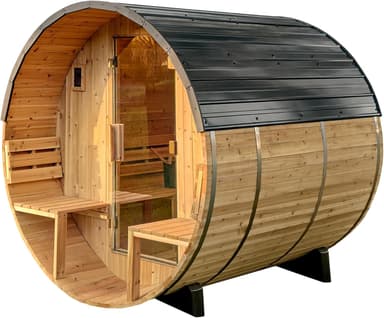
Backyard Discovery Paxton 2-4 Person Cedar Barrel Sauna
- 9kW heater reaches 170°F roughly 50% faster than budget competitors
- Barrel design eliminates dead zones with superior natural heat convection
- HDPE cradles and galvanized steel roof built for genuine year-round outdoor use
Best 2-Person Models to Consider
The Almost Heaven Salem represents the budget end at $4,935-$9,057 depending on configuration, measuring 72" x 47" x 75" and weighing 540 pounds. The Backyard Discovery Paxton is another 2-4 person cedar barrel in this size range. For cedar barrel saunas specifically, look for tight grain, vertical orientation, and proper kiln drying - these characteristics matter far more in smaller saunas where wood movement from heat cycling is more pronounced relative to the overall structure.
4-Person Barrel Saunas - The Sweet Spot
After analyzing hundreds of owner reviews and retailer sales data, the 4-person barrel sauna is the most-purchased size tier for residential buyers, and the reasoning holds up under scrutiny. Typical dimensions sit at 5.5 to 6 feet (168-183 cm) in diameter and 8 to 9 feet (244-274 cm) in length. Interior volume ranges from approximately 7 to 10 cubic meters. The 6-foot diameter is particularly significant: it produces an interior ceiling height of approximately 6.2 feet at the apex, enough for most adults to stand comfortably in the center.
The 4-person form factor balances three competing demands: enough interior volume for a genuinely spacious session with two people, the ability to host a small group of three to four when the occasion calls for it, and a heat-up time of 35 to 50 minutes that remains manageable for frequent use. This is the size that works for a family of four where typically two or three people sauna together, and occasionally the whole group.
The Volume Advantage Over 2-Person
The jump from a 5-foot diameter to a 6-foot diameter barrel increases cross-sectional area by approximately 44% (from 19.6 sq ft to 28.3 sq ft). Over an 8-foot length, that translates to roughly 70 cubic feet of additional interior volume. This isn't just more room for people - it's more thermal mass in the air, more consistent temperature distribution, and more space for proper sauna breathing. Finnish sauna tradition emphasizes deep, full-body relaxation that requires the ability to shift positions, lean back, and occasionally stretch out. The 4-person tier enables this in ways the 2-person tier simply cannot.
Electrical and Heater Requirements
A 4-person barrel sauna pairs with a 6 to 8 kilowatt heater and requires a dedicated 240V/40A circuit. This is the minimum size where a licensed electrician visit becomes non-negotiable for most installations. Budget $300 to $800 for the electrical work depending on distance from your panel and local labor rates. For electric heater saunas in this size, the Harvia KIP series and HUUM Drop are popular pairings, both offering good rock capacity relative to their kilowatt ratings - important because rock mass determines steam quality when you ladle water.
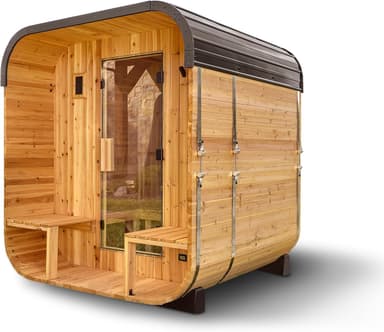
Backyard Discovery Lennon 2-4 Person Cedar Cube Sauna
- 9kW heater reaches temperature significantly faster than budget competitors
- 5-year warranty covers heater and hardware, not just the shell
- Wi-Fi preheat control adds genuine everyday convenience
Nootka and Backcountry - Benchmarks in This Tier
The Nootka Hand-Crafted 8-foot model (94" x 80" x 82") represents premium construction in the 4-person tier, using western red cedar with hand-selected staves for minimal gaps and superior heat retention. The Backcountry Recreation Classic at approximately 71" x 73" x 77" and 900 pounds offers a more accessible price point with Canadian western red cedar construction. Both use HUUM or Harvia electric heaters as standard options, with wood-burning stove conversion available on most models.
For buyers comparing options across brands, our best barrel saunas guide evaluates the top 4-person models on construction quality, warranty, and value.
6-Person Barrel Saunas - Family Size
The 6-person barrel sauna enters different territory. At 6 to 7 feet (183-213 cm) in diameter and 9 to 11 feet (274-335 cm) in length, these units have interior volumes ranging from 12 to 18 cubic meters. The 7-foot diameter produces an interior apex height approaching 6.8 feet, making it the first size tier where tall adults never feel constrained by the curve. More importantly, 6-person units allow the upper bench to be wide enough for an adult to lie flat - the most therapeutically effective position for heat exposure, since it maximizes the body surface area exposed to both radiant heat from the heater and convective heat from the air near the ceiling.
Lying flat in a sauna produces meaningfully different physiological effects than sitting upright. In the supine position, your entire posterior chain, including the lower back, hamstrings, and calves - common tension areas - receives sustained, even heat. This matters for recovery-focused users and anyone using the sauna for musculoskeletal relief.
Family Dynamics and Scheduling
For families of four to six, the 6-person tier eliminates "sauna scheduling" - the phenomenon where family members have to rotate through sessions because the smaller unit can't accommodate everyone. If weekend mornings or post-dinner sauna sessions with the full household are your goal, this size delivers. The Dundalk Leisurecraft Panoramic (84" x 71" x 84", 1,065 lbs, $11,849) is a well-known 6-person option with panoramic end windows that dramatically improve the outdoor connection - particularly valuable in scenic settings.
Heat-Up Time Trade-off
The honest assessment: 45 to 60 minutes of heat-up time changes the behavioral calculus. You need to plan ahead. Spontaneous 30-minute sauna sessions aren't realistic at this size. Many 6-person owners settle into a weekly rather than daily rhythm, which reduces the compounding health benefits of frequent use. If your lifestyle supports planned sessions on a regular schedule, this trade-off is entirely manageable. If you're more impulsive about your wellness routine, the 4-person tier will serve you better.
Electrical Requirements
A 6-person barrel sauna requires a 9 to 10.5 kilowatt heater and a dedicated 240V/60A circuit. At this power level, the circuit cost and potential panel upgrade become significant considerations. If your main panel is near capacity, adding a 60-amp dedicated circuit may require panel expansion - potentially $1,500 to $3,000 in electrical work before you've paid for the sauna itself. For outdoor barrel saunas in this size tier, wood-burning stoves become particularly attractive because they eliminate the electrical upgrade entirely.
8+ Person - Commercial and Estate
At 8 or more persons, barrel saunas transition from residential amenities to commercial or estate-grade installations. Dimensions typically exceed 7 feet in diameter and 11 feet in length, with some commercial barrel configurations running 14 to 16 feet in length with interior volumes approaching 25-30 cubic meters. These units require heaters rated at 12 to 18 kilowatts, dedicated 240V/80-100A service, and engineered foundations.
The use cases are specific: hotel wellness centers, spa facilities, large vacation rentals, or genuine estate properties hosting corporate or social events regularly. A private residence rarely justifies this size unless the property has 8+ regular occupants or functions as a semi-commercial retreat. Heat-up times of 75 to 90 minutes and running costs of $3 to $5 per session make casual use economically inefficient.
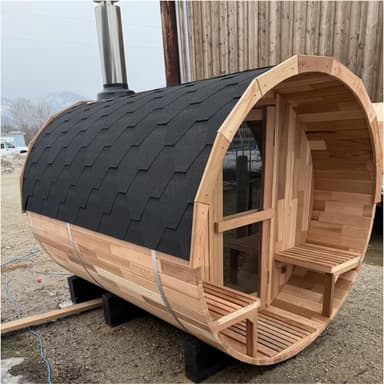
Smartmak 2-10 Person Canadian Hemlock Barrel Sauna
- Barrel shape genuinely improves heat distribution compared to box saunas
- Real red cedar and hemlock construction should last 15-plus years with care
- ETL-certified heater hits 195°F - legitimately hot for authentic steam sessions
Commercial Considerations
Commercial barrel sauna buyers must evaluate factors that residential buyers can largely ignore: ADA accessibility requirements in public accommodations, commercial-grade heater certification (UL/ETL listing becomes critical), liability insurance implications, and local health department regulations. Wood-burning stoves are frequently prohibited in commercial installations due to fire code requirements. For wood-burning saunas in a commercial context, always consult your local fire marshal before purchasing.
Construction quality demands escalate at this size. Stave thickness should be 44mm minimum (compared to 38mm adequate for residential), and tongue-and-groove precision becomes more critical because larger diameter barrels have more linear feet of joins that must seal against thermal cycling. Look for manufacturers offering engineered stave profiles rather than simple square-cut tongue-and-groove.
Diameter vs Length - What Matters More
This is the question that separates informed buyers from those who rely on manufacturer marketing. The answer, based on the geometry involved, is that diameter dominates on nearly every dimension that matters: comfort, headroom, bench width, heat distribution, and actual usable interior volume.
Here's the math. Interior volume of a barrel sauna approximates a cylinder: V = π × r² × L. Increasing diameter from 5 feet to 6 feet (r from 2.5 to 3 feet) increases volume by 44% at any given length. Increasing length by 1 foot adds only 1/L × 100% to volume - roughly 12-14% for a typical barrel. Put differently: buying a 5-foot diameter, 9-foot long barrel gives you less interior volume than a 6-foot diameter, 7-foot long barrel, despite being visually longer.
What Diameter Determines
Diameter determines four critical user-experience factors:
Peak interior headroom - directly equal to interior diameter minus stave thickness (typically 1.5-2 inches per side). A 5-foot (60") diameter barrel with 1.75" staves has approximately 56.5" of interior diameter, meaning 4'8" of standing headroom. A 6-foot (72") barrel gives you approximately 68.5" - nearly 5'9". A 7-foot barrel delivers approximately 80.5", or 6'9". The practical threshold for comfortable standing without ducking is around 66-68 inches of interior diameter, which corresponds to a 70-72" exterior diameter - the 6-foot tier.
Upper bench width - the upper bench in a barrel sauna is limited by the interior curve. In a 5-foot diameter barrel, the upper bench width practical maximum is approximately 18-20 inches. In a 6-foot diameter barrel, benches can reach 24-28 inches. In a 7-foot diameter barrel, 30-36 inches becomes possible. Bench width determines whether you can lie flat, which is the difference between a sitting-only and a full-body sauna experience.
Heat distribution evenness - larger diameter allows the heater to distribute heat more evenly in three dimensions, reducing temperature stratification between floor and ceiling. The temperature differential in a 5-foot diameter barrel can reach 15-20°C between floor and upper bench. In a 7-foot diameter, that stratification is more pronounced but the ceiling height keeps the upper bench at an optimal 80-90°C while the lower bench remains at a more moderate 60-70°C - giving users a choice of intensity.
Natural ventilation - larger diameter barrels accommodate better air circulation, important for CO2 management during extended sessions and for the "fresh" sensation that distinguishes a well-designed sauna from a stuffy box.
What Length Determines
Length primarily determines capacity - how many people can be seated simultaneously on the benches. A 6-foot diameter barrel at 7 feet long seats 2-3 people comfortably. At 9 feet, 4-5 people. At 11 feet, 6-7 people. Length also affects the "entrance vestibule" option: some manufacturers configure longer barrels with a changing/cool-down area behind the main sauna door, separated by a partition. This requires at least 10-11 feet of total barrel length to be practical.
Length also influences structural requirements. Barrels longer than 10 feet need intermediate support bands or internal structural rings to prevent the barrel profile from distorting under the stave tension and occupant weight. Check manufacturer specifications for this - it's a common quality differentiator.
| Diameter (ft) | Interior Height | Max Bench Width | Comfortable Capacity | Volume (8 ft length) |
|---|---|---|---|---|
| 4.5 | ~4'6" | 16 in | 1-2 persons | 17.5 cu ft |
| 5.0 | ~4'8" | 18-20 in | 2 persons | 21.5 cu ft |
| 5.5 | ~5'4" | 20-24 in | 2-3 persons | 26.1 cu ft |
| 6.0 | ~5'9" | 24-28 in | 3-4 persons | 31.0 cu ft |
| 6.5 | ~6'2" | 28-32 in | 4-5 persons | 36.3 cu ft |
| 7.0 | ~6'8" | 30-36 in | 5-6 persons | 42.0 cu ft |
Heater Sizing by Volume
Proper heater sizing is the most technically precise decision in sauna setup, and getting it wrong in either direction creates problems. An undersized heater never reaches target temperature or takes 90+ minutes to get there. An oversized heater cycles on and off rapidly, creating temperature swings and shortening heater element life.
The Finnish Sauna Society and sauna heater manufacturers use a cubic meter calculation as the baseline: 1 kilowatt of heater capacity per 1 cubic meter of interior volume, with adjustments for insulation quality, ambient temperature, and window area. For outdoor barrel saunas in climates with winter temperatures below 0°C, add 15-20% to the base calculation. For well-insulated cedar barrels in mild climates, the standard 1kW/m³ rule holds.
Volume Calculations by Size Tier
| Sauna Size | Typical Dimensions | Interior Volume | Recommended Heater | Min Circuit |
|---|---|---|---|---|
| 2-person | 5 ft dia x 6 ft | ~3.5 m³ | 3.5-4 kW | 240V/20A |
| 3-person | 5 ft dia x 8 ft | ~4.8 m³ | 4.5-5 kW | 240V/30A |
| 4-person | 6 ft dia x 8 ft | ~6.7 m³ | 6-8 kW | 240V/40A |
| 6-person | 6.5 ft dia x 10 ft | ~10.0 m³ | 9-10.5 kW | 240V/60A |
| 8-person | 7 ft dia x 12 ft | ~14.0 m³ | 12-15 kW | 240V/80A |
Wood-Burning Stoves - A Different Calculation
Wood-burning saunas use BTU ratings rather than kilowatts, and the relationship to volume is less linear because wood stoves produce both radiant and convective heat at different ratios than electric. The Harvia M3, one of the most common barrel sauna wood stoves, is rated for spaces up to 14 cubic meters - appropriate for 4-person barrel saunas but undersized for 6-person units. The Harvia Pro 20 handles up to 20 cubic meters, covering most 6-person applications.
Wood stoves have a significant advantage in cold climates: their radiant heat output warms the thermal mass of the sauna structure faster than electric resistance elements, compensating for outdoor heat loss. In practice, a wood stove can heat a well-insulated 4-person barrel to 80°C in 30-40 minutes even at -20°C ambient temperatures, while an equivalently powered electric heater may take 60+ minutes under the same conditions.
Rock Capacity and Steam Quality
Heater rock capacity is often overlooked in sizing discussions but directly affects the sauna experience. Rocks store thermal energy and release it as steam (löyly) when water is ladled over them. A heater with 15 kg of rocks produces a more satisfying, sustained steam response than one with 8 kg, even at the same kilowatt rating. For 4-person and larger saunas, prioritize heaters with 20+ kg rock capacity for quality steam sessions.
Bench Layout and Comfort
Bench configuration in a barrel sauna is constrained by the curved geometry in ways that flat-wall saunas are not, and the design choices here have large effects on usable space and thermal positioning.
Most barrel saunas use a two-bench layout: an upper bench at approximately 36-42 inches from the floor and a lower bench at approximately 18-20 inches. The upper bench is the primary bathing position - at this height, you're sitting in the hottest zone of air, typically 80-90°C in a well-operating sauna. The lower bench serves as a step, a cool-down position, or additional seating for groups.
The 2-Foot-Per-Person Rule
Industry standard bench allocation is approximately 24 inches (60 cm) per person for seated use - enough for shoulder width with a small buffer. For a 4-person sauna with benches on both sides of the interior (facing each other), each bench needs to accommodate 2 persons at 24 inches each, meaning 48 inches of bench run minimum. For a single-bench layout, the full 4-person capacity requires 96 inches (8 feet) of bench length - nearly the entire interior length of the barrel.
For lying down - which should be considered the target configuration for therapeutic use - each person requires approximately 70-76 inches (178-193 cm) of bench run depending on height. This means lying down is realistically a solo activity in 2 and 3-person saunas, and requires careful coordination in 4-person units. In 6-person and larger barrels with upper bench widths approaching 30 inches, two people can lie head-to-foot simultaneously.
L-Bench and Backrest Configurations
Some barrel sauna manufacturers offer L-bench configurations, particularly in longer barrels, where one bench runs along the interior length and the other bench turns 90 degrees at one end. This maximizes lying-down space for solo or couple use while still providing seated capacity for groups. The L-bench typically suits 4-person and larger barrels due to the turning radius required.
Backrests are a comfort addition that many buyers overlook until they're sitting in a sessioin without one. Angled at approximately 15-20 degrees from vertical, backrests allow the user to relax their core musculature fully - important for sessions lasting more than 10-15 minutes. In smaller diameter barrels, the curved wall itself serves as a partial backrest when the bench is positioned correctly. In larger diameter barrels, the wall curves away from the seated user, making dedicated backrests more important.
Entry Door Positioning
Most barrel saunas place the entry door at one flat end. This means the area immediately inside the door is partially occupied by the vestibule/entry space, reducing effective bench length by 18-24 inches. A nominal 8-foot barrel doesn't have 8 feet of bench available - it has approximately 6.5 to 7 feet after accounting for door clearance and heater placement. Factor this into your sizing decisions: if you're planning a 4-person barrel based on "8 feet of bench space," the real bench run is closer to 6.5 feet per side in a dual-bench layout.
Backyard Space Requirements
The barrel sauna footprint on your property is larger than the unit itself. Safety clearances, access paths, ventilation space, and the visual impact of a 7-foot diameter cylinder in your yard all factor into site selection. Understanding these requirements before purchase prevents the common and painful scenario of a delivered sauna that doesn't legally or practically fit your intended location.
Minimum Clearances
Fire codes and manufacturer warranties typically specify minimum clearances from structures, property lines, and combustible materials. General requirements:
- ●From house/attached structures: 4-6 feet minimum (varies by local code; some jurisdictions require 10 feet for wood-burning stoves)
- ●From property lines: Check local setback requirements - typically 5-10 feet in residential zones
- ●From overhead power lines: 10 feet minimum
- ●From combustible landscaping (trees, shrubs): 5 feet minimum for wood-burning stoves
A 6-person barrel sauna measuring 7 feet wide and 11 feet long, with required clearances on all sides, needs a footprint of approximately 17 feet x 21 feet of clear space to meet typical codes. Many suburban lots cannot accommodate this without careful siting.
Practical Site Planning
| Sauna Size | Unit Footprint | Min. Clearance Zone | Recommended Total Space |
|---|---|---|---|
| 2-person (5 ft x 6 ft) | 5 x 6 ft | 4 ft all sides | 13 x 14 ft |
| 4-person (6 ft x 8 ft) | 6 x 8 ft | 4-5 ft all sides | 16 x 18 ft |
| 6-person (7 ft x 10 ft) | 7 x 10 ft | 5 ft all sides | 17 x 20 ft |
| 8-person (7 ft x 12 ft) | 7 x 12 ft | 6 ft all sides | 19 x 24 ft |
Beyond code minimums, practical experience suggests accounting for: a plunge pool or cold shower area (adds 6-10 feet if desired), access path width (minimum 3 feet for comfortable movement carrying towels/buckets), and any future deck or seating platform around the sauna. Many owners eventually want a small deck at the entrance for cool-down seating - plan 6-8 additional feet in that direction.
Delivery Access
Barrel saunas over 900 pounds often arrive by freight truck and require a clear path from the street to the installation site. A 6-person barrel weighing 1,000+ pounds cannot be carried through a 36-inch gate by two people - it requires either a path wide enough for equipment (typically 6+ feet) or disassembly into stave bundles at the delivery point. If your yard access is limited, confirm with the manufacturer whether flat-pack/kit delivery is available, and factor assembly time into your planning. Our barrel sauna installation guide covers delivery logistics in detail.
Weight and Foundation Needs by Size
Structural failure in barrel sauna foundations is rare but catastrophically expensive when it happens. A 1,000-pound sauna that settles unevenly over two years develops gaps between staves, stress cracks at the hooping points, and door frames that no longer square up. Understanding weight ranges and matching them to appropriate foundations is non-negotiable.
Weight by Size Tier
Cedar barrel saunas weigh significantly more than comparable hemlock or pine models due to cedar's density and typically thicker stave profiles. The following ranges assume western red cedar construction with standard stave thickness:
| Sauna Size | Diameter | Length | Weight Range (lbs) | Weight per Linear Foot |
|---|---|---|---|---|
| 2-person | 5 ft | 6 ft | 450-600 | 75-100 lbs/ft |
| 3-person | 5 ft | 7.5 ft | 550-750 | 73-100 lbs/ft |
| 4-person | 6 ft | 8.5 ft | 750-1,000 | 88-118 lbs/ft |
| 6-person | 6.5-7 ft | 10 ft | 950-1,200 | 95-120 lbs/ft |
| 8-person | 7 ft | 12 ft | 1,200-1,600 | 100-133 lbs/ft |
These are unoccupied weights. Add 150-200 pounds per person for occupant load, plus the heater (45-90 lbs for electric, 80-150 lbs for wood-burning with rocks). A 6-person sauna at full capacity can exert over 2,000 pounds on the foundation.
Foundation Options
Crushed gravel pad: The minimum acceptable foundation for barrel saunas up to approximately 800 pounds. Requires 4-6 inches of compacted crushed stone (3/4" clean crushed, not pea gravel which shifts) over a weed barrier. Cost: $50-$200 in materials. Limitation: provides minimal frost protection in cold climates and may settle unevenly in clay-heavy soils.
Concrete slab: The standard recommendation for 4-person and larger barrel saunas. A 4-inch slab reinforced with rebar or wire mesh can support 3,000-5,000 pounds per square foot of bearing pressure - far exceeding any residential sauna load. Cost: $800-$2,500 depending on size and local labor. Advantage: permanent, level, frost-resistant when properly installed below frost line.
Pressure-treated timber cradles: Several manufacturers supply or recommend wooden cradle assemblies - two or three curved pressure-treated runners that match the barrel's diameter. These distribute load along the barrel's base and require a level, compacted surface beneath them. They allow minor repositioning after installation and are generally appropriate for barrels up to 1,000 pounds on stable, well-drained ground.
Deck integration: Mounting a barrel sauna on an existing deck is possible but requires structural assessment. A 1,000-pound sauna concentrated over a 6x10 foot footprint creates approximately 17 pounds per square foot of load - within the 40 psf live load design standard for most residential decks, but only if the deck was properly built and is in good condition. Have a contractor assess any deck before placing a sauna on it.
Price by Size - What to Expect
Barrel sauna pricing doesn't scale linearly with size - it scales with volume, which grows as the square of diameter times the linear length. A 6-person barrel sauna uses roughly 2.5-3 times the material of a 2-person model, but the price is typically only 1.8-2.2 times higher, meaning the per-person cost actually decreases as you move up. This counterintuitive finding makes the 4-person and 6-person tiers better value propositions on a cost-per-user basis.
| Size Tier | Diameter x Length | Kit/Entry Price | Mid-Range | Premium | Notes |
|---|---|---|---|---|---|
| 2-person | 5 ft x 6 ft | $3,500-$5,000 | $5,000-$7,500 | $8,000-$12,000 | Almost Heaven Salem at $4,935 is benchmark |
| 3-person | 5 ft x 7.5 ft | $4,500-$6,000 | $6,000-$8,500 | N/A | Limited options in this tier |
| 4-person | 6 ft x 8-9 ft | $5,500-$7,500 | $7,500-$10,000 | $12,000-$18,000 | Most competitive market |
| 6-person | 7 ft x 10-11 ft | $7,500-$10,000 | $10,000-$14,000 | $15,000-$22,000 |
Frequently Asked Questions
Barrel saunas typically come in sizes based on capacity, with diameters of 4.5-7 feet and lengths of 6-11 feet. Common models include 2-person (4.5-5 ft diameter, 6-7 ft long), 3-person (5 ft diameter, 7-8 ft long), 4-person (5.5-6 ft diameter, 8-9 ft long), and 6-person (6-7 ft diameter, 9-11 ft long). Exact dimensions vary by manufacturer, so check specific product specs for your space.
Related Guides
Medical Disclaimer - This article is for informational purposes only and does not constitute medical advice. Consult a healthcare professional before beginning any sauna routine.