
Health & Wellness
Sauna and Cardiovascular Health - The Research Evidence
The strongest evidence base for any sauna benefit is cardiovascular. Here is exactly what 20+ years of research shows.
Written by Dr. Maya Chen
Wellness & Health Editor
The evidence connecting saunas to heart health is stronger than most people realize. A single Finnish study tracked over 2,300 men for nearly 21 years and found that frequent sauna use cut fatal cardiovascular disease risk in half.
That is not a minor finding. Here is what the research actually shows, what it does not show, and how to use a sauna in a way that mirrors the protocols behind those numbers.
The 20-Year Finnish Study - What the Numbers Actually Mean
The landmark research on sauna cardiovascular health comes from the University of Eastern Finland. The study followed 2,315 middle-aged Finnish men for an average of 20.7 years, tracking sauna frequency against cardiac outcomes.
Men who used the sauna 4-7 times per week showed a 63% reduction in sudden cardiac death risk compared to once-weekly users. Fatal coronary heart disease dropped 48%, fatal cardiovascular disease dropped 50%, and all-cause mortality fell 40%. The study recorded 190 sudden cardiac deaths, 281 fatal coronary heart disease events, 407 fatal cardiovascular disease deaths, and 929 total deaths across the cohort.
The average session was 14 minutes at 175°F (79°C). That is a standard Finnish dry sauna temperature, not extreme by Finnish standards. Men using the sauna 2-3 times per week saw 38% all-cause mortality versus 49% for once-weekly users and 31% for the 4-7 times per week group. Frequency, not duration, drove the effect.
One important caveat: this was observational data. Dr. Prashant Rao at Beth Israel Deaconess Medical Center has noted that the benefits may partly reflect healthier overall lifestyles among frequent sauna users rather than pure causation. The association is strong, but randomized trials testing the same long-term outcomes do not exist yet.
How Sauna Use Affects the Heart and Circulation
The cardiovascular effects of a sauna session are measurable and well-understood. Heat exposure pushes heart rate to 100-150 bpm, dilates blood vessels, and triggers up to 1 pint of sweat per session. This response closely mirrors low-to-moderate aerobic exercise.
Repeated sessions lower resting blood pressure, improve endothelial function (the health of artery linings), and reduce levels of norepinephrine and natriuretic peptides, both markers of cardiovascular stress. Left ventricular performance also improves with consistent use in coronary heart disease patients.
A multicenter randomized controlled trial with 149 advanced heart failure patients showed that 2 weeks of dry sauna therapy increased 6-minute walk distance by 44.9 meters, reduced cardiothoracic ratios by 1.58%, and moved patients out of the most severe NYHA heart failure classifications. A separate RCT with 30 heart failure patients who had frequent premature ventricular contractions found that sauna reduced those contractions from 3,097 per day to 848 per day after 2 weeks. That is direct evidence answering the question of whether sauna is good for heart palpitations - for this specific type, controlled sauna therapy produced dramatic reductions.
For peripheral artery disease, an RCT with 21 patients showed improvements in ankle-brachial index and walking distance after sauna therapy.
Where the Research Gets More Complex
Not every trial has confirmed benefits. A 2023 RCT with 41 stable coronary artery disease patients found no improvements in blood pressure or arterial flexibility after 8 weeks of 20-30 minute sauna sessions four times per week. A 2025 review of 20 RCTs covering passive heating (saunas, hot baths, hot yoga) found no benefits for cholesterol, inflammation, or arterial stiffness.
Short-term trials measuring the wrong endpoints are likely part of this picture. The Finnish cohort data shows benefits accumulated over decades of regular use. Expecting 8 weeks to move cholesterol numbers misses how this mechanism works.
The distinction between sauna types also matters. Every major piece of long-term cardiovascular data comes from traditional Finnish dry saunas operating at 160-195°F with low humidity. Infrared saunas operate at 120-150°F and lack any comparable long-term CVD data. If sauna cardiovascular health is your primary motivation, traditional Finnish style is the only evidence-backed choice.
Pairing Sauna With Exercise - The Synergy Effect
Sauna use after exercise produces better outcomes than either alone. Research from UCLA Health found that adding 15 minutes of sauna immediately after workouts three times per week produced greater blood pressure reductions than exercise alone.
For people with low cardiovascular respiratory fitness, the exercise-plus-sauna combination improved fitness levels more than exercise did by itself. For people already in good cardiovascular shape, the combination reduced heart death risk further, including sudden cardiac death risk.
The practical protocol: complete your workout, then enter the sauna for 15-20 minutes while your heart rate is still elevated. This timing maximizes the cardiovascular adaptation signal.
Safety - Who Should Use Caution and Who Should Avoid It
Sauna is safe for people with mild heart failure, controlled hypertension, and stable coronary artery disease. Harvard's Dr. Thomas Lee has endorsed sauna for people with high cholesterol, hypertension, and diabetes specifically for vascular health benefits.
Avoid sauna if you have unstable angina, had a heart attack within the past few weeks, or have uncontrolled arrhythmias. The question of sauna and heart arrhythmia is nuanced: controlled sauna therapy reduced PVCs in the clinical trial cited above, but uncontrolled arrhythmias are a different situation requiring physician clearance first.
On sauna and blood pressure medication: certain medications including diuretics and beta-blockers interact with heat stress. Diuretics increase dehydration risk significantly. Beta-blockers blunt heart rate response, which changes how your body handles heat. If you take any cardiac medication, get explicit physician sign-off before starting regular sauna use.
Always drink 16-32 ounces of water before and after each session. Exit immediately if you feel dizzy or develop chest discomfort. Keep sessions to 15-20 minutes. Elderly users, pregnant individuals, and anyone who has consumed alcohol face higher risk and need extra caution.
Choosing a Sauna That Matches the Research Protocols
The Finnish trial protocol - 175°F, 14-20 minutes, 4-7 times per week - requires a sauna that holds temperature consistently. This is where cheap kits fail. Units under $4,000 with poor insulation cannot reliably reach and hold 175°F, which means you are not replicating the conditions behind the research.
Barrel saunas work well for home cardiovascular routines because their curved shape circulates heat evenly and they retain temperature efficiently. Here are three options I recommend for people prioritizing heart health outcomes.
The SaunaRay Harvia Legend 6-person barrel (6.5-foot diameter, 195°F maximum, $7,500-$9,000) uses an authentic Finnish Harvia heater built specifically for the temperature ranges in the research. Owners consistently report it reaching and holding session temperatures without fluctuation, which matters when you are targeting 4-7 sessions per week long-term. The price premium of roughly 20% over comparable models reflects heater quality and build longevity of 15-20 years.

Cedar Square 6-Person Outdoor Sauna with Harvia Heater
- Canadian Red Cedar resists rot, warping, and holds up beautifully outdoors
- Harvia heater is a trusted, ETL-certified brand worth having in any sauna
- Six-person capacity with real usable floor space, not just a claimed number
The Almost Heaven Morgan 6-person barrel (7-foot length, 180°F operating temperature, $6,000-$8,000) offers the best per-person value at roughly $1,000 per capacity slot. Users report easy 4-times-per-week routines without operational issues. This is the model I would recommend for a family or household where multiple people share the unit.
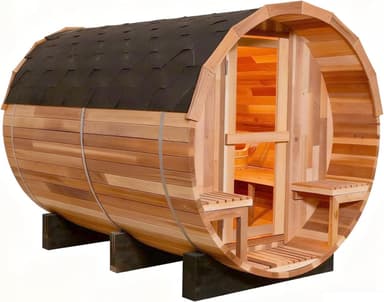
TOULE 6-8 Person Canadian Red Cedar Barrel Sauna
- Barrel shape eliminates uneven heat and shortens warm-up time noticeably
- Canadian Red Cedar resists moisture, rot, and handles temperature swings well
- Triple waterproofing system is more thorough than most competitors offer
The Redwood Outdoors Thermowood 4-person barrel (5.8-foot diameter, 185°F, $5,500-$7,200) uses thermowood cedar that handles moisture and temperature cycling better than standard cedar over time. Its even heat distribution makes it a strong choice for beginners working toward the 2-3 times per week frequency that already showed 38% all-cause mortality reduction in the Finnish cohort.

Panoramic 6-Person Canadian Red Cedar Barrel Sauna
- Triple waterproofing system meaningfully outperforms single-layer barrel competitors
- Barrel design circulates heat evenly and reaches 195°F in 30 minutes
- Canadian red cedar construction resists humidity-driven warping reasonably well
For a broader look at the top-tier options in this category, the best premium barrel saunas guide covers additional models with detailed specs.
On cost and return: entry-level barrels in the $5,000-$7,000 range used four times per week access the same risk reduction data as the Finnish cohort. U.S. cardiovascular disease treatment costs average over $10,000 per year for managed conditions. Factor in $200 per year in electricity and $500 for installation, and the math on a 15-year sauna lifespan is straightforward.
Putting It Into Practice
The research on sauna benefits and disadvantages shows a clear pattern: benefits are real, measurable, and linked to frequency, but they require consistency over years, not weeks.
Start at 2-3 sessions per week to build heat tolerance. Use a traditional Finnish dry sauna at 160-175°F. Keep sessions at 14-20 minutes. Add sauna immediately after exercise when possible. Hydrate before and after every session. Build toward 4-7 sessions per week over 2-3 months.
That protocol - grounded in the 20-year sauna study data - is what the evidence actually supports. The question is not whether sauna cardiovascular health benefits exist. The question is whether you will use it consistently enough to access them.
Frequently Asked Questions
Traditional Finnish saunas are the best for cardiovascular health among barrel sauna options, as their intense dry heat (150°F-195°F) elevates heart rate to 120-150 bpm, mimicking moderate exercise and providing proven benefits like 63% lower risk of sudden cardiac death and 50% reduced fatal heart disease risk per long-term Finnish studies on 2,300+ men. Barrel saunas typically use this traditional design with heated rocks, outperforming gentler infrared models that lack equivalent longitudinal data, though combining both can optimize results. Laukkanen et al.'s research confirms regular use (4-7 times weekly) lowers blood pressure and inflammation.
Backed by Peer-Reviewed Research
Health claims on this page are verified against peer-reviewed studies by our health editor, Dr. Maya Chen.
- Association Between Sauna Bathing and Fatal Cardiovascular and All-Cause Mortality Events
Laukkanen T, Khan H, Zaccardi F, Laukkanen JA (2015)
20-year study found frequent sauna use (4-7 times/week) was associated with 40% lower all-cause mortality.
- Cardiovascular and Other Health Benefits of Sauna Bathing
Laukkanen JA, Laukkanen T, Kunutsor SK (2018)
Regular sauna bathing reduces risk of cardiovascular disease, hypertension, and neurocognitive diseases.
- Clinical Effects of Regular Dry Sauna Bathing
Hussain J, Cohen M (2018)
Evidence supporting sauna bathing for pain conditions, chronic fatigue, and cardiovascular improvements.
Related Guides
Affiliate Disclosure - SaunasNMore earns a commission from qualifying purchases through our Amazon affiliate links. This does not affect our editorial integrity.