
Installation
Outdoor Sauna Installation - Foundation and Setup Guide
Outdoor installation has one big enemy - water. Get foundation and drainage right or pay for it later.
Written by Jake Morrison
Installation & DIY Expert
This guide walks you through outdoor sauna installation from raw ground to a level, ready-to-use structure. You will choose the right foundation type, prep your site correctly, and set your sauna so it lasts 20+ years without shifting, rotting, or heaving.
Before You Start
Time estimate: 1-2 days for a gravel pad foundation, 7-28 days if you pour concrete (cure time), plus 4-8 hours for sauna assembly.
Tools needed:
- ●Laser level or 4-foot spirit level
- ●Plate compactor (rent from Home Depot for $60-$80/day)
- ●Sod cutter or flat spade
- ●Wheelbarrow and tamping bar
- ●Measuring tape and marking paint or stakes
- ●Work gloves, safety glasses
Materials (gravel pad baseline):
- ●3/4-inch crushed stone or class 5 gravel
- ●Landscape fabric (weed barrier)
- ●Pressure-treated 4x4 skids (if your sauna kit requires them)
Prerequisites:
Check your local building codes before breaking ground. Concrete slabs over 200 square feet require permits in most jurisdictions. Call 811 at least 3 business days before digging to have underground utilities marked. Know your local frost line depth - in Minnesota or Montana that is 42-60 inches, while in Georgia it is only 6 inches.
Step 1 - Choose Your Foundation Type
The foundation is the single most important decision in outdoor sauna installation. Get this wrong and you are dealing with a shifted structure, rotting floor boards, or heaved footings within two seasons.
Gravel pad is the right call for 80% of installations. It costs $500-$1,500 for materials and labor on an 8x12-foot area, drains moisture immediately, and lets you relocate the sauna if needed. Zook Cabins and Almost Heaven both recommend it as the top choice for longevity. Real-world owners report gravel bases lasting 15+ years without problems.
Concrete slab makes sense for permanent cabin-style saunas in high-snow climates. Budget $2,000-$5,000 for a poured and reinforced slab. The downside is poor drainage unless you slope it 1/4 inch per foot, and concrete cracks over time in freeze-thaw cycles.
Frost-proof footings with gravel (sonotube bell footings dug to your local frost line, typically 36 inches) is the premium option for cold regions. Cedar and Stone mandates this for all their installs. Each footing handles 2,500 pounds, and this system prevents the 2-6 inches of annual heaving that destroys foundations above the frost line. Budget $1,500-$3,500 and hire a contractor for the depth assessment.
Pavers or patio stones on a 4-inch compacted gravel base run $800-$2,000 and work well if you are placing the sauna on or near an existing patio. SaunaFin endorses this approach for its even weight distribution.
For the steps that follow, the instructions focus on a compacted gravel pad - the most DIY-friendly and widely recommended option.
Step 2 - Mark and Measure Your Site
Your prep area must extend 2-3 feet beyond the sauna's footprint on all sides. This gives you drainage buffer and equipment access.
For a barrel sauna that is 7 feet wide and 7 feet long, mark out a 10x10-foot minimum area. For an 8x12-foot cube-style sauna, mark a 11x15-foot area. Use stakes and string or marking paint to outline the zone clearly.
Place the sauna 10-20 feet from your house. Close enough to run electrical conduit without expensive trenching, far enough to meet fire clearance requirements (3 feet minimum around heater exhaust areas, though 10 feet is safer for combustibles).
Stay away from large trees. Tree roots grow outward 1.5 times the tree's height and will push under your foundation within 5-10 years, causing uneven settling. Aim for at least 15 feet of clearance from any mature tree.
Check sun and wind orientation. A southern exposure keeps the sauna warmer in winter and reduces heating costs. Position the door opening away from your prevailing wind direction.
Step 3 - Excavate and Prepare the Ground
Mark your perimeter clearly, then strip the top 4 inches of soil across the entire marked area. Go 6 inches if you have heavy clay soil - clay holds moisture and needs a deeper gravel layer to drain properly.
Remove all organic material - grass roots, leaves, rocks, and debris. Organic matter retains moisture and compresses unevenly over time. This is the number one reason sauna foundations fail within 2 years when owners skip this step.
Once excavated, rake the subgrade flat. Run your laser level across multiple points. You are looking for a variance of no more than 1/4 inch across the entire area before gravel goes in. For barrel saunas, precision here is critical - the staves align only when the base is perfectly level. Finnish Sauna Builders report that 20% of barrel sauna installation failures trace back to a base that was off by just 1 inch.
Lay landscape fabric across the excavated area. Overlap seams by 12 inches and fold the edges up against your perimeter border. This stops weeds from pushing up through the gravel while still allowing water to drain down.
Step 4 - Install and Compact the Gravel Base
Pour 3/4-inch crushed stone or class 5 gravel into the excavated area. Do not dump all of it at once. Work in 2-inch lifts - pour 2 inches, compact fully, then add the next 2 inches.
Use a plate compactor for each lift. Hand tamping is inadequate for this job. A plate compactor rents for $60-$80 per day at Home Depot or any equipment rental shop. Run it in overlapping passes across the entire surface, similar to mowing a lawn. Each 2-inch lift should compress down to about 1.5 inches under proper compaction.
You need a minimum finished depth of 4 inches of compacted gravel, and 6 inches if your soil is clay-heavy or your area gets significant rainfall.
After each lift, check the level again. Add or remove gravel in low or high spots before compacting. The final surface should be dead flat across the entire area.
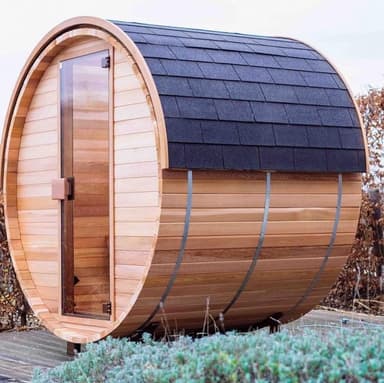
Cedar Barrel Sauna 2-10 Person Customizable Outdoor
- Own-factory quality control beats generic barrel sauna kit competitors
- Canadian red cedar delivers genuine durability and aromatic sauna experience
- Electric heater options reach 195°F in roughly 10-15 minutes
Total gravel needed for an 8x12-foot area at 6-inch depth: approximately 1.5 tons. Order 2 tons to account for compaction loss. At $0.50-$1.50 per square foot, you are looking at $50-$150 in materials for a basic pad.
Step 5 - Set Your Skids or Support Frame
Most outdoor saunas - particularly barrel models and cube-style kits - require pressure-treated 4x4 skids laid across the gravel base. These lift the sauna floor off the gravel, create a ventilation gap that prevents rot, and provide a flat, consistent bearing surface.
Space the skids according to your sauna manufacturer's specifications. For most 8-foot-wide saunas, that means two parallel skids running the full length, set 4-6 inches in from each side. Some heavier models need a third center skid.
Check that each skid is level independently, then check that both skids are level relative to each other. Use cedar shims under the skids on the gravel to fine-tune. Cedar shims are preferable to softwood because they resist moisture and insects.
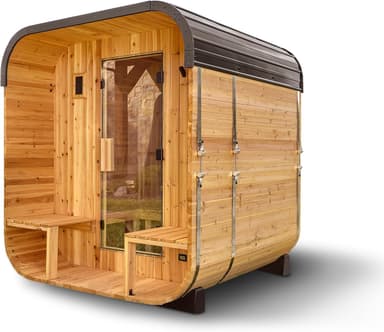
Backyard Discovery Lennon 2-4 Person Cedar Cube Sauna
- 9kW heater reaches temperature significantly faster than budget competitors
- 5-year warranty covers heater and hardware, not just the shell
- Wi-Fi preheat control adds genuine everyday convenience
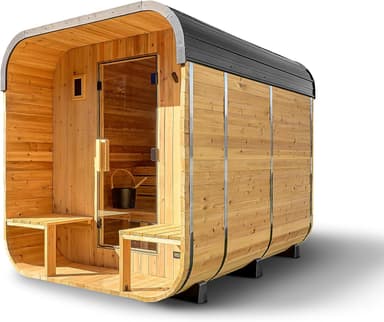
Backyard Discovery Lennon 4-6 Person Cedar Cube Sauna
- 9kW heater reaches target temperature significantly faster than competitors
- Tongue-and-groove cedar construction eliminates cold spots effectively
- Wi-Fi preheat lets you walk into a ready sauna every time
For concrete slab installations, mark anchor bolt positions per your sauna's instructions before the pour. For pier systems, set the pier caps level and use adjustable post bases so you can fine-tune height after the concrete sets.
Pro tip: Spray the underside of your skids with a borate-based wood preservative like Tim-bor before setting them. This adds 5-10 years of rot and insect resistance at minimal cost.
Step 6 - Position and Assemble the Sauna Structure
Use furniture dollies or a pallet jack to move barrel saunas and pre-assembled cube units into position. Do not drag them - even a small shift can crack staves or twist the frame.
Follow your manufacturer's assembly sequence exactly. For barrel saunas, the stave alignment depends entirely on your foundation being level. Start from the bottom band and work outward. If staves are not lining up, recheck your foundation level before forcing hardware - the problem is almost always in the base, not the staves.
For kit saunas like those from Backyard Discovery, wall panels connect at factory-cut joints. Tighten fasteners to spec - over-tightening cedar connections can crack the wood, and under-tightening allows gaps that pull heat.
Maintain a minimum 2-inch ventilation gap between the sauna floor and your skids or foundation. Never seal this gap. Air movement under the structure is what prevents floor rot, and without it you will see decay within 3-5 years even with treated wood.
Once the structure is in position and assembled, recheck level at the floor level inside the sauna. If it is off by more than 1/4 inch from side to side, shim the skids now before installing interior components.
Step 7 - Finish the Foundation Perimeter and Drainage
Backfill the perimeter around your gravel pad with additional 3/4-inch gravel to meet grade. This prevents edge erosion and keeps the pad contained.
Slope the surrounding grade away from the sauna in all directions at 1/4 inch per foot minimum. This is non-negotiable. Poor drainage causes 30-50% faster wood decay according to builder data, and standing water around the base is a mold risk.
If your site sits in a low area or has water pooling issues, install a French drain. Run a 4-inch perforated pipe wrapped in landscape fabric around the perimeter of your pad, sloping to a daylight outlet or dry well. A French drain typically runs $500 in materials and a few hours of digging.
Add corner molding or flashing at the base where the sauna walls meet the skids. This closes the gap against insects and debris without blocking airflow.
Run your electrical conduit to the sauna before backfilling around the perimeter. Bury electrical conduit at least 12 inches deep (24 inches for direct-burial cable without conduit per NEC code). Grounding the electrical system is mandatory after the foundation is complete - this is not optional, and improper grounding is a genuine electrocution risk in a high-moisture environment.
Common Mistakes to Avoid
Placing directly on grass or bare dirt. Moisture retention and organic decomposition will cause sinking and rot within 1-2 years. No exceptions.
Skipping the frost line on footings. In cold climates, footings above the frost line will heave 2-6 inches annually. This cracks foundations, shifts walls, and warps doors.
Compacting gravel in thick lifts. Dumping 6 inches and running a plate compactor once does not work. You get a hard crust on top and loose material underneath. Always compact in 2-inch lifts.
Assuming a concrete slab is always the best choice. Concrete costs 4-8 times more per square foot than gravel, drains poorly without precise sloping, and cracks in freeze-thaw cycles. Gravel outperforms it in the majority of outdoor sauna applications.
Ignoring local codes. Permits are required for slabs over 200 square feet in most areas, and some jurisdictions require permits for any permanent outdoor structure. Skipping permits can block a home sale later.
Positioning too close to trees. Root intrusion is slow and invisible until the foundation has already shifted. Maintain 15 feet of clearance from mature trees.
Next Steps
Once your foundation is set and your sauna structure is assembled, three things need to happen before your first session.
First, complete the electrical connection. Hire a licensed electrician for the 240V heater hookup and any outdoor wiring. This is not a DIY task - sauna heaters draw 6-8 kilowatts, and the combination of high heat and moisture demands compliant wiring.
Second, season your sauna. Run the heater at half power for 1-2 hours, then let it cool completely. Repeat twice before your first full session. This cures any manufacturing oils in the wood and seats all the joints properly.
Third, inspect the foundation after your first hard rain and after your first freeze-thaw cycle. Walk the perimeter, check that gravel has not shifted, recheck the level inside, and look for any pooling water near the structure. Catching small drainage issues early prevents expensive wood damage later.
For ongoing maintenance, top up your gravel base with a fresh inch of crushed stone every 3-5 years to compensate for natural settling and compaction. Treat exposed wood surfaces annually with a water-based exterior wood preservative - avoid oil-based products near the heater area.
Frequently Asked Questions
The best outdoor barrel sauna installation uses a solid, level foundation like concrete, pavers, stone, or reinforced decking to ensure stability and longevity. Position it on firm ground reasonably close to your home for electricity access, privacy, and views, ideally near a pool or cold plunge for contrast therapy. Avoid soft dirt or grass if possible, as cabins and similar structures require prepared bases like concrete for optimal performance.
Related Guides
Affiliate Disclosure - SaunasNMore earns a commission from qualifying purchases through our Amazon affiliate links. This does not affect our editorial integrity.