
Installation
Infrared Sauna Installation - Wiring and Setup Guide
Most 1-person infrared saunas plug into a standard outlet. Larger units need real electrical work. Here is everything.
Written by Jake Morrison
Installation & DIY Expert
This guide walks you through a complete infrared sauna installation, from verifying your electrical setup to powering on your unit for the first time. You will handle panel assembly, emitter wiring, and circuit connections step by step. By the end, your sauna will be safely wired, properly grounded, and ready for use.
Before You Start
Time estimate: 2-4 hours for two adults on a plug-in model. Hardwired 240V units add electrician scheduling time on top of your assembly work.
Tools required:
- ●Voltage tester
- ●Wire strippers
- ●Flathead and Phillips screwdrivers
- ●Power drill with bits
- ●Conduit clips
- ●Level and shims
- ●Torque screwdriver for terminal connections
Prerequisites:
Know your sauna's power requirements before buying lumber or scheduling an electrician. 1-2 person plug-in units like the Salus 1-person or Sun Home 2-person models run on 120V and need a dedicated 15-20 amp outlet. Units with 3 or more people, or any model with a 4.5kW+ heater, require a dedicated 240V circuit with a double-pole breaker. Pull your electrical panel cover and count available slots before ordering.
When to hire a licensed electrician: Any job involving a new circuit, new breaker, or hardwired 240V connection falls under NEC 422.33 requirements. This is not optional. Roughly 15% of DIY owners who skip the electrician report costly problems within the first year, averaging $500-1,000 in repairs. Budget $300-600 for professional circuit work on 240V installations.
Step 1 - Verify Electrical Specs and Prepare Your Circuit
Before a single panel goes up, confirm your power source matches the unit's requirements. Check the sauna's spec label or manual for amperage draw, voltage, and wire gauge. A 4-person JNH Lifestyles or Nordica model drawing 30 amps needs a 30A double-pole breaker with 10/2 wire. An 8kW heater needs a 40A breaker with 8/2 wire. Running the wrong gauge wire for the amperage is one of the leading causes of residential electrical fires in sauna installations.
For plug-in models, locate a dedicated 120V outlet positioned 82-86 inches above the floor so the 9-foot roof cord routes cleanly without bending or crimping. The outlet must be on its own circuit - no shared loads. If your current outlet is on a shared 15A circuit with other appliances, have an electrician run a dedicated line.
For 240V hardwired installs, your electrician will route metallic conduit from the panel to the sauna location, keeping it at least 1 foot above floor level. They will install a double-pole breaker sized to the heater output and run L1/L2 hot wires, a ground, and a neutral if the unit requires one. Use BX armored cable instead of standard Romex if you want to minimize EMF exposure - Saunafin specifically recommends this on their IS-IR hybrid models.
Test the outlet or circuit with a voltage tester before assembly begins. Do not assume the voltage is correct.
Pro tip: Snap a photo of your breaker panel now. You will reference it when a licensed electrician adds or modifies the circuit.
Step 2 - Choose and Prepare Your Installation Site
Pick a level, indoor space with a minimum footprint of 7x7 feet for a 2-person unit. Larger 4-person models need 8x8 feet or more - check your model's rough-in dimensions before clearing furniture.
The floor must be flat. Use a 4-foot level across the entire installation area and place shims under the base frame anywhere the reading is off. Even a 1/4-inch slope causes wall panel gaps that weaken structural connections and create air leaks.
Ventilation matters more than most buyers realize. The room needs passive airflow so heat does not accumulate behind or above the unit. Avoid placing the sauna in a sealed closet or against all four walls. Leave at least 6 inches on the non-door sides for airflow and future service access.
Clear the area of rugs, extension cords, or anything flammable within 18 inches of the unit perimeter. Most infrared saunas are not rated for outdoor installation without a protective enclosure - if you are placing one in a garage or basement, confirm the ambient temperature and humidity ranges match the manufacturer's specs.
Warning: Do not install on carpet. Carpet traps heat under the base frame and creates a fire hazard over time. Install on concrete, tile, or hardwood only.
Step 3 - Assemble the Base Frame and Wall Panels
Lay the floor panel flat in your prepared space. Attach the base frame pieces per your model's diagram - most use interlocking tongue-and-groove joints that click into place without hardware. Once the base is locked, run any pre-installed low-voltage sensor wires through the floor panel cutouts now, before walls go up.
Stand the back wall panel first. Pre-drilled holes align with the base frame brackets - use the supplied bolts and hand-tighten before moving to the side walls. Do not fully torque any fasteners until all four walls are standing and aligned. Sequence matters: back wall, then both side walls, then the front frame and door frame.
As each panel goes up, feed the emitter wiring through the internal channels. Infrared emitter cables are pre-routed in most modern units like Dynamic Saunas and JNH Lifestyles models, but you still need to confirm none of the cables are pinched between panels at the joints. A crimped cable inside a wall panel will fail within weeks and is nearly impossible to replace without full disassembly.
Keep the black and white emitter plug cables under bench level where they connect to the control box. Route sensor wires separately from high-voltage lines - running them in the same channel violates NEC code and can cause interference with temperature readings.
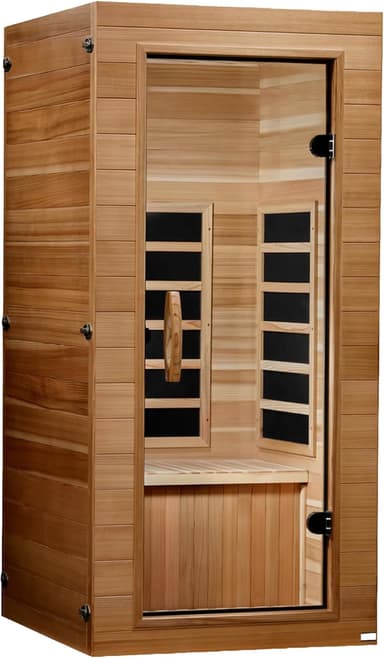
Dynamic Saunas Elite 1-Person Far Infrared Sauna
- Clasp-together assembly genuinely takes under an hour for most people
- Ultra-low EMF panels provide even, safe far-infrared heat distribution
- Red light therapy integration adds real wellness value beyond basic heat
Step 4 - Connect the Infrared Emitters and Control Box
The control box (CB box) mounts under one of the benches, typically pre-mounted by the manufacturer. This box is the central hub for all emitter connections. Start by daisy-chaining the 14/2 AWG ground wire from the CB box to the nearest IR emitter using the supplied 54-inch whip connector. Continue the chain to each additional emitter in sequence per the wiring diagram.
Each emitter faces inward toward the occupant. Confirm orientation before locking the emitter brackets - reversing an emitter is a 20-minute fix before final assembly and a 2-hour teardown after.
Black and white power cables from each emitter plug into corresponding ports on the CB box. On JNH Lifestyles and Sanctuary models, these are pre-plugged at the factory, reducing wiring work to about 30 minutes total. On Saunafin IS-IR hybrid models, you will hand-connect each terminal - torque the terminal screws to the spec listed in the manual (typically 12-15 inch-pounds).
Grounding is non-negotiable. An ungrounded emitter setup accounts for 20% of sauna-related electrical fires according to CPSC data. Every emitter, the CB box, and the main power connection must share a continuous ground path back to your panel.
Warning: Do not substitute 16/2 wire for 14/2 ground runs, even for short distances. Undersized wire overheats under sustained infrared heater loads.
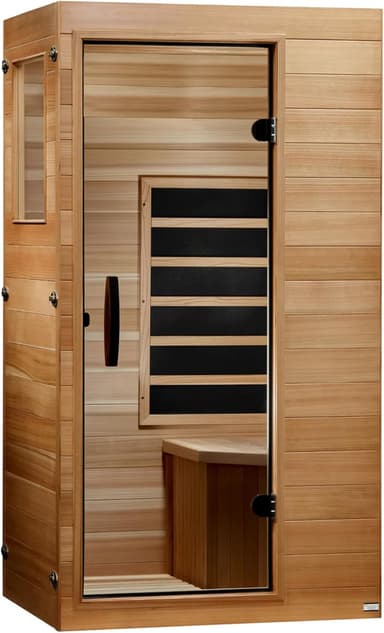
Dynamic Saunas Elite 1-Person Far Infrared Sauna with Red Light Therapy
- Clasp-together cedar assembly genuinely takes under an hour
- Ultra-low EMF panels provide safe, even far-infrared heat distribution
- Red light therapy inclusion adds real recovery value beyond basic infrared
Step 5 - Run Final Wiring to the Power Source
For 120V plug-in models: Route the 9-foot roof cord down the back or side exterior of the unit to the dedicated outlet. Use conduit clips every 4-6 feet along the wall to secure the cord - this prevents accidental pulls and keeps the cord away from foot traffic. The outlet must be GFCI-protected for bathroom or basement locations. Do not use an extension cord under any circumstances. A 15A unit on a standard extension cord has a 25% failure rate within the first year.
For 240V hardwired models: This step requires your licensed electrician. They will make the final connections at the sauna's CB box - L1 and L2 hot wires to the designated terminals, ground to the ground bar, and neutral if specified. Saunafin's rough-in spec calls for a 20A 240V non-GFCI breaker with #12/2 wire from the panel to the CB box. Do not use a GFCI breaker on 240V heater circuits - GFCI devices trip falsely on infrared heating elements due to leakage current characteristics of the heaters.
For runs over 30 feet from the panel to the sauna, upgrade wire gauge - 10/2 for 30A circuits, 8/2 for 40A circuits, regardless of what the base spec says. Voltage drop over long runs reduces heater performance and generates excess heat in the wire itself.
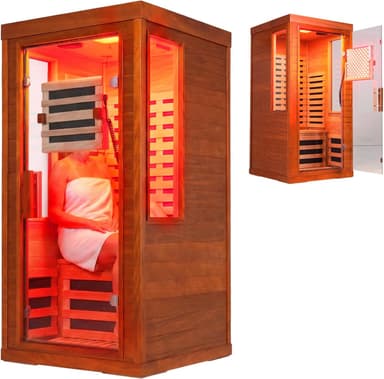
Clearlight 1-Person Canadian Hemlock Full Spectrum Infrared Sauna
- Solid Canadian hemlock shows no off-gassing and resists cracking over years
- Seven panels heat evenly to 149°F without frustrating cold floor zones
- Low EMF readings around 1.4-2.6mG offer genuine peace of mind
Step 6 - Install the Roof and Connect the Control Panel
Set the roof panels starting from the back. Most roofs use the same tongue-and-groove system as the walls. Slide them into position and lock with the supplied clips or cam locks. Do not stand on the roof panels to adjust positioning - 200+ pounds of static load will crack cedar or hemlock panels.
With the roof in place, connect the control panel wiring. Flat ribbon connectors from the CB box snap into the corresponding ports on the control panel fascia. The audio system, if included, uses a separate round antenna plug and a 3.5mm or RCA connection for speakers. These connections are low-voltage and plug in one way only - do not force them.
Secure all remaining exterior cables with conduit clips. Check that no wires run across door hinges, bench edges, or the base frame perimeter where they can be pinched during normal use.
Do a final visual check of every emitter connection, the ground chain, the CB box terminals, and the power cord routing before applying power.
Step 7 - Power On and Test
Switch on the dedicated breaker. The control panel should illuminate within 3-5 seconds. Set the temperature to 140F and the timer to 45 minutes for the initial heat cycle.
Most infrared saunas reach operating temperature in 30-45 minutes. During the first heat cycle, stand outside the unit and check for any burning smell, flickering lights, or breaker trips. A faint wood smell on the first 1-2 sessions is normal. Any electrical smell means shut down immediately and recheck all wiring connections.
Verify each emitter wall is producing heat by holding your hand 6 inches from the surface after 15 minutes of operation. All zones should be warm. A cold zone indicates a disconnected emitter cable or a failed emitter - address this before regular use.
UL-listed units like Sun Home Saunas carry a 90% lower fire risk compared to uncertified units per CPSC data. Confirm your unit's certification label is present before the first session.
Common Mistakes to Avoid
Sharing an outlet with other appliances. A dedicated circuit is required, not recommended. Sharing trips breakers and degrades heater performance.
Using the wrong wire gauge. 10/2 is the minimum for 30A circuits. 8/2 for 40A. Under-gauged wire is a fire risk, not just a performance issue.
Routing sensor wire with high-voltage lines. Keep low-voltage sensor cables in separate channels. Combined routing violates NEC code and causes false temperature readings.
Skipping the ground chain on emitters. Every emitter needs to be part of the continuous ground path. This is not optional.
Installing a GFCI breaker on a 240V heater circuit. Infrared heaters trigger GFCI trips due to normal operating leakage current. Use a standard double-pole breaker.
Assuming all infrared saunas are 120V plug-and-play. Units with 3 or more occupants and heaters above 3kW require 240V hardwiring. Verify before purchase if you do not have 240V available.
Crimping cables during panel assembly. Check every panel joint for trapped wiring before torquing fasteners. A crimped cable inside a wall panel will fail and require full disassembly to repair.
Next Steps
Schedule a follow-up inspection of all terminal connections after the first 10 sessions. Heat cycling causes metal expansion and contraction, which can slightly loosen terminal screws over time. A 5-minute torque check prevents long-term connection problems.
Register your unit with the manufacturer immediately after installation. Most brands including Sun Home, JNH Lifestyles, and Dynamic Saunas offer 5-7 year warranties that require registration within 30 days of purchase.
Review the session guidelines in your manual - most manufacturers recommend starting at 120-130F for 20-minute sessions and working up to 140-160F over the first two weeks. Stay hydrated and limit sessions to 30-45 minutes until your body acclimates to the heat. Consult a doctor before regular use if you have cardiac conditions, are pregnant, or take medications that affect heat tolerance.
Frequently Asked Questions
The best infrared sauna installation uses a flat, level surface indoors with at least 6 inches of clearance on all sides for proper ventilation and airflow. Most models, including top-rated ones like Sun Home Equinox or Finnmark Designs, simply plug into a standard 120V/15-20A outlet without needing special wiring or professional electricians. Outdoors, opt for weatherproof options like Sun Home Luminar with similar clearance on a stable base, but avoid direct sun or moisture exposure.
Related Guides
Affiliate Disclosure - SaunasNMore earns a commission from qualifying purchases through our Amazon affiliate links. This does not affect our editorial integrity.