
Listicle
7 Barrel Sauna Buying Mistakes to Avoid
After testing 40+ barrel saunas I see the same expensive mistakes over and over. Here are the seven you must avoid.
Written by Erik Nordgren
Senior Sauna Reviewer
Barrel saunas are one of the most satisfying backyard investments you can make, but the buying process is littered with traps that cost owners thousands in repairs or replacements within just a few years. These barrel sauna buying mistakes are not obvious at first glance, which is why so many buyers end up frustrated with warped wood, flooded interiors, or underpowered heaters. Knowing what to watch for before you purchase saves you from the $5,000 to $15,000 replacement costs that catch too many owners off guard.
1. Buying Too Small for Future Use
The most common buyer regret in the barrel sauna world is sizing down to save money, then immediately wishing for more space.
A 4-person barrel sauna sounds generous until you actually have four adults inside at 180°F. Real-world comfort maxes out at about half the advertised capacity for most budget models in the $4,500 to $6,000 range. Barrel owners consistently report that "4-person" units feel cramped for two people who want to actually stretch out on the benches.
The physical dimensions matter more than the person count on the label. A 7-foot barrel is a fundamentally different experience than an 8-foot model. The extra foot of ceiling height allows upper bench placement that keeps your feet elevated above the floor-level heat zone, eliminating the "hot head, cold feet" problem that plagues shorter designs. Lower ceilings also restrict airflow, which makes achieving an even 180°F throughout the cabin harder to accomplish.
Think about how your usage patterns grow over time. You may start solo or with a partner, but saunas become social. Neighbors visit, family comes to stay, and suddenly your 2-person weekend unit is the center of a gathering it was never designed to handle.
Spend the extra $1,500 to $2,000 to step up one size tier. A 6-person barrel in the $8,000 to $9,000 range serves two people in total luxury and four people comfortably, and it holds resale value far better than the entry-level options.
2. Skipping the Foundation Prep
Poor site preparation destroys barrels faster than almost any other mistake, and the damage is often irreversible within two years.
Uneven ground causes a barrel to rack and twist through seasonal freeze-thaw cycles. Over time, the staves on the low side of an unlevel barrel bear disproportionate weight and crack. Owners who skip proper leveling report gaps of 1 to 3 inches developing between staves, which admits water and kills the barrel's insulating ability. The fix costs around $2,000 once the structure has already settled unevenly, and that assumes the wood has not already rotted.
The correct approach is straightforward but non-negotiable. Excavate 4 to 6 inches of soil at the installation site and replace it with compacted gravel. The finished base must be level within 1 inch across its entire surface. For a standard 7-foot by 7-foot barrel footprint, budget $200 to $400 in materials for a proper gravel pad.
Concrete piers or treated lumber cradles placed on top of the gravel provide the actual contact points for the barrel's support rails. Most manufacturers, including Dundalk LeisureCraft and Almost Heaven Saunas, publish specific cradle-spacing requirements. Follow those specs exactly rather than eyeballing it.
Drainage around the perimeter matters just as much as the base itself. Grade the surrounding ground so water flows away from the barrel at a minimum 2% slope. Standing water against the wood cradles introduces rot within one season in humid climates.
3. Ignoring Wood Species Quality
The wood species and stave thickness in a barrel sauna determine whether it lasts 5 years or 20 years, and budget kits frequently cut corners in ways that are not obvious from product photos.
Staves thinner than 1.5 inches warp under repeated heat cycles, creating gaps and reducing insulation efficiency. The premium standard is 1.65-inch thick staves, which retain heat approximately 25% better than sub-1.5-inch alternatives and handle the expansion-contraction cycle of heating from 40°F to 185°F without cracking. Almost Heaven Saunas uses 1.5-inch Western Red Cedar in their mid-range $6,500 barrels, while premium brands push to 1.65 inches in models priced above $10,000.
Fast-growth cedar is the primary species used in budget kits priced $4,000 to $7,000. It looks identical to slow-growth cedar in photographs, but it softens structurally within 2 to 3 years of regular heating and loses the aromatic properties that make Western Red Cedar desirable in the first place. Slow-growth Western Red Cedar and thermally modified Nordic Spruce - used by brands like SaunaFin in their $7,000 to $11,000 kits - resist moisture absorption at roughly twice the rate of fast-growth alternatives.
Research by Leppik et al. (2019) on sauna volatile compounds confirmed that slow-growth aromatic woods release beneficial terpenes during sessions that fast-growth variants do not produce in meaningful quantities.
Pay close attention to bench wood as well. Knotty wood on bench surfaces becomes a burn hazard at temperatures above 160°F. Clear Abachi or clear Western Red Cedar bench boards run about $500 as an add-on and are worth every dollar.
4. Underestimating Heater Wattage Needs
Buying a heater that is too small for your barrel's cubic footage is a mistake that no amount of patience fixes. An undersized heater simply cannot reach target temperature, and running it at 100% capacity continuously shortens its lifespan dramatically.
The standard calculation is 1 kilowatt of heater capacity per 50 cubic feet of sauna volume. A 6-person barrel sauna measuring roughly 7 feet in diameter by 8 feet long contains approximately 308 cubic feet, which requires a minimum 6kW heater. Many buyers purchase 4kW units to save $300 upfront and then spend sessions waiting 90 minutes for a sauna that tops out at 155°F instead of 185°F.
A properly matched 6kW to 9kW electric heater in a well-insulated barrel uses 5 to 7 kWh per session, which translates to roughly $1 to $2 in electricity at average U.S. rates. The efficiency gap between a correctly sized heater and an undersized one is negligible in operating cost but enormous in performance.
GFCI breaker protection and a dedicated 220V circuit are non-negotiable for any heater above 6kW. A 9kW unit like the Harvia Vega draws around 41 amps and must run on a properly rated circuit. Hire a licensed electrician for this step. Running a high-wattage sauna stove on an undersized circuit is a fire hazard, and insurance companies deny claims when improper electrical installation is the cause.
Traditional wood-burning stoves are an alternative for off-grid installations, but they require 12 to 18-inch clearances from all combustible walls and a proper flue installation, adding $400 to $800 to the project cost.
5. Not Planning Proper Drainage
Water management inside a barrel sauna is the detail that separates a comfortable, long-lasting installation from a maintenance disaster.
Every sauna session generates moisture. Löyly - the act of pouring water on hot rocks to produce steam - adds direct water to the floor. Sweat drips from bathers. Towels and buckets track in more moisture. Without a floor drain, that water sits and soaks into the wood, accelerating rot at the floor level first, then working up through the lowest stave rings.
The correct setup involves a 2-inch PVC floor drain plumbed to daylight or a dry well located at least 10 feet from the structure. The drain should sit at the lowest point of the interior floor, which requires planning the barrel's cradle height and tilt angle before installation, not after. A small 1 to 2 degree tilt toward the drain side is enough to move water effectively.
Many budget kits ship without floor drain provisions at all. If you are buying a kit without a pre-cut drain hole, factor $200 to $400 into your budget for a plumber to core through the floor decking and connect to a drain line.
The exterior matters too. The seam where the barrel meets its floor cradles is a common rot entry point. BZ Cabins documents rot appearing in as little as 2 years in barrels installed without proper flashing at these joints. A strip of aluminum flashing sealed with exterior-grade silicone along the cradle contact points costs under $30 and adds years to the structure's life.
6. Overlooking Assembly Difficulty
Barrel sauna kit assembly is frequently marketed as a weekend project for two people. That framing is technically true for experienced builders, but it significantly underrepresents the difficulty for everyone else.
A standard 6-person barrel kit contains 40 to 60 curved staves that must be assembled in a specific sequence using metal tension bands. The bands must be tightened to exact specifications to prevent gaps without over-stressing the wood. Mis-sequenced staves cause the barrel to be out-of-round, which prevents doors from sealing properly and puts uneven stress on the entire structure.
Kits secured with stainless steel screws rather than nails are meaningfully easier to assemble and repair. Northern Lights Cedar Barrels and similar brands in the $9,000 range use screw-fastened construction throughout. Nailed barrel kits, common under the $5,000 price point, loosen after 5 to 10 heat cycles as the wood expands and contracts. Owner forums document nailed models shifting 1 to 2 inches annually, eventually voiding warranties.
Budget 12 to 16 hours for assembly if you have moderate carpentry skills, and plan for at least two people on site for the entire duration. The tension band tightening step alone benefits enormously from a second set of hands.
If you are not confident in your assembly skills, most manufacturers offer professional installation at $500 to $1,500 depending on your location. For a $10,000 barrel, paying $1,000 for professional assembly that protects your warranty and ensures proper construction is straightforward math.
Ask the manufacturer specifically whether their instructions include torque specifications for fasteners. Vague instructions are a red flag for cheap kit construction.
7. Forgetting Annual Maintenance Costs
The purchase price is only the beginning of what a barrel sauna costs to own. Buyers who budget only for the initial purchase get surprised by ongoing maintenance expenses that, if skipped, lead to premature failure.
Untreated exterior wood rots three times faster in humid climates than properly maintained surfaces. Annual exterior oiling or staining with a product like Sikkens or Sansin takes about two hours and costs $60 to $120 in materials per application. Buyers who skip this step for even two consecutive years in wet Pacific Northwest or Southeast conditions see visible graying and surface cracking begin within 36 months.
The exterior is not the only surface that needs attention. Interior bench surfaces benefit from a light sanding every 2 to 3 years to remove the gray oxidation layer that develops from heat and moisture cycling. A 120-grit orbital sander handles the job in under an hour.
Heater element inspections every 2 to 3 years add to the cost, with replacement elements for brands like Harvia or Tylo running $150 to $300. Sauna rocks need replacement every 2 to 4 years as they crack and break down from thermal cycling. A 15-pound bag of sauna rocks runs $40 to $80 depending on stone type.
Research by Laukkanen et al. published in JAMA Internal Medicine in 2015 found that regular sauna use cuts cardiovascular risk by 27% in frequent users. That long-term health benefit is only accessible if your sauna is properly maintained and actually functional year after year.
Total annual maintenance costs for a properly cared-for barrel sauna run $200 to $500 per year - a modest figure against a $10,000 investment that, with proper care, carries a realistic 15 to 20-year service life.
Avoiding these barrel sauna buying mistakes comes down to doing the homework before you commit to a purchase. Prioritize wood thickness, screw-fastened construction, proper site drainage, and correctly sized heating equipment over headline price. Mid-range barrels from reputable brands like Almost Heaven Saunas, Dundalk LeisureCraft, and Northern Lights in the $8,000 to $12,000 range consistently outperform budget kits over a 10-year horizon. Get the foundation right, maintain the exterior annually, and the investment pays for itself in years of reliable use.
Our Top Recommendations
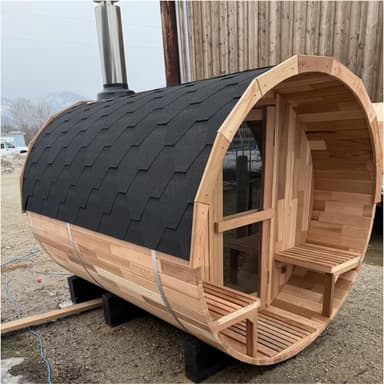
Smartmak 2-10 Person Canadian Hemlock Barrel Sauna
- Barrel shape genuinely improves heat distribution compared to box saunas
- Real red cedar and hemlock construction should last 15-plus years with care
- ETL-certified heater hits 195°F - legitimately hot for authentic steam sessions
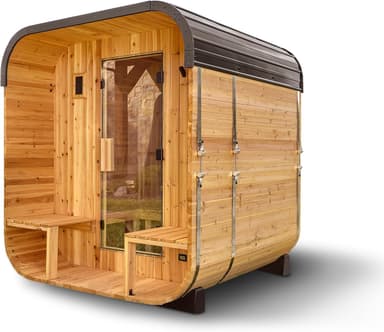
Backyard Discovery Lennon 2-4 Person Cedar Cube Sauna
- 9kW heater reaches temperature significantly faster than budget competitors
- 5-year warranty covers heater and hardware, not just the shell
- Wi-Fi preheat control adds genuine everyday convenience
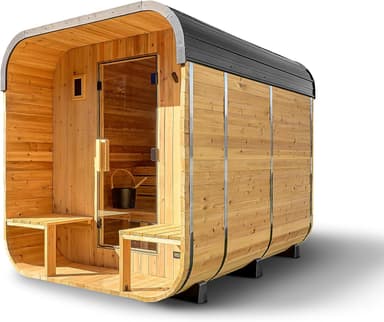
Backyard Discovery Lennon 4-6 Person Cedar Cube Sauna
- 9kW heater reaches target temperature significantly faster than competitors
- Tongue-and-groove cedar construction eliminates cold spots effectively
- Wi-Fi preheat lets you walk into a ready sauna every time
Frequently Asked Questions
Common barrel sauna buying mistakes include prioritizing low price over quality materials like thermally modified spruce (which warp and crack otherwise), ignoring leaks from uninsulated staves that require constant maintenance and elevation off the ground, and overlooking poor ventilation, heat flow, and single bench height that lead to uneven heating. Barrel designs often lack insulation, mimicking uninsulated sheds with low energy efficiency, and cheap kits from big-box stores fail to deliver proper sauna heat. To avoid these, select larger diameters for better airflow, kiln-dried woods, and proven builders over budget illusions.
Related Guides
Affiliate Disclosure - SaunasNMore earns a commission from qualifying purchases through our Amazon affiliate links. This does not affect our editorial integrity.